
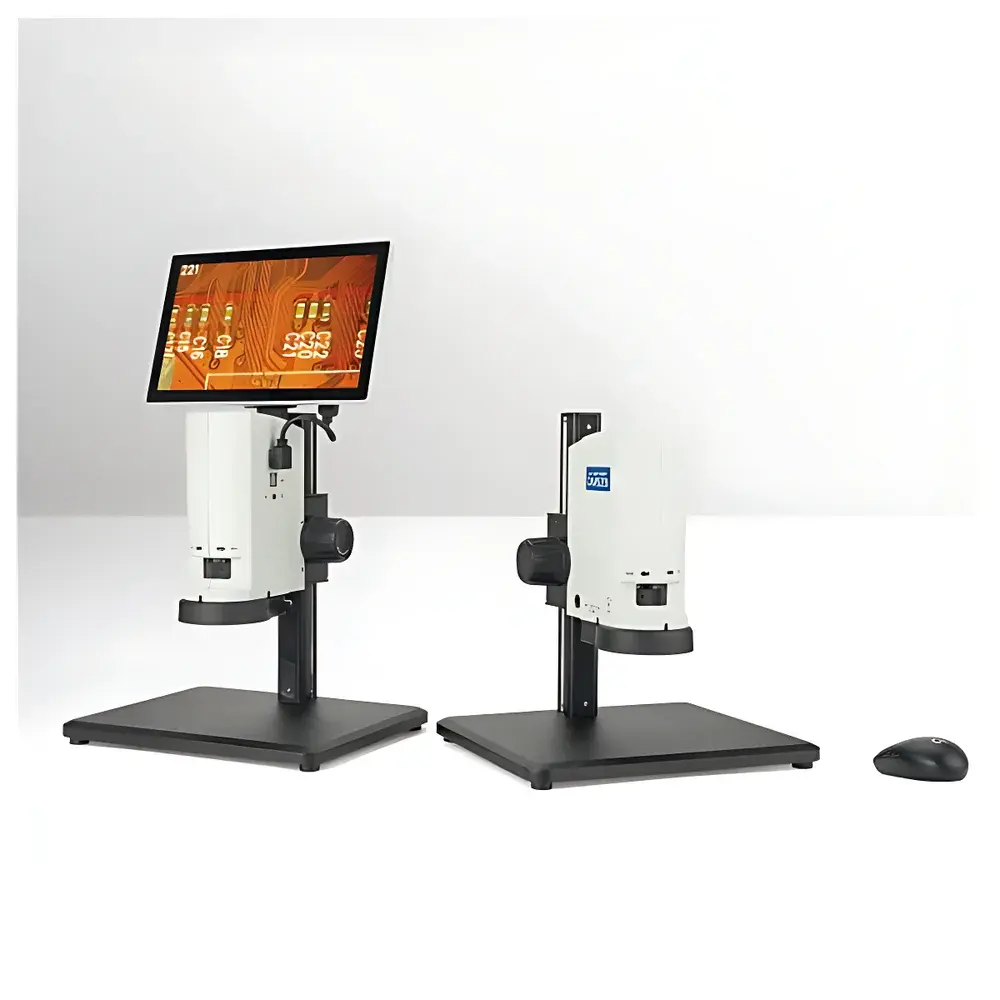
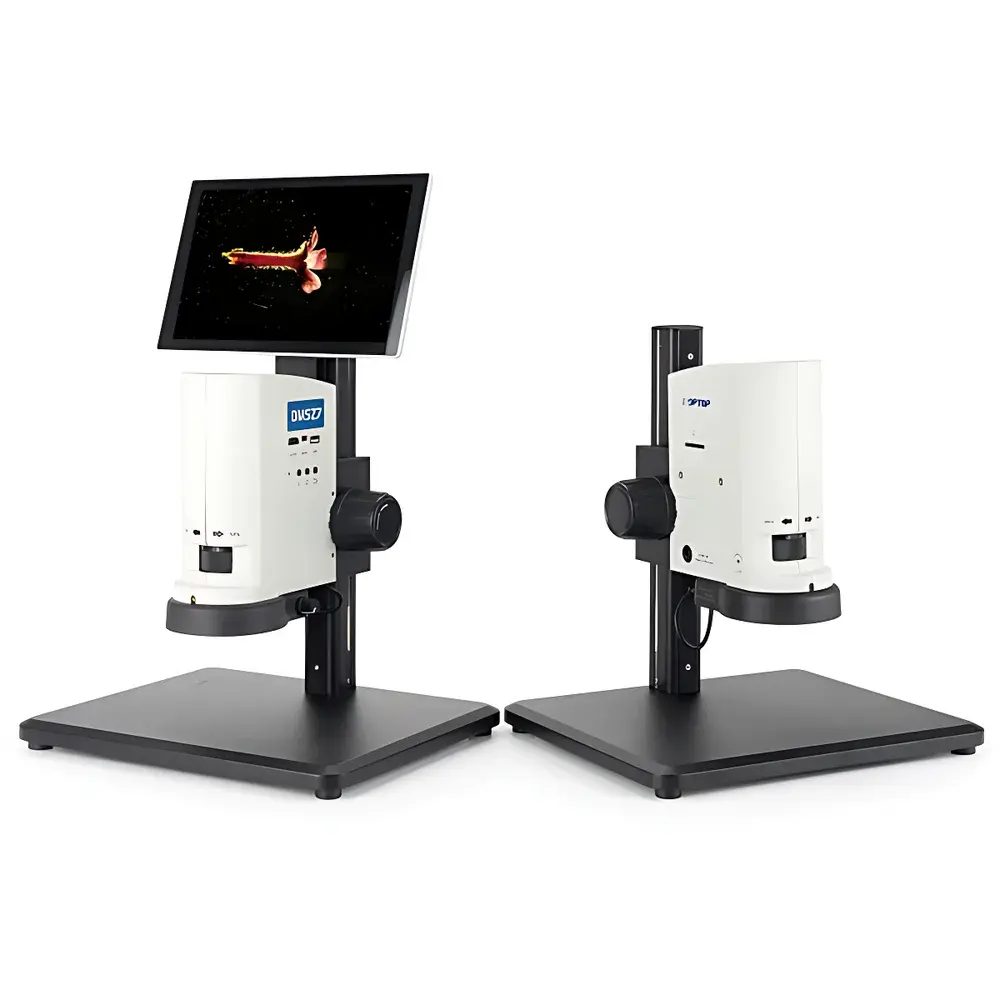
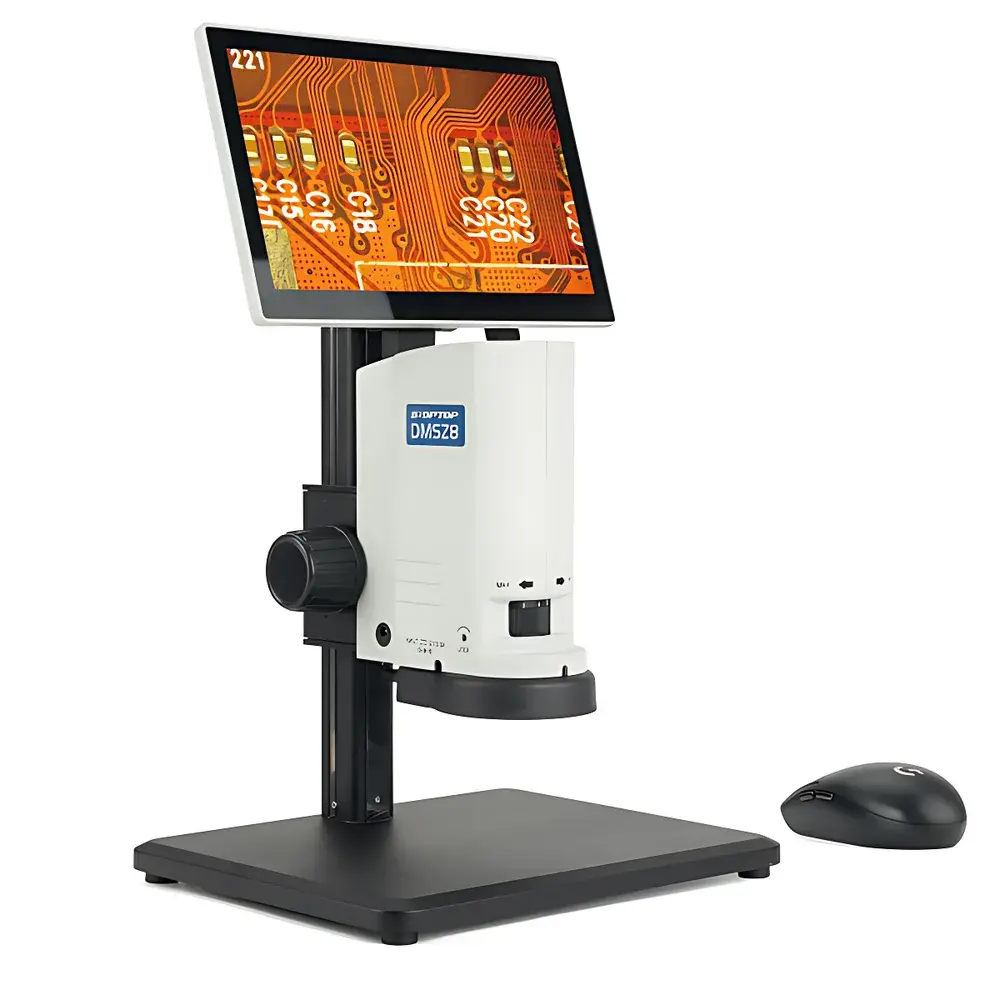
SOPTOP DMSZ Series Integrated Video Microscope System
| Brand | SOPTOP |
|---|---|
| Origin | Zhejiang, China |
| Manufacturer Type | Original Equipment Manufacturer (OEM/ODM) |
| Model | DMSZ |
| Optical Zoom Ratio | 0.7×–5× Continuous |
| Working Distance Options | 110 mm (DMSZ8 w/ 0.5× objective) or 170 mm (DMSZ7 w/ 0.5× objective) |
| Sensor | 2 MP CMOS, 1/2" format |
| Display | 12" LCD, 1920×1080 resolution, 60 fps |
| Illumination | Dual-zone LED ring light with independent inner/outer control and dimming knob |
| Focus Travel | 225 mm |
| Field of View Enhancement | +33% vs. DMSZ7 (DMSZ8 model) |
Overview
The SOPTOP DMSZ Series Integrated Video Microscope System is an engineered solution for real-time visual inspection, quality control, and educational demonstration in laboratory, industrial, and academic environments. Unlike conventional optical microscopes relying on ocular observation, the DMSZ integrates a high-fidelity continuous-zoom optical path with a calibrated digital imaging subsystem—enabling direct video output, measurement-ready image capture, and ergonomic operator interaction. Its core optical architecture follows telecentric and parfocal design principles, ensuring minimal distortion across the full 0.7×–5× zoom range and stable focus position during magnification changes. The system operates on a unified power architecture: the microscope body supplies regulated DC power to the camera module, integrated display panel (optional), and dual-zone LED illumination—eliminating cable clutter and reducing electrical noise interference that may degrade image fidelity. Designed for ISO/IEC 17025-aligned workflows and compatible with GLP-compliant documentation practices, the DMSZ supports traceable image acquisition and metadata embedding for audit-ready records.
Key Features
- Continuous optical zoom from 0.7× to 5× with parfocal calibration—no refocusing required during magnification adjustment.
- Modular configuration: available in screen-integrated (12″ FHD LCD, 1920×1080, 60 fps) or screen-free variants for integration into custom vision systems or production lines.
- Extended vertical focus travel of 225 mm—accommodating samples up to 170 mm in height (DMSZ7 with 0.5× objective) or optimized for low-profile industrial fixtures (DMSZ8 with 110 mm working distance).
- Dual-zone LED ring illuminator with independent inner/outer circuit control and analog dimming—inner zone provides near-telecentric coaxial illumination for dimensional accuracy; outer zone delivers oblique lighting to enhance surface texture contrast and edge definition.
- Interchangeable auxiliary objectives (0.5×, 1×, 1.4×) expand total magnification range and field-of-view flexibility—supporting both macro overview and fine-feature inspection without repositioning the sample.
- Robust aluminum-magnesium alloy housing with ESD-safe finish—designed for long-term stability in Class 10,000 cleanrooms and factory-floor environments subject to vibration and thermal fluctuation.
Sample Compatibility & Compliance
The DMSZ series accommodates a broad spectrum of non-destructive inspection tasks across electronics assembly (PCB solder joint evaluation), precision machining (thread pitch verification), materials science (coating uniformity assessment), and life sciences education (specimen morphology demonstration). Its large working distance and modular objective selection enable safe examination of irregularly shaped, tall, or heat-sensitive samples—including assembled circuit boards, injection-molded components, and biological slide preparations. The system complies with IEC 61000-6-3 (EMC emission limits) and IEC 61000-6-2 (immunity requirements), and meets CE marking directives for safety (2014/35/EU) and electromagnetic compatibility (2014/30/EU). All firmware and image metadata adhere to EXIF 2.3 and XMP schema standards—ensuring interoperability with LIMS and QMS platforms requiring FDA 21 CFR Part 11–compliant audit trails when paired with validated third-party software.
Software & Data Management
While the DMSZ operates as a standalone imaging platform, its USB 3.0–enabled camera interface supports standard UVC/UVC 1.5 protocols—allowing seamless integration with industry-standard machine vision software (e.g., HALCON, OpenCV-based applications) and metrology suites (e.g., Keyence IM Series, Olympus Stream). Captured images and videos embed timestamp, magnification setting, objective ID, illumination mode, and exposure parameters—enabling automated report generation and version-controlled archiving. Optional SDKs provide API-level access to real-time frame buffers, ROI selection, and hardware-triggered capture—facilitating synchronization with motion controllers or PLCs in automated inspection cells. Image processing includes real-time noise reduction, gamma correction, and histogram equalization—preserving dynamic range without introducing interpolation artifacts.
Applications
- Electronics Manufacturing: Solder paste inspection, BGA void analysis, component placement verification, and post-reflow defect identification.
- Precision Engineering: Surface finish evaluation, thread form measurement, burr detection, and GD&T feature validation using calibrated on-screen overlays.
- Academic Instruction: Live projection of microscopic specimens in lecture halls; student-led image annotation and comparative morphological analysis.
- Quality Assurance Labs: Visual documentation of incoming material defects, supplier audit evidence collection, and standardized pass/fail decision support per ASTM E284 or ISO 10934-1 guidelines.
- Maintenance & Repair: In-situ inspection of turbine blades, hydraulic valve seats, and composite layup integrity—leveraging extended working distance and oblique lighting for subsurface flaw visibility.
FAQ
Is the DMSZ compatible with third-party measurement software?
Yes—the embedded UVC-compliant camera outputs uncompressed YUV or MJPEG streams over USB 3.0, supporting integration with most metrology and image analysis platforms.
Can the DMSZ be used in a GMP-regulated environment?
When deployed with validated software and documented calibration procedures (including stage scale bar verification and illumination uniformity mapping), the DMSZ meets foundational requirements for visual inspection under Annex 11 and ISO 13485 clause 7.6.
What is the maximum usable field of view at 0.7× zoom with the 0.5× objective?
Approximately 102 mm diagonal FOV on the 12″ display—scaling linearly with magnification change; actual FOV depends on sensor active area and optical magnification factor.
Does the system support external trigger input for synchronized capture?
Yes—via optional GPIO expansion module (sold separately), enabling TTL-level hardware triggering synchronized with conveyor belt encoders or robotic end-effector positioning signals.
How is focus repeatability ensured across multiple operators?
The coarse/fine dual-knob focus mechanism features detent-indexed coarse travel and 1 µm-per-division micrometer scale—combined with parfocal lens design, enabling sub-5 µm Z-axis reproducibility without recalibration.




