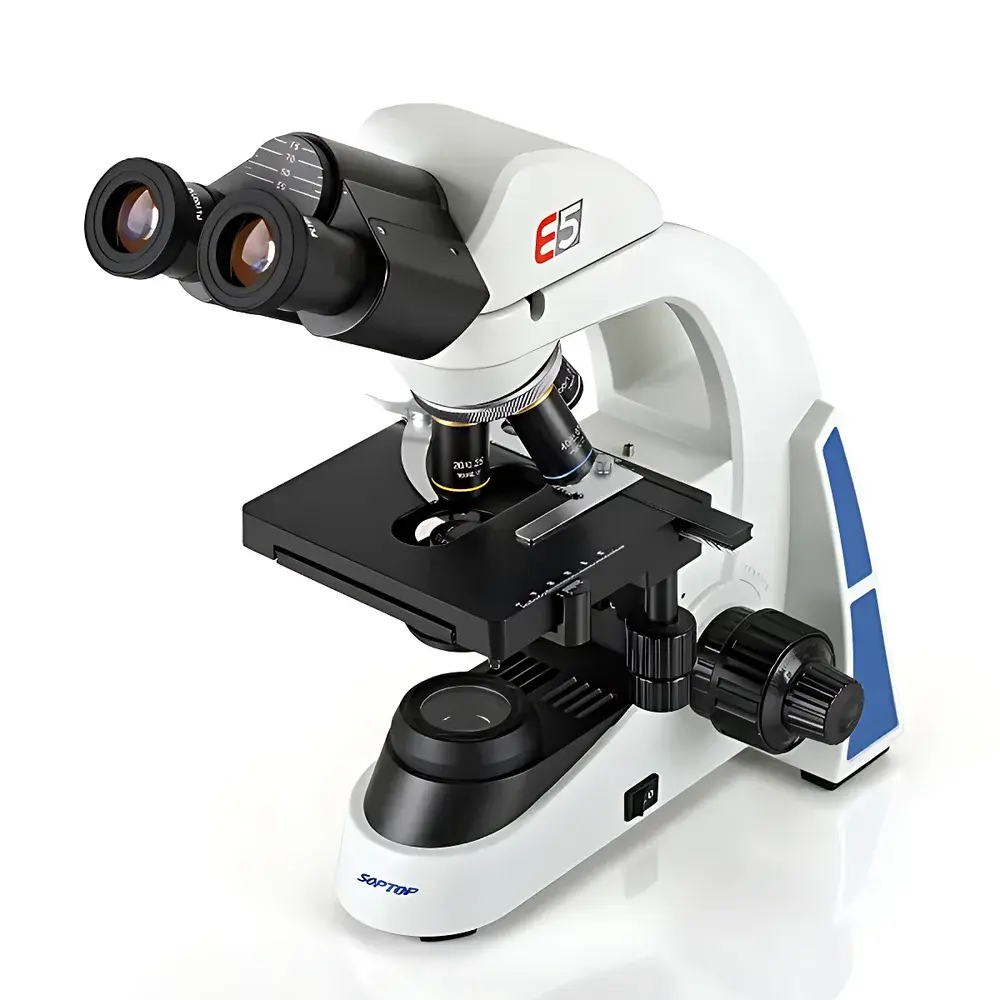
SOPTOP E5 Biological Microscope
| Brand | SOPTOP |
|---|---|
| Origin | Zhejiang, China |
| Manufacturer Type | Original Equipment Manufacturer (OEM) |
| Product Category | Upright Biological Microscope |
| Eyepiece Configuration | Binocular |
| Magnification Range | 40×–1000× (with standard 10× eyepieces and 4×/10×/40×/100× objectives) |
| Focusing Mechanism | Coaxial coarse/fine focus with adjustable coarse tension and 2 µm fine focus increment |
| Interpupillary Adjustment | 50–75 mm |
| Eyepiece Diopter Compensation | ±5 D on right eyepiece tube |
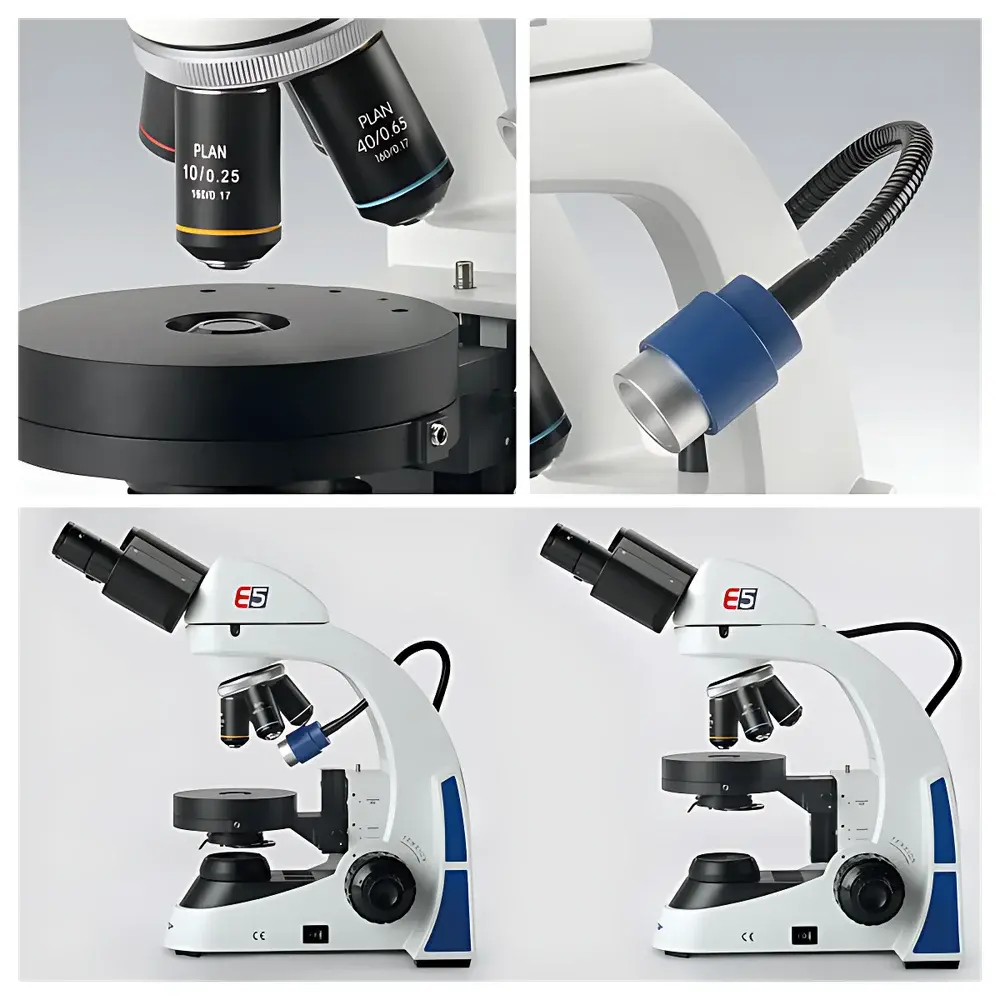
| Illumination | LED transmitted light (6 V/3 W), optional integrated LED incident light via flexible gooseneck |
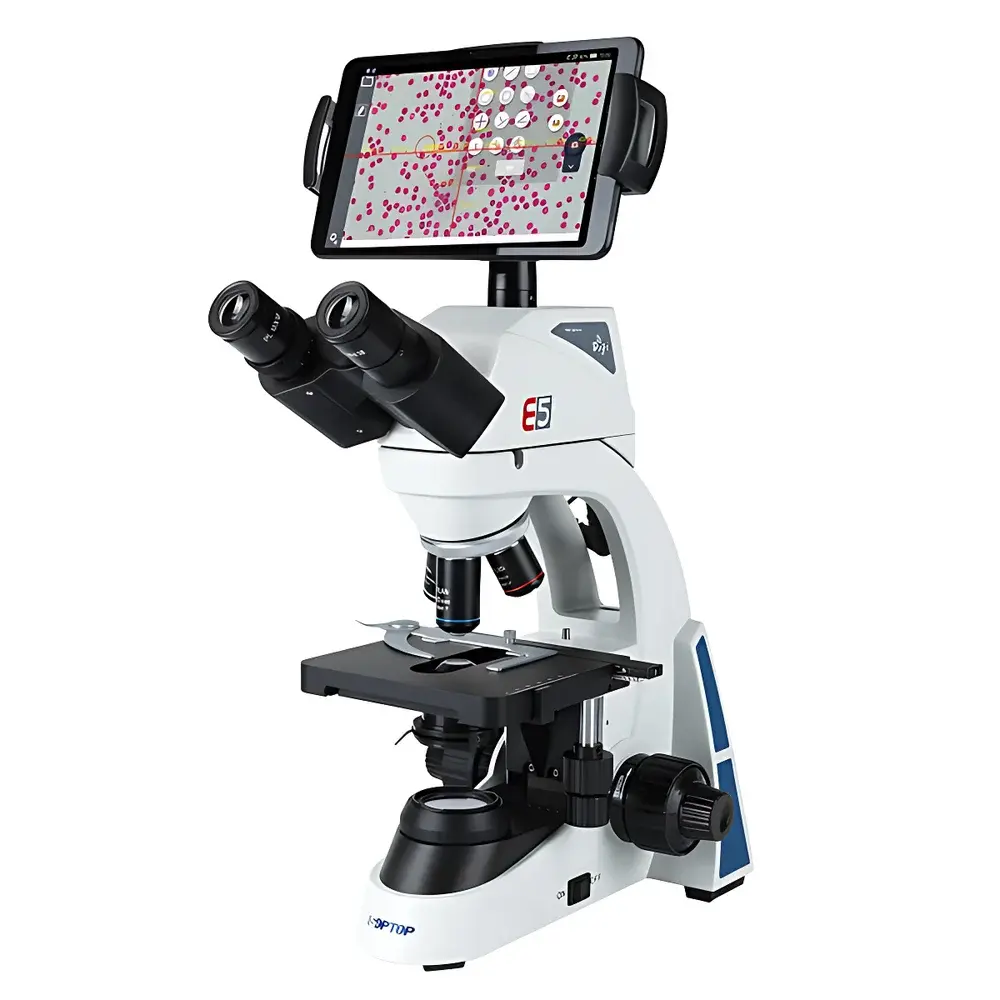
| Digital Imaging Interface | Built-in Wi-Fi digital observation head (1080p real-time streaming), USB-C output, cross-platform compatibility (iOS, Android, Windows) |
| Mechanical Stage | Double-layer mechanical stage with vernier scale |
| Objective Mount | Standard 45 mm RMS nosepiece (reversible for oil immersion) |
| Compliance | CE, ISO 13485 (manufacturing), RoHS |
Overview
The SOPTOP E5 Biological Microscope is an upright, binocular optical instrument engineered for precision life science education, clinical basic diagnostics, and entry-level biomedical research. Designed around Köhler illumination principles and optimized optical path geometry, the E5 delivers high-contrast, color-accurate monochrome and stained specimen imaging across standard magnifications (40× to 1000×). Its rigid yet lightweight aluminum-magnesium alloy chassis—featuring a hollowed ergonomic arm structure—reduces total mass without compromising mechanical stability or vibration damping. This architecture supports consistent image registration during extended observation sessions and minimizes operator fatigue in classroom or shared-lab environments. The optical system employs fully coated achromatic objectives (4×, 10×, 40×, 100× oil) and wide-field 10× eyepieces with field number 18 mm, ensuring flatness of field and minimal chromatic aberration per ISO 8578:2017 standards for educational microscopes.
Key Features
- Ergonomic binocular head with interpupillary distance adjustment (50–75 mm) and independent diopter correction (±5 D) on the right ocular tube to accommodate diverse user anthropometry.
- Coaxial focusing system with dual-sided coarse and fine focus controls; fine focus calibrated to 2 µm increments and coarse focus tension independently adjustable for varying specimen thicknesses and cover slip compliance.
- Mechanical stage with graduated X-Y translation (76 × 50 mm travel range) and vernier readout for repeatable sample repositioning—critical for comparative histology or longitudinal cell tracking.
- LED-transmitted illumination (6 V / 3 W, 50,000-hour lifetime) with centerable condenser and iris diaphragm enabling precise control of numerical aperture and contrast optimization per specimen type.
- Integrated flexible gooseneck LED incident illuminator (optional) for low-power surface inspection of opaque or semi-transparent biological samples—e.g., insect cuticles, plant epidermis, or tissue sections on frosted slides.
- Built-in Wi-Fi digital observation head supporting real-time 1080p video streaming to local displays or networked mobile endpoints without physical cabling—eliminating signal latency and portability constraints inherent in USB-based systems.
Sample Compatibility & Compliance
The E5 accommodates standard 1″ × 3″ (25 × 75 mm) glass microscope slides and 0.13–0.17 mm cover slips. It supports brightfield, phase contrast (with optional phase annuli), and basic darkfield techniques using auxiliary condensers. All optical components comply with ISO 10934-1:2002 (microscope terminology) and meet CE marking requirements under Directive 2014/30/EU (EMC) and 2014/35/EU (LVD). Manufacturing processes adhere to ISO 13485:2016 for medical device-related instrumentation, ensuring traceability and process validation. While not certified for GLP/GMP-regulated analytical workflows, its mechanical repeatability and illumination consistency support documentation-compliant teaching labs and preliminary diagnostic screening per CLIA-waived protocols.
Software & Data Management
The E5’s embedded Wi-Fi module operates via a vendor-neutral HTTP/RTSP streaming protocol—requiring no proprietary drivers or client software. Captured stills and videos are saved in lossless TIFF or MP4 (H.264) format directly to connected devices. Metadata—including timestamp, magnification, illumination intensity, and objective identification—is embedded in EXIF headers. For institutional deployment, the system supports integration into existing LMS platforms (e.g., Moodle, Canvas) via URL-based iframe embedding. Audit trails for image capture events are locally stored on endpoint devices; however, native FDA 21 CFR Part 11 compliance (electronic signatures, secure audit logs) is not implemented—users requiring regulatory-grade data integrity must employ third-party validated image management software.
Applications
- Undergraduate and secondary-level biology instruction: mitosis staging, blood smear analysis, protozoan motility studies, and fungal hyphae morphology.
- Clinical point-of-care settings: rapid peripheral blood film review, urine sediment examination, and basic dermatophyte identification.
- Botanical and entomological fieldwork: portable macro-to-micro transition via optional zoom auxiliary lenses (0.5×–2×).
- Quality assurance in biomanufacturing: visual verification of cell culture confluence, contamination screening, and scaffold porosity assessment.
- Community lab and maker-space use: open-source firmware modification supported through documented UART debug interface (available under NDA).
FAQ
Is oil immersion supported on the E5?
Yes—the 100× objective is designed for standard Type A cedarwood oil (n = 1.515) and features spring-loaded retraction to prevent slide damage.
Can the E5 be used with third-party camera adapters?
Yes—its trinocular port accepts C-mount adapters (M28.5 × 0.6 thread) for external DSLR or industrial CMOS sensors.
Does the Wi-Fi module support WPA3 encryption?
No—it operates on WPA2-PSK only, compatible with IEEE 802.11 b/g/n networks at 2.4 GHz band.
What is the maximum working distance for the 4× objective?
21.5 mm—enabling observation of thicker specimens such as whole-mount Drosophila larvae or agarose gel slabs.
Is service calibration available outside China?
Authorized SOPTOP service partners exist in Germany, USA, and Singapore; calibration certificates follow ISO/IEC 17025:2017 guidelines upon request.