
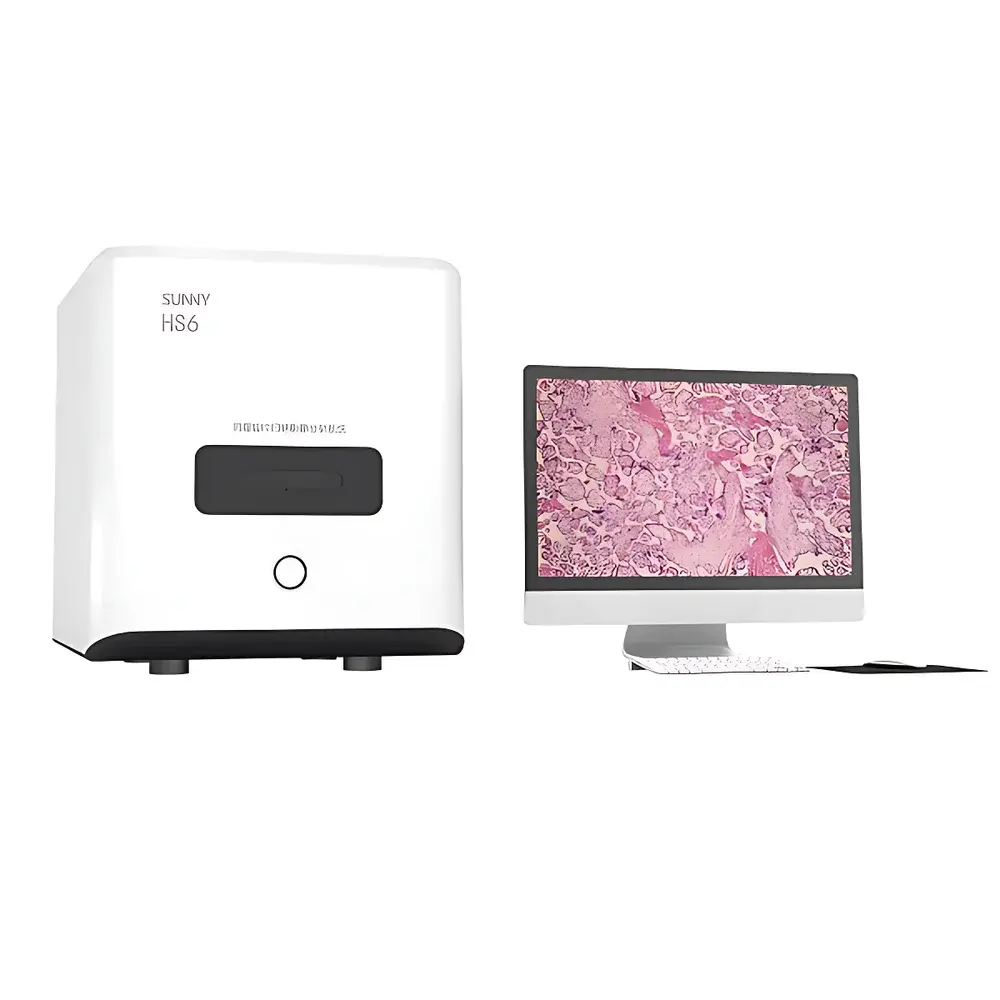
SOPTOP HS Digital Whole Slide Scanner
| Brand | SOPTOP |
|---|---|
| Origin | Zhejiang, China |
| Manufacturer Type | Direct Manufacturer |
| Region of Origin | Domestic (China) |
| Model | HS |
| Price Range | USD 56,000 – 126,000 |
Overview
The SOPTOP HS Digital Whole Slide Scanner is an advanced, clinical-grade whole slide imaging (WSI) system engineered for high-fidelity digitization of histopathological glass slides. It employs prism-based trichromatic imaging architecture—integrating a precision optical prism beam splitter with three synchronized CMOS/CCD sensors dedicated to red, green, and blue spectral channels—ensuring pixel-accurate spatial registration and true-color fidelity without chromatic misalignment. Unlike conventional single-sensor scanning systems that rely on sequential RGB filtering or Bayer interpolation, the HS scanner captures full-color information simultaneously across all three channels under a unified optical axis, minimizing color crosstalk and preserving subtle morphological and staining nuances critical for diagnostic interpretation. Designed for routine pathology laboratories and academic research centers, the system supports 20× objective scanning of standard 15 mm × 15 mm tissue regions in under 40 seconds—achieving throughput suitable for high-volume slide digitization workflows while maintaining sub-micron positional repeatability.
Key Features
- Prism-based trichromatic imaging engine with co-aligned R/G/B CMOS/CCD sensors for true-color, artifact-free acquisition
- Magnetic levitation autofocus mechanism with closed-loop position feedback, eliminating mechanical drift and ensuring consistent focus stability across multi-layer z-stack acquisitions
- High-precision linear motor-driven XY stage with optical encoder feedback for sub-100 nm step resolution and minimal vibration-induced image blur
- B/S (Browser/Server) architecture enabling zero-client deployment—accessible via standard web browsers on desktops, tablets, and smartphones without local software installation
- End-to-end AES-256 encryption for data in transit and at rest, coupled with automatic CRC32 checksum validation to guarantee bit-perfect digital slide integrity during upload, storage, and retrieval
- Modular software interface supporting customizable workflow modules—including annotation, measurement, region-of-interest tagging, and collaborative review tools
Sample Compatibility & Compliance
The HS scanner accommodates standard 1″ × 3″ (25 mm × 75 mm) glass slides with thicknesses ranging from 0.9 mm to 1.2 mm, including coated, charged, and adhesive-backed variants. It supports common histological staining protocols (H&E, IHC, FISH, PAS, Trichrome) and immunofluorescence preparations. The system complies with DICOM Supplement 145 (Whole Slide Imaging), adheres to ISO 13485:2016 quality management requirements for medical device manufacturers, and provides audit trail functionality aligned with GLP and GCP documentation standards. Optional integration packages support HL7/FHIR messaging and DICOM-SR structured reporting for interoperability with PACS, LIS, and EMR systems in hospital environments.
Software & Data Management
The embedded WSI platform delivers scalable, role-based access control (RBAC) through a secure web console. All digital slides are stored in vendor-neutral SVS or NDPI format with embedded pyramid layers for efficient multi-resolution rendering. The system includes native support for RESTful API endpoints—enabling seamless integration with third-party AI inference engines (e.g., tumor detection, mitotic count, biomarker quantification). Audit logs record user actions, timestamped metadata, and configuration changes in accordance with FDA 21 CFR Part 11 requirements for electronic records and signatures. Data retention policies, automated backup scheduling, and S3-compatible cloud storage gateways are configurable via administrative dashboard.
Applications
- Clinical telepathology and remote expert consultation
- AI model training and validation using annotated ground-truth datasets
- Education and digital slide libraries for medical student instruction
- Multi-center clinical trials requiring centralized, standardized slide review
- Quality assurance programs involving inter-observer concordance assessment
- Longitudinal tissue archive digitization for biobank curation
FAQ
Does the HS scanner support FDA-cleared AI algorithms?
Yes—the system provides certified DICOM WSI export and open API access, enabling integration with FDA-cleared or CE-marked AI tools deployed as external microservices.
Can the HS be integrated into an existing hospital PACS?
Yes—it supports DICOM WSI conformance (Supplement 145) and offers optional HL7 ADT and ORM message handling for automated slide ingestion and patient matching.
What is the maximum supported slide capacity per batch?
The standard loader accommodates up to 400 standard glass slides; high-throughput configurations support robotic cassette integration for unattended 24/7 operation.
Is offline operation possible for secure network environments?
Yes—local server deployment mode allows fully air-gapped operation with encrypted local storage and manual media-based data export.
How is focus consistency maintained across large tissue sections?
The magnetic levitation Z-axis actuator, combined with real-time contrast-based autofocus and multi-plane depth fusion algorithms, ensures uniform sharpness across variable tissue topography and section thickness.
Related Products





