
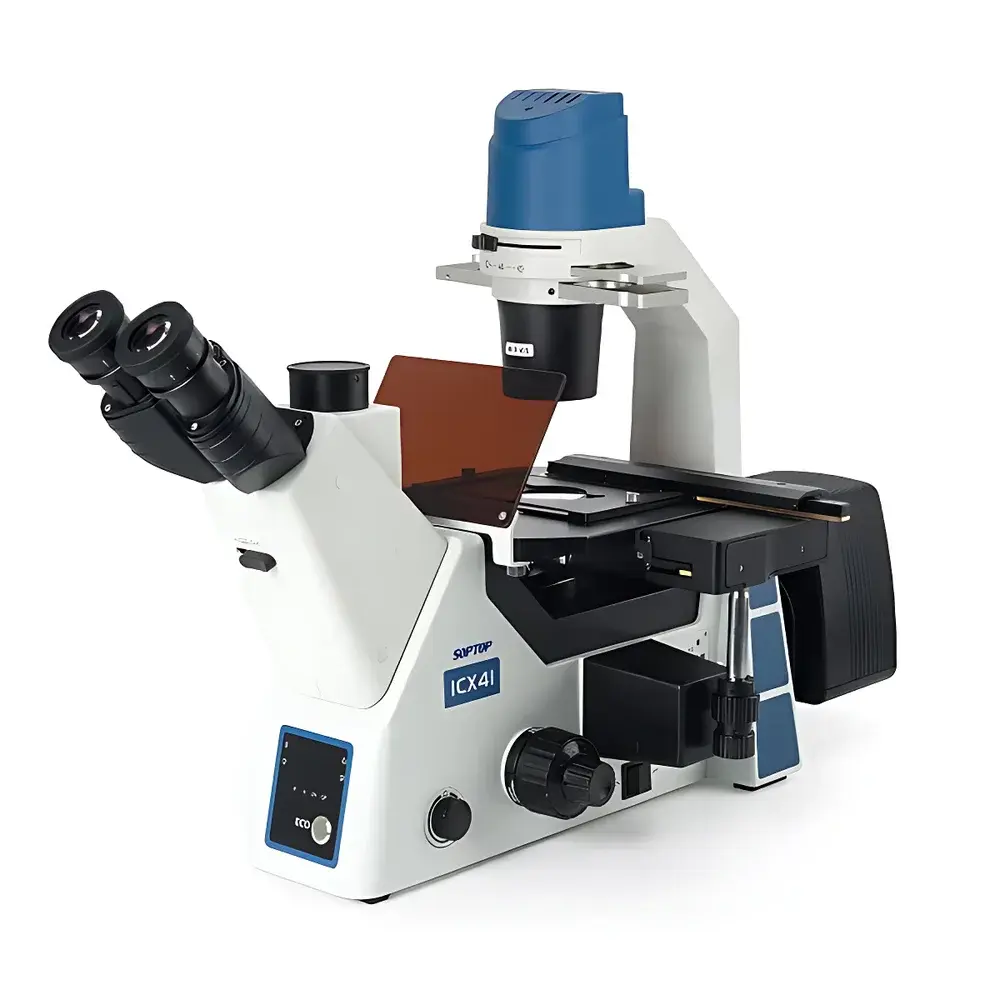
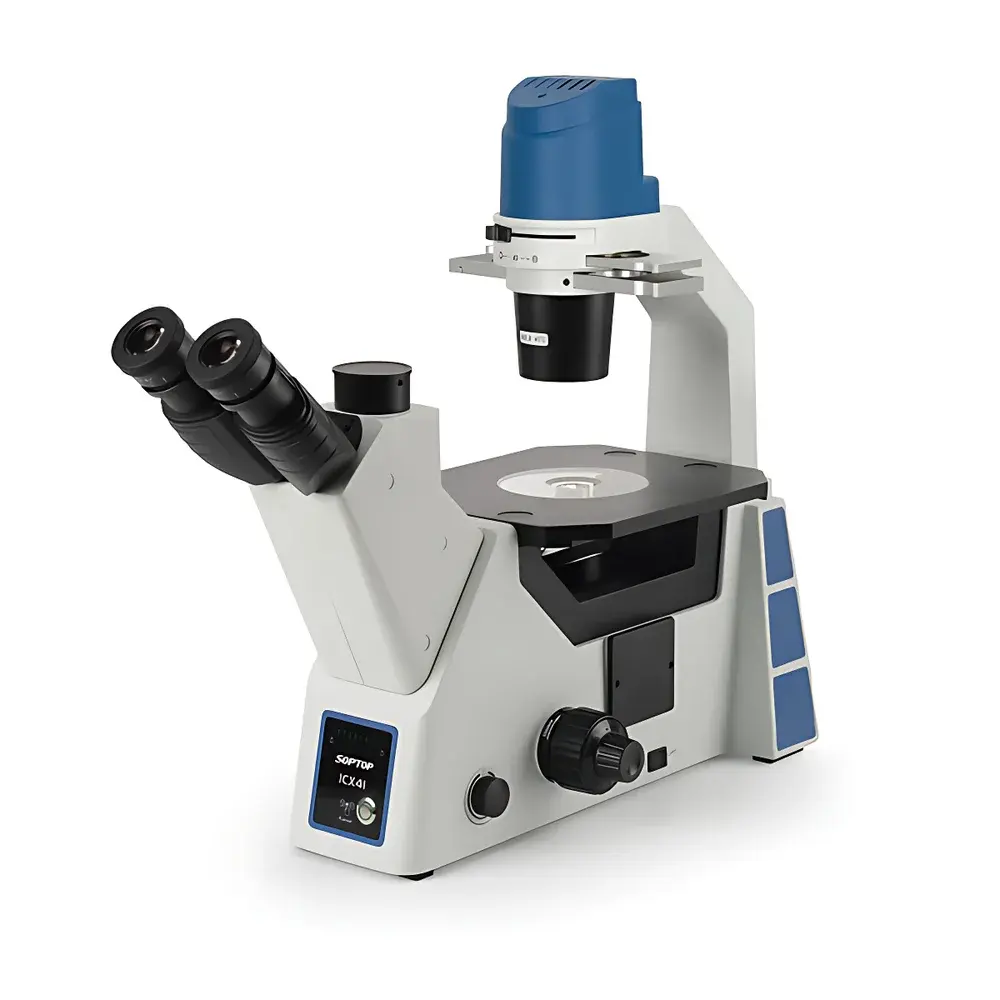
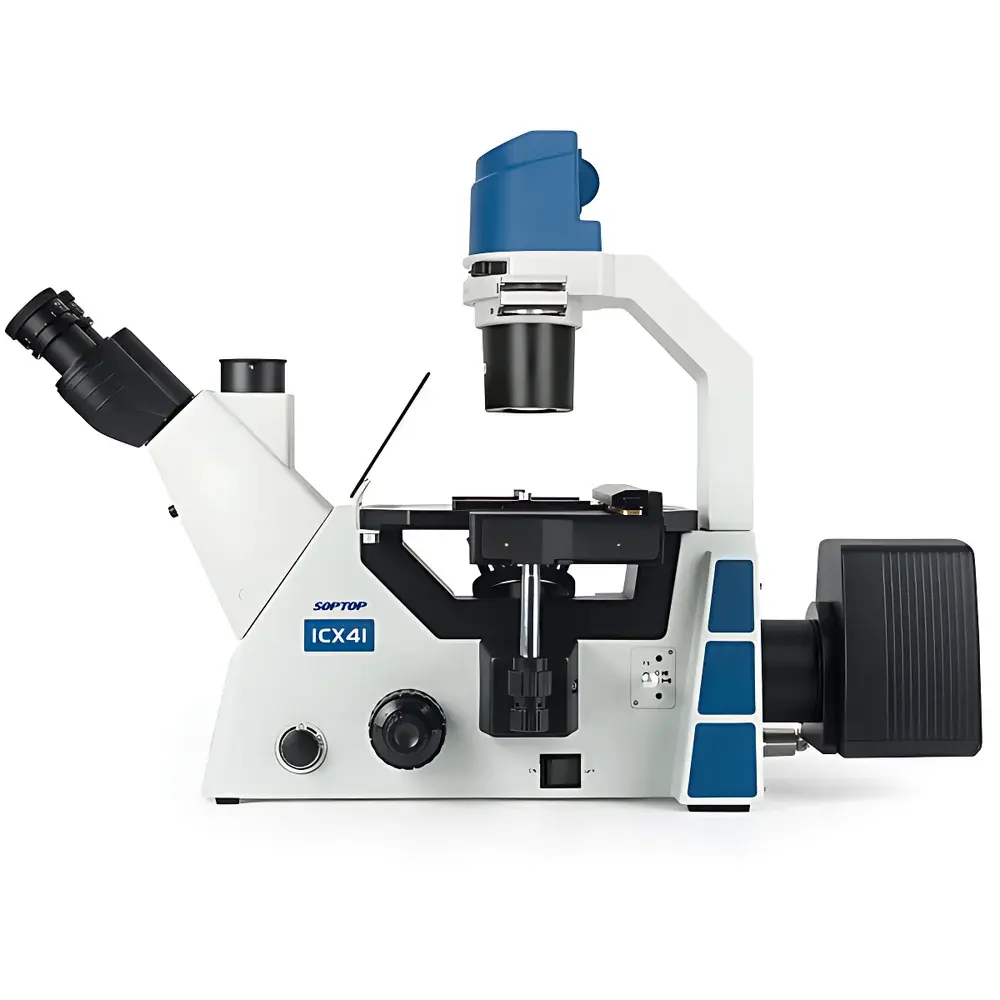
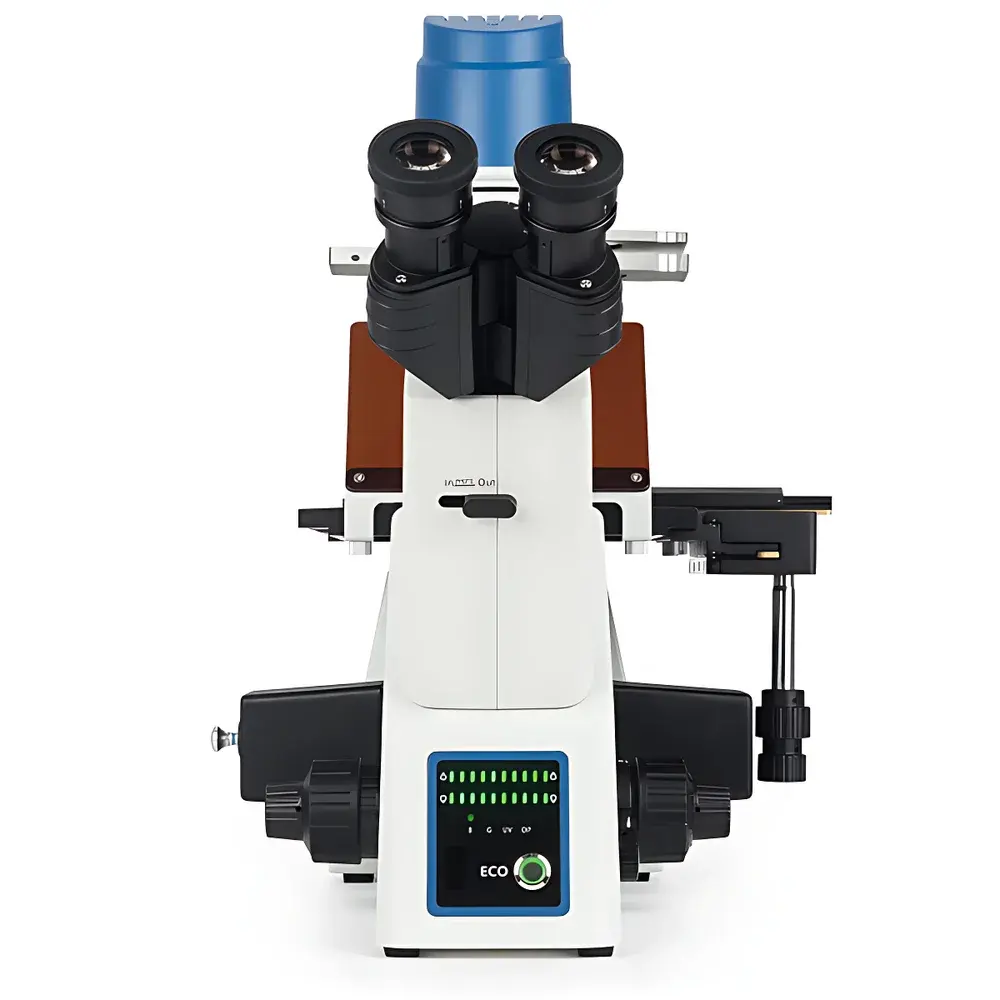
SOPTOP ICX41 Inverted Fluorescence Microscope
| Brand | SOPTOP |
|---|---|
| Origin | Zhejiang, China |
| Manufacturer Type | Original Equipment Manufacturer (OEM) |
| Product Category | Domestic |
| Model | ICX41 |
| Instrument Type | Inverted Fluorescence Microscope |
| Excitation Source | High-Efficiency LED (385 nm, 470 nm, 560 nm) |
| Eyepieces | Wide-Field Plan Eyepieces PL10X/22 mm with Adjustable Diopter and Optional Reticle |
| Objectives | Infinity-Corrected Long Working Distance (LWD) Achromatic, Phase Contrast, Fluorescence, Semi-Apochromatic Fluorescence & DIC-Compatible Objectives (4×, 10×, 20×, 40×, 60×) |
| Fluorescence Filter Sets | UV1 (DAPI), B1 (FITC), G1 (TRITC) |
| Transmitted Illumination | Dual-Temperature LED (3000 K / 5000 K) |
| Focus Mechanism | Coaxial Coarse/Fine Adjustment with Low-Position Knobs |
| Condenser | NA 0.3, WD 72 mm, Removable |
| Observation Tube | Trinocular, 45° Inclined, 360° Rotatable Hinged Head, Fixed Eyepiece Tubes, Interpupillary Distance 50–75 mm |
| Stage | Fixed 215 × 250 mm Platform with Optional Mechanical Stage (120 × 80 mm Travel), Petri Dish Holders (Ø35 mm), Slide Holder, Teraseki Holder, Perforated Metal & Glass Stage Plates |
| Filter Wheel | Motorized 4-Position Turret (2 Fluorescence + 1 Brightfield + 1 Open Position) |
| ECO Mode | IR-Sensor-Based Automatic Power Management |
| Compliance | Non-Medical Device (Not FDA 510(k) or CE IVD Certified) |
Overview
The SOPTOP ICX41 Inverted Fluorescence Microscope is engineered for routine and exploratory life science applications requiring high-fidelity observation of live cells and adherent cultures in standard tissue culture vessels. Its inverted optical architecture positions the objective lenses beneath the specimen stage—enabling direct access to culture flasks, dishes, and multi-well plates without disturbing sample integrity. The system employs Köhler illumination principles for both transmitted and epi-fluorescence pathways, ensuring uniform intensity distribution and optimal signal-to-noise ratio across the field of view. Designed around an infinity-corrected optical platform, the ICX41 supports modular expansion with phase contrast, differential interference contrast (DIC), and fluorescence modalities—all within a single, thermally stable mechanical framework. Its LED-based excitation system eliminates mercury lamp hazards and thermal drift while delivering narrow-band spectral output compatible with common fluorophores including DAPI, FITC, and TRITC.
Key Features
- Infinity-corrected optical path with chromatic aberration correction across visible and near-UV wavelengths, supporting interchangeable objective families for fluorescence, phase contrast, and brightfield imaging.
- Motorized 4-position filter turret with precision gear-driven actuation; enables repeatable, vibration-free switching between UV1 (385 nm), B1 (470 nm), G1 (560 nm), and brightfield channels.
- Long working distance (LWD) semi-apochromatic fluorescence objectives (20×/40×) provide simultaneous high-resolution fluorescence and phase contrast imaging—eliminating the need for objective repositioning during multimodal acquisition.
- Integrated infrared occupancy sensor activates ECO mode after user absence (>15 min), automatically powering down LED sources and illumination circuits to reduce energy consumption by >65% during idle periods.
- Front-panel LED indicator displays real-time excitation band selection (UV/B/G), eliminating ambiguity during multi-channel acquisition and improving experimental traceability.
- Trinocular head with 45° inclination and 360° rotational capability accommodates varied ergonomic setups—including integration with scientific CMOS cameras and digital capture systems compliant with USB 3.0 and HDMI protocols.
Sample Compatibility & Compliance
The ICX41 accommodates standard cell culture formats including 35 mm Petri dishes, 6–96-well plates, chambered coverglasses, and flask adapters. Its 72 mm condenser working distance and LWD objectives (up to 10.6 mm at 4×) permit unobstructed imaging of thick specimens and multi-layered co-cultures. While classified as a non-medical research instrument, the system conforms to IEC 61000-6-3 (EMC emissions) and IEC 62471 (LED photobiological safety Class 3R). It is not certified under FDA 21 CFR Part 11, ISO 13485, or EU IVDR—but supports GLP-compliant documentation workflows when paired with validated third-party image acquisition software featuring audit trail and electronic signature capabilities.
Software & Data Management
The ICX41 operates independently of proprietary control software; it interfaces seamlessly with industry-standard imaging platforms such as NIS-Elements (Nikon), ZEN (Zeiss), and open-source alternatives like MicroManager and Fiji/ImageJ. All motorized functions—including filter turret positioning and focus memory presets—are controllable via TTL or RS-232 signals, enabling synchronization with external hardware triggers (e.g., shutters, environmental chambers). Digital camera outputs support TIFF, PNG, and raw Bayer formats with metadata embedding (objective ID, exposure time, excitation band, gain settings) for reproducible experiment logging.
Applications
- Live-cell monitoring of GFP/RFP-tagged protein dynamics in monolayer and spheroid cultures.
- Quantitative assessment of transfection efficiency using fluorescent dyes (e.g., Calcein AM/EthD-1) in cytotoxicity assays.
- Multimodal phenotyping of stem cell differentiation via combined phase contrast morphology and nuclear fluorescence labeling.
- Time-lapse imaging of mitotic progression, organelle trafficking, and calcium flux using ratiometric indicators.
- Quality control of primary cell lines and bioprinted constructs prior to downstream functional assays.
FAQ
Is the ICX41 suitable for quantitative fluorescence intensity measurements?
Yes—when calibrated with NIST-traceable neutral density filters and standardized fluorophore solutions, the system supports semi-quantitative intensity comparisons across samples imaged under identical acquisition parameters.
Can the microscope be upgraded to support DIC or polarization contrast?
Yes—compatible DIC prism sets and polarizers are available as optional accessories; mechanical and optical tolerances align with ISO 8578 standards for contrast modality interchangeability.
What is the expected lifetime of the LED excitation modules?
Rated at ≥50,000 hours at nominal drive current, with lumen maintenance >90% at 10,000 hours per IES LM-80 testing protocols.
Does the system meet requirements for ISO/IEC 17025-accredited laboratories?
While the base instrument lacks formal accreditation, its mechanical repeatability (focus drift <0.5 µm/h at 23°C), LED intensity stability (<±2% over 2 h), and filter position accuracy (±0.1°) support validation per ISO/IEC 17025 Clause 5.5.2 when documented with in-house SOPs.
Are third-party objectives compatible with the ICX41 nosepiece?
Yes—the standard RMS-threaded (M26×0.707) nosepiece accepts any infinity-corrected objective with 45 mm parfocal distance and compatible tube lens focal length (180 mm).





