
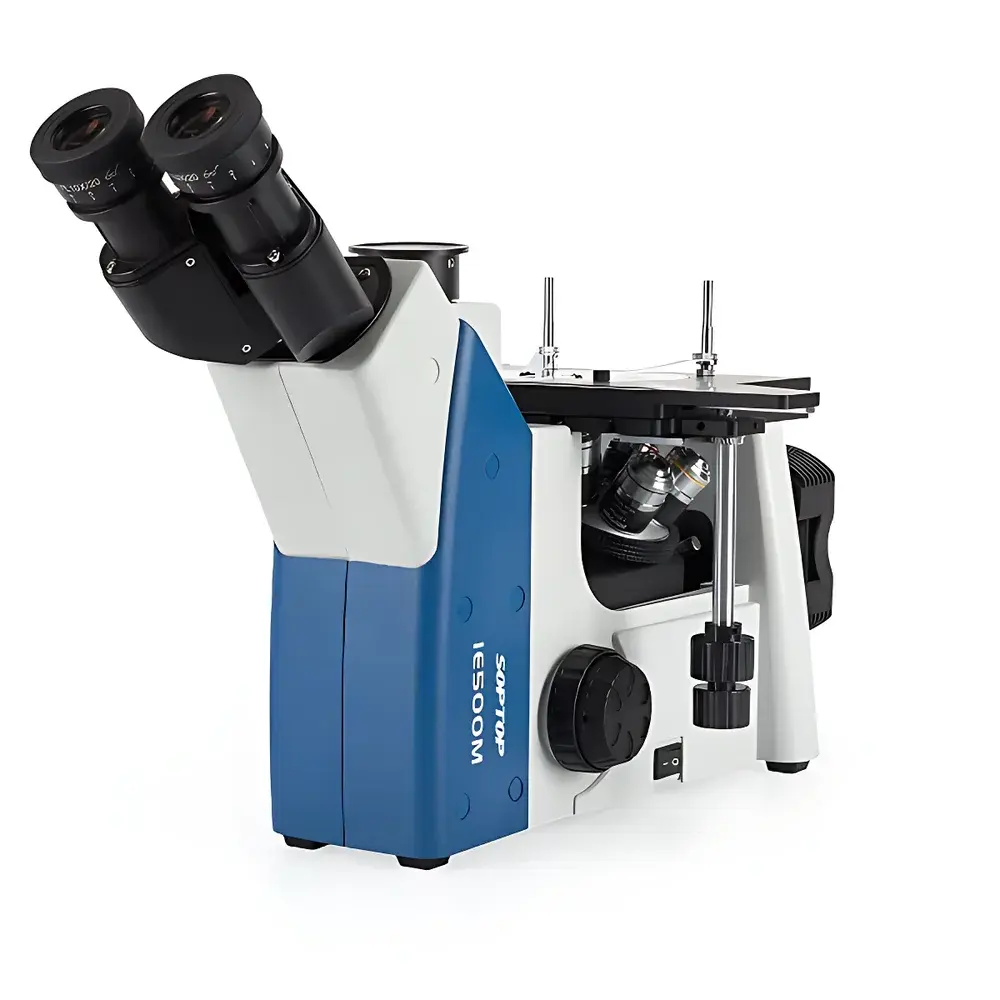
SOPTOP IE500M Upright Metallurgical Microscope
| Brand | SOPTOP |
|---|---|
| Origin | Zhejiang, China |
| Manufacturer Type | Direct Manufacturer |
| Product Type | Upright |
| Total Magnification Range | 50×–1000× |
| Eyepieces | High-eye-point wide-field plan eyepieces PL10×/20 mm with adjustable diopter and optional reticle |
| Objectives | 5×, 10×, 20×, 50×, 100× (long working distance, apochromatic-corrected) |
| Stage | 180 mm × 155 mm mechanical stage with center aperture (Ø12 mm), rotatable stage plate with ergonomic handle |
| Focusing Mechanism | Coaxial coarse/fine focus with low-position controls, fine focus graduation: 2 µm per division |
| Illumination | Reflected LED Köhler illumination (6 V/30 W halogen optional), brightness continuously adjustable |
| Observation Modes | Brightfield, Polarized Light |
| Trinocular Port | C-mount compatible (1× or 0.5× photo port magnification) |
| Compliance | ISO 10934-1 (Microscopy — Nomenclature of microscope components), ISO 9001 certified manufacturing |
Overview
The SOPTOP IE500M is an upright metallurgical microscope engineered for precision microstructural analysis of opaque, polished, and etched solid materials—including metals, alloys, ceramics, composites, and electronic packaging substrates. Unlike inverted configurations, its upright optical layout places the specimen on top of the stage with objectives positioned above, enabling direct access to large, heavy, or irregularly shaped samples during preparation and observation. The system employs a finite-conjugate optical path with apochromatically corrected long-working-distance (LWD) objectives, minimizing chromatic and spherical aberrations across the full 50×–1000× magnification range. Köhler illumination—delivered via a high-stability reflected LED light source—ensures uniform, glare-free illumination critical for quantitative metallographic assessment. Designed in accordance with ISO 10934-1 nomenclature standards, the IE500M supports both routine quality control and foundational academic research in materials science laboratories where reproducibility, ergonomic usability, and regulatory traceability are essential.
Key Features
- Upright configuration with 180 mm × 155 mm mechanical stage accommodating specimens up to 75 mm in height and Ø100 mm in diameter; central 12 mm aperture facilitates edge-on or cross-sectional viewing of small specimens.
- Rotatable water-drop-shaped stage plate with dual-position ergonomic handle—enables precise angular reorientation of anisotropic samples during polarized light analysis without stage drift.
- Low-hand-position coaxial coarse/fine focusing mechanism featuring 2 µm fine-focus graduation and ±5 diopter-adjustable high-eye-point PL10×/20 mm plan eyepieces—optimized for extended use by users wearing corrective lenses or safety goggles.
- Five-objective turret (5×, 10×, 20×, 50×, 100×) with LWD design (≥5.1 mm at 100×) and enhanced anti-reflection multilayer coatings—improves contrast, resolution, and color fidelity under both brightfield and polarized illumination.
- Dual-path trinocular head with standardized C-mount interface (1× or 0.5× photo port magnification)—enables seamless integration with industrial-grade CMOS cameras for real-time imaging, time-lapse acquisition, and digital archiving compliant with GLP documentation requirements.
Sample Compatibility & Compliance
The IE500M accommodates standard metallographic mounts (30 mm and 40 mm diameter), as well as unmounted bulk specimens, weld sections, fracture surfaces, and coated substrates. Its robust stage design supports weight loads up to 2.5 kg, while the large aperture and rotational capability simplify alignment of crystallographic axes during birefringence studies. All optical components comply with ISO 10934-1 definitions for metallurgical microscopy, and the LED illumination system meets IEC 62471 photobiological safety Class 1 requirements. Manufacturing adheres to ISO 9001:2015 quality management protocols, ensuring batch-to-batch consistency in optical performance and mechanical repeatability—critical for inter-laboratory comparison and internal audit readiness.
Software & Data Management
When paired with SOPTOP’s optional ImagePro™-compatible acquisition software (or third-party platforms such as NIS-Elements, Stream Motion, or open-source Fiji/ImageJ), the IE500M supports calibrated measurement (line, area, particle count, grain size per ASTM E112), annotation, multi-channel overlay, and export in TIFF, JPEG2000, or lossless PNG formats. Audit trails—including operator ID, timestamp, objective used, magnification, and exposure settings—are embedded in EXIF metadata. For regulated environments, the system can be configured to meet FDA 21 CFR Part 11 requirements when deployed with validated software modules supporting electronic signatures, role-based access control, and immutable data logging.
Applications
- Quantitative grain size analysis (ASTM E112, ISO 643) and phase fraction determination in ferrous/non-ferrous alloys.
- Polarized light evaluation of twinning, slip bands, and crystal orientation in titanium, magnesium, and nickel-based superalloys.
- Defect identification—porosity, inclusions, cracking—in castings, additive-manufactured parts, and solder joints.
- Coating thickness estimation (via focused-ion-beam cross-section correlation) and interfacial reaction zone characterization.
- Teaching laboratories: student-led microstructure interpretation, comparative analysis of heat-treated vs. as-cast states, and hands-on polarized light training.
FAQ
Is the IE500M suitable for DIC (Differential Interference Contrast) observation?
No—the IE500M does not include Nomarski prism sets or strain-free objectives required for DIC. It is optimized for brightfield and polarized light only.
Can the microscope be upgraded to support fluorescence imaging?
Not natively—the reflected-light path lacks excitation filter cubes and mercury/xenon lamp compatibility. Fluorescence capability requires a dedicated epi-fluorescence platform.
What is the maximum specimen height clearance under the 100× objective?
With the standard nosepiece and LWD 100× objective, working distance is 1.0 mm—sufficient for most polished metallographic mounts but not for thick sectioned samples without custom spacer rings.
Does SOPTOP provide calibration certificates traceable to NIST or equivalent national standards?
Yes—upon request, factory calibration reports for stage micrometer verification and eyepiece reticle calibration are available, traceable to CNAS-accredited reference standards.
Is motorized focusing or automated stage control available as an option?
Not for the base IE500M model. These features are supported on the higher-tier IE600 series, which shares optical compatibility but includes programmable hardware interfaces.



