
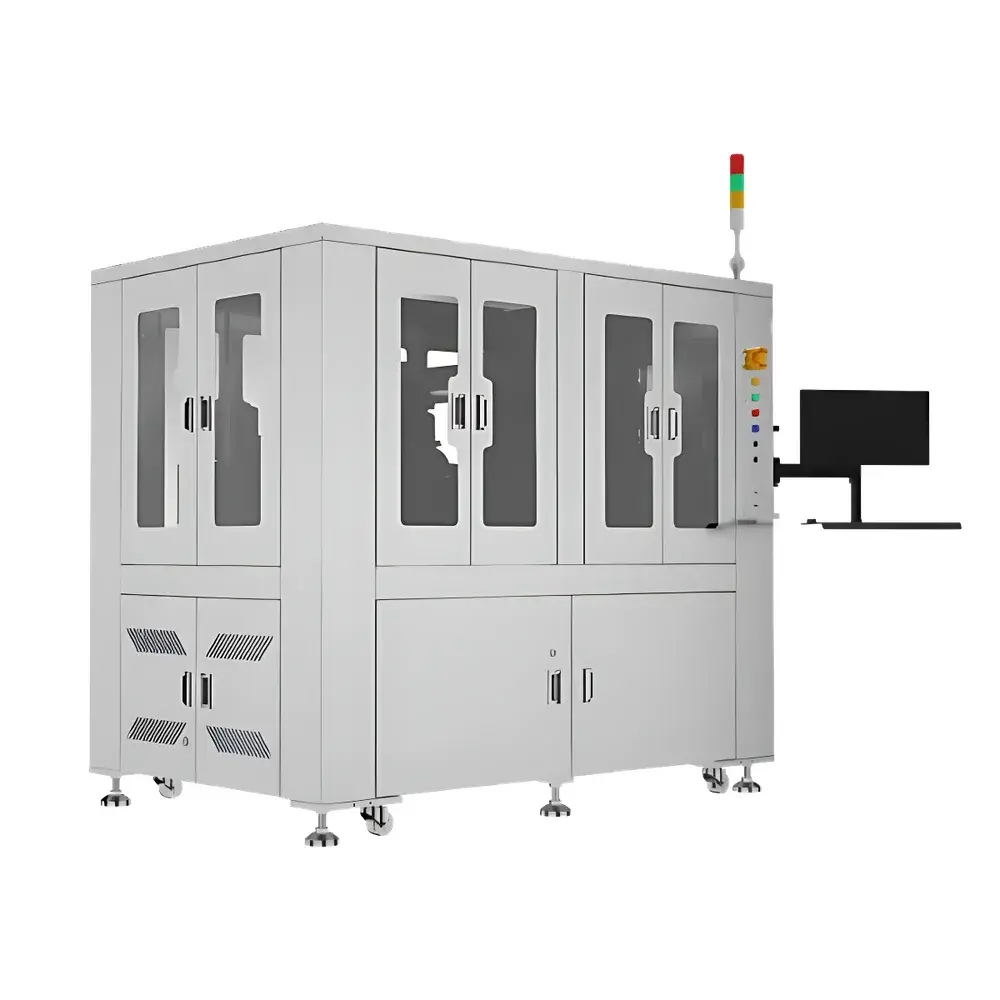
SOPTOP MINIRZJ-300 Automated Visual Inspection System for IR Cut Filter Assemblies
| Brand | SOPTOP |
|---|---|
| Origin | Zhejiang, China |
| Manufacturer | SOPTOP Optics Co., Ltd. |
| Type | Domestic Industrial Vision Inspection System |
| Model | MINIRZJ-300 |
| Power Supply | AC 220 V |
| Total Power Consumption | 5000 W |
| Compressed Air Requirement | 0.5 MPa |
| Overall Dimensions (L×W×H) | 2000 × 1300 × 2100 mm |
| Weight | 1600 kg |
| X/Y/Z Transport Axis Repeatability | ±0.02 mm |
| Sorting Y/Z Axis Repeatability | ±0.02 mm / ±0.03 mm |
| Feeding & Detection Z/X Axis Repeatability | ±0.03 mm / ±0.02 mm |
| Field of View | 21 mm × 21 mm |
| Miss Detection Rate | <1% (typical) |
| Overkill Rate | <10% (typical) |
| UPH | ≥7000 (for ≤8×8 mm components, 10×10 tray, ≥80% pass rate) / ≥4000 (for ≥12×12 mm components, 7×7 tray, ≥80% pass rate) |
| Defect Localization Accuracy | ±2.1 µm (point), ±0.1° (angle) |
| Compatible Carrier Sizes | 115×115 mm, 115×135 mm, 101.5×101.5 mm |
| Supported Component Types | Square, round-threaded, screen-printed, dual-camera IR cut filter assemblies |
| Minimum Component Footprint | 4.5×4.5 mm |
| Detection Principle | Grayscale-based optical contrast analysis using high-resolution CCD imaging |
Overview
The SOPTOP MINIRZJ-300 is an industrial-grade automated visual inspection system engineered specifically for the high-throughput, high-precision surface quality assessment of blue glass infrared (IR) cut filter assemblies used in consumer optics, mobile camera modules, and advanced imaging systems. It operates on a calibrated machine vision architecture grounded in monochromatic CCD imaging and pixel-level grayscale differential analysis — not spectral or interferometric measurement — enabling robust detection of surface anomalies based on localized reflectance and transmission contrast. The system integrates precision motion control (X-Y-Z linear stages with sub-20 µm repeatability), programmable lighting configurations, and deterministic image acquisition protocols to ensure consistent illumination geometry and spatial registration across diverse component geometries. Designed for integration into ISO 9001-certified manufacturing lines, the MINIRZJ-300 replaces manual microscope-based inspection workflows while maintaining traceability, audit readiness, and statistical process control (SPC) compatibility.
Key Features
- Precision multi-axis motion platform with ≤±0.03 mm repeatability across all transport, sorting, feeding, and inspection axes — compliant with ISO 230-2 positioning accuracy standards.
- Dual-camera optical configuration: top-mounted high-resolution CCD for full-surface defect mapping; bottom-view camera dedicated to narrow-band transmission verification (e.g., IR cutoff performance validation at specified wavelengths).
- Modular carrier compatibility supporting industry-standard trays: 115×115 mm, 115×135 mm, and 101.5×101.5 mm — configurable via software-defined tray templates without mechanical retooling.
- Defect classification engine trained on >12 validated defect morphologies including particles, scratches, contamination, chipping (edge/corner), misprinted ink, dimensional deviation in silkscreen patterns, adhesive line irregularities, lens-to-holder offset, material mix-ups, and holder surface damage.
- Automated pick-and-place subsystem with vacuum nozzles rated for components ≥4.5×4.5 mm — including dual-camera module stacks requiring simultaneous handling stability and non-contact orientation preservation.
- Real-time SPC dashboard exporting defect counts per category, positional heatmaps, yield trends, and OEE metrics — exportable in CSV/Excel format for MES integration.
Sample Compatibility & Compliance
The MINIRZJ-300 accommodates square, round-threaded, screen-printed, and dual-camera IR filter assemblies with planar top surfaces and standard mounting footprints. It is validated for use with blue glass substrates (Schott BG series equivalents) and common AR/AR+HR coatings. While not a metrology instrument per ISO 10110 or ISO 14999, its detection sensitivity aligns with IPC-A-610 Class 2/3 visual acceptability criteria for optoelectronic subassemblies. The system supports GLP-aligned operation: all inspection logs include timestamped image captures, operator ID, tray ID, and machine configuration snapshots. Audit trails comply with FDA 21 CFR Part 11 requirements when deployed with optional electronic signature and role-based access control modules.
Software & Data Management
Controlled by SOPTOP VisionSuite™ v4.x — a Windows-based deterministic real-time inspection platform — the system executes synchronized hardware triggering, adaptive threshold segmentation, multi-region-of-interest (ROI) analysis, and hierarchical defect binning. Calibration routines follow ASTM E2912-21 guidelines for industrial vision system validation. All raw images and annotated results are stored locally with SHA-256 hashing for integrity verification. Data export supports direct OPC UA connectivity for factory-wide SCADA integration. Software updates are delivered via signed firmware packages with cryptographic checksum verification; version history and change logs are retained for regulatory review.
Applications
- Final QA screening of IR cut filters prior to camera module assembly in Tier-1 mobile OEM supply chains.
- In-line 100% inspection during blue glass substrate polishing and coating processes to detect post-processing damage.
- Supplier qualification audits where objective, repeatable surface defect quantification replaces subjective human grading.
- Yield loss root cause analysis via spatial clustering of defects across trays and batches — correlated with upstream process parameters (e.g., cleaning chemistry dwell time, annealing profiles).
- Validation of new filter designs (e.g., hybrid polymer-glass laminates) under controlled lighting conditions replicating end-use optical paths.
FAQ
What defect types does the MINIRZJ-300 reliably detect?
It detects particles, scratches, stains, edge chipping, misaligned silk-screen patterns, adhesive defects, positional offsets, and surface blemishes — provided sufficient grayscale contrast exists between defect and background under standardized illumination.
Can it inspect coated or anti-reflective (AR) treated blue glass?
Yes, but detection efficacy depends on coating uniformity and angular reflectance behavior; highly specular or angle-sensitive coatings may require custom lighting angle optimization.
Is the system compatible with existing factory MES or QMS platforms?
Yes — via native CSV/Excel export, OPC UA server interface, and optional REST API add-on for real-time data ingestion into SAP QM, ETQ Reliance, or similar quality management ecosystems.
How is measurement traceability maintained?
Each inspection cycle records calibrated pixel-to-mm mapping coefficients, lighting intensity logs, and environmental temperature/humidity metadata; calibration certificates reference NIST-traceable photometric standards.
Does it support dual-camera or stacked module inspection?
Yes — the vacuum handling system and field-of-view alignment accommodate vertically integrated dual-sensor configurations up to 12 mm height, with independent top/bottom surface evaluation sequences.






