
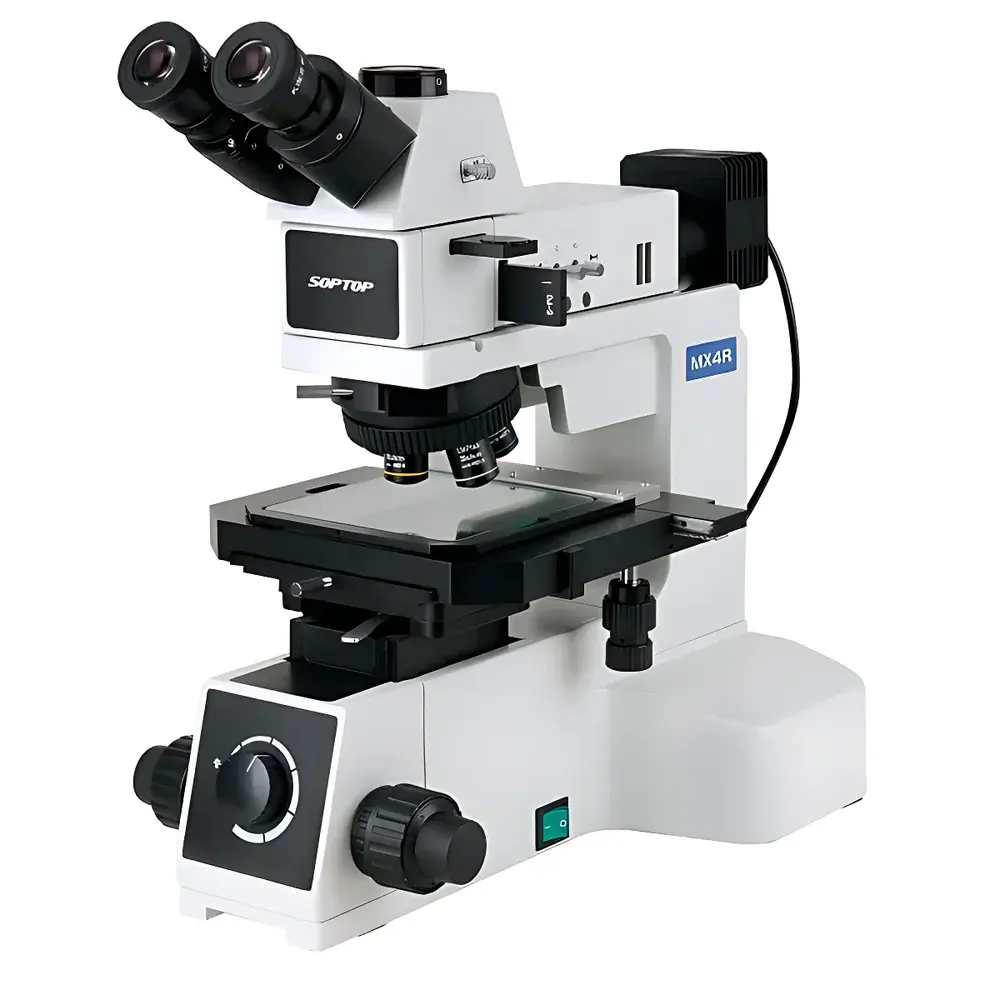
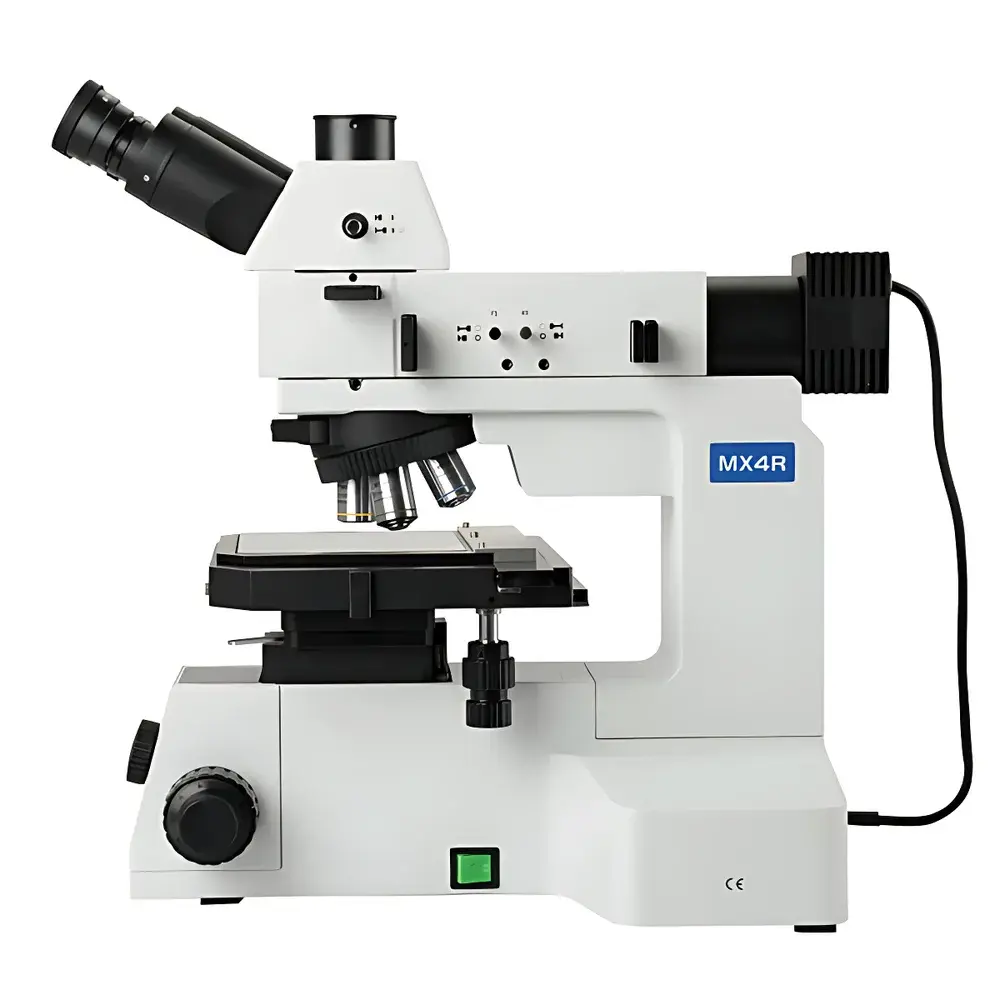
SOPTOP MX4R Upright Metallurgical Microscope
| Brand | SOPTOP |
|---|---|
| Origin | Zhejiang, China |
| Manufacturer Type | Original Equipment Manufacturer (OEM) |
| Product Category | Domestic |
| Model | MX4R |
| Pricing | Upon Request |
| Configuration | Upright |
| Total Magnification Range | 50×–1500× |
| Eyepieces | High-eye-point wide-field plan eyepieces PL10×/22 mm and PL15×/16 mm |
| Objectives | 5×–100× semi-apochromatic long-working-distance objectives |
Overview
The SOPTOP MX4R is an upright metallurgical microscope engineered for high-precision microstructural analysis in industrial quality control and materials science laboratories. It operates on reflected-light optical principles—specifically optimized for opaque, polished, or etched metallic and ceramic specimens—leveraging Köhler illumination, semi-apochromatic long-working-distance (LWD) objectives, and multi-mode contrast enhancement to deliver diffraction-limited resolution across the full magnification range (50× to 1500×). Designed for semiconductor wafer inspection, flat panel display (FPD) defect characterization, and metallographic evaluation per ASTM E3, ASTM E407, and ISO 4967 standards, the MX4R integrates mechanical stability, thermal management, and ergonomic operability into a single robust platform. Its low-center-of-gravity metal frame, precision-machined base, and internal air-circulation cooling system ensure minimal thermal drift and vibration-induced image degradation during extended observation sessions.
Key Features
- Upright configuration with large-travel mechanical stage (compatible with 4-inch platforms; optional 6-inch stage support)
- Semi-apochromatic long-working-distance objectives (5×, 10×, 20×, 50×, 100×) featuring multi-layer broadband anti-reflection coatings for uniform brightness, chromatic fidelity, and edge-to-edge sharpness
- High-eye-point wide-field plan eyepieces (PL10×/22 mm and PL15×/16 mm) supporting extended observation periods without eye strain
- Precision-bearing revolving nosepiece with high repeatability and tight objective centering tolerance (< 0.02 mm), ensuring consistent field alignment across magnifications
- Hinged trinocular observation tube with parfocal, ergonomically angled viewing port—maintains object/image movement congruence (i.e., specimen motion direction matches image motion direction)
- Integrated multimodal illumination system supporting brightfield, oblique illumination, polarized light, and Differential Interference Contrast (DIC) for enhanced topographic and birefringent contrast
- Coaxial coarse/fine focusing mechanism with front-mounted low-position controls and 1 µm fine-focus graduation; built-in universal 100–240 V AC power supply with active thermal regulation
Sample Compatibility & Compliance
The MX4R accommodates standard metallographic specimens (up to 3” × 3” × 1” thick) mounted on glass or metal slides, as well as unmounted wafers (up to 200 mm diameter) when used with optional vacuum chucks or kinematic holders. Its LWD objectives provide ≥10 mm working distance at 10× and ≥2 mm at 50×, enabling compatibility with tall sample holders, stage-top accessories (e.g., heating/cooling stages), and in-situ test fixtures. The instrument conforms to IEC 61000-6-2 (electromagnetic immunity) and IEC 61000-6-4 (emission) standards. Optical performance is validated per ISO 10934-1 (microscope terminology) and ISO 9345-2 (objective lens specifications). DIC and polarized modules meet requirements for ASTM E112 grain size analysis and ASTM E1245 inclusion rating protocols.
Software & Data Management
The MX4R supports integration with third-party digital imaging systems via C-mount (23.2 mm) or optional 1×/0.5× video couplers. When paired with compliant USB3.0 CMOS cameras (e.g., SOPTOP SC500 or equivalent), it enables image acquisition, measurement (line, area, particle count), annotation, and report generation under ISO/IEC 17025-aligned workflows. Optional software packages provide audit trail logging, user access control, and metadata embedding (EXIF-compliant), facilitating compliance with FDA 21 CFR Part 11 and GLP/GMP documentation requirements. All firmware updates are delivered via secure HTTPS endpoint with SHA-256 signature verification.
Applications
- Metallurgical QC: Grain boundary analysis, phase identification, inclusion quantification (ASTM E45, E112), heat-affected zone (HAZ) assessment
- Semiconductor manufacturing: Wafer surface defect mapping (scratches, pits, residues), bond pad inspection, lithography residue verification
- Advanced display R&D: FPD pixel structure evaluation, OLED layer delamination detection, touch sensor trace continuity testing
- Geological thin-section analysis of opaque minerals using reflected-light polarimetry
- Failure analysis labs: Fractography, corrosion morphology classification, solder joint integrity assessment
FAQ
Is the MX4R compatible with automated stage controllers or motorized focus units?
Yes—standard RS-232 and USB-B ports support integration with third-party motorized XY stages and Z-drive modules. SOPTOP provides SDK documentation for custom API development.
Can DIC and polarized light modules be used simultaneously?
No—DIC requires dedicated Nomarski prisms and strain-free objectives; polarized light uses separate analyzer and rotatable polarizer. Modules are mechanically interchanged but not co-installed.
What is the maximum specimen height clearance under the 100× objective?
Approximately 2.1 mm working distance, sufficient for standard metallographic mounts and most epoxy-embedded samples.
Does the MX4R include calibration certification?
A NIST-traceable stage micrometer and eyepiece graticule are supplied; formal ISO/IEC 17025 calibration certificates are available upon request through authorized service centers.
Is service and technical support available outside mainland China?
Yes—SOPTOP maintains certified service partners in North America, Europe, and Southeast Asia, offering remote diagnostics, on-site maintenance, and application engineering support.





