
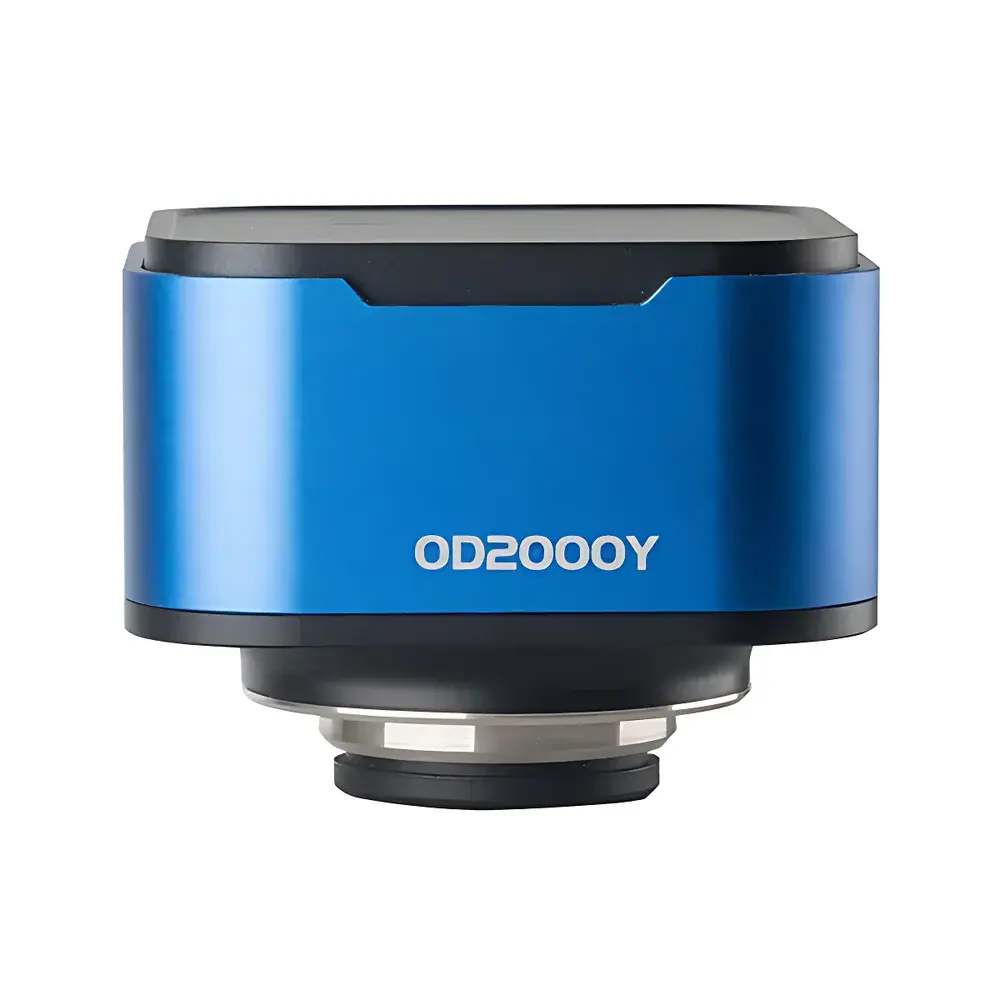
SOPTOP OD2000Y 20-Megapixel USB 3.0 Scientific CMOS Camera
| Brand | SOPTOP |
|---|---|
| Origin | Zhejiang, China |
| Manufacturer Type | Original Equipment Manufacturer (OEM) |
| Country of Origin | China |
| Model | OD2000Y |
| Price | USD 2,800 (FOB) |
| Image Resolution | 15 fps at 5440 × 3648 |
| Pixel Size | 2.4 µm × 2.4 µm |
| Interface | USB 3.0 |
| Effective Pixels | 20 megapixels |
| Color Fidelity | High CRI spectral response optimized for microscopy illumination |
| Read Noise | <2.5 e⁻ RMS (typical, 12-bit mode) |
| Dynamic Range | >64 dB (typical, full well capacity ~12,000 e⁻) |
Overview
The SOPTOP OD2000Y is a high-performance scientific-grade CMOS camera engineered for demanding optical microscopy and industrial imaging applications. Built upon a global-shutter or rolling-shutter (configurable) 20-megapixel CMOS sensor with 2.4 µm pixel pitch, it delivers exceptional spatial resolution and photometric fidelity across visible wavelengths (400–700 nm). Its measurement principle relies on photon-to-electron conversion followed by correlated double sampling (CDS) and 12-bit analog-to-digital conversion—ensuring low read noise (65% peak at 550 nm), and linear response over 4-decade intensity range. Designed for integration into upright, inverted, and stereo microscopes—as well as machine vision inspection stations—the OD2000Y supports real-time acquisition at 15 frames per second (fps) at full native resolution (5440 × 3648), enabling dynamic observation of cellular motility, particle tracking, and time-lapse morphological analysis without motion blur.
Key Features
- 20-megapixel native resolution (5440 × 3648) with 2.4 µm × 2.4 µm pixel size—optimized for diffraction-limited imaging with 20×–60× microscope objectives
- USB 3.0 Vision-compliant interface ensuring sustained bandwidth up to 350 MB/s—eliminating frame drops during continuous acquisition
- Hardware binning (2×2, 3×3, 4×4) and region-of-interest (ROI) selection to enhance signal-to-noise ratio (SNR) or increase frame rate up to 60 fps at reduced resolution
- On-sensor microlens array and back-illuminated architecture for >65% peak quantum efficiency and uniform pixel response (±3% flatness)
- Programmable exposure control (10 µs – 10 s), gain adjustment (0–24 dB), and black-level calibration for quantitative intensity measurements
- Rugged aluminum housing with passive thermal management—operational stability verified from 10 °C to 40 °C ambient
Sample Compatibility & Compliance
The OD2000Y is compatible with standard C-mount and CS-mount optical interfaces (adapters included), supporting integration with Nikon, Olympus, Leica, Zeiss, and custom-built optical benches. It complies with CE marking requirements for electromagnetic compatibility (EN 61326-1) and safety (EN 61010-1). Firmware and driver stacks are validated under Windows 10/11 (x64) and Linux kernel 5.4+ via UVC 1.5 and GenICam v3.3 protocols. For regulated environments—including GLP/GMP laboratories—the camera supports metadata embedding (EXIF + custom tags), timestamp synchronization via PTPv2 (IEEE 1588), and audit-ready logging when used with SOPTOP’s certified SDK. While not FDA 510(k)-cleared as a medical device, its performance characteristics meet ASTM E2912-21 guidelines for digital image capture in materials characterization and biological documentation.
Software & Data Management
The OD2000Y ships with SOPTOP’s cross-platform SDK (C/C++, Python 3.8+, MATLAB R2020b+ bindings) and GUI application “SOPView Pro”, which enables live histogram display, real-time gamma/LUT adjustment, multi-channel overlay (RGB + monochrome), and batch TIFF/RAW12 export. All acquired images embed EXIF metadata—including exposure time, gain, sensor temperature, and lens ID—and support lossless compression (ZIP64) without pixel value truncation. The SDK provides full access to trigger modes (hardware TTL, software command, free-run), pixel format negotiation (Mono12, RGB8, BayerRG12), and memory-mapped buffer handling for high-throughput automation. Integration with third-party platforms—including Micro-Manager 2.0, NIS-Elements, and HALCON—is supported via standardized GenTL producer and Aravis-compatible drivers.
Applications
- High-resolution brightfield, phase contrast, and DIC microscopy in academic and clinical histology labs
- Automated wafer defect inspection and PCB solder-joint analysis in semiconductor manufacturing QA workflows
- Time-lapse cytology and organoid development monitoring requiring stable SNR across multi-hour acquisitions
- Fluorescence co-localization studies using dual-band excitation where color channel registration accuracy ≤0.25 pixels is required
- Educational microscopy systems where USB plug-and-play simplicity, deterministic latency (<12 ms end-to-end), and driver-free operation are critical
FAQ
Is the OD2000Y compatible with Linux-based acquisition servers?
Yes—full source-available drivers and sample code are provided for Ubuntu 20.04 LTS and later, compliant with V4L2 and libusb-1.0 APIs.
Does the camera support hardware triggering for synchronized multi-camera setups?
Yes—dedicated opto-isolated I/O connector supports TTL-level input (exposure trigger) and output (frame valid/strobe), with configurable polarity and delay (1 µs resolution).
Can raw 12-bit data be streamed without on-camera debayering?
Yes—BayerRG12 and Mono12 pixel formats are natively supported; debayering is performed client-side to preserve quantization integrity.
What is the calibrated radiometric accuracy across the field of view?
Factory-calibrated flat-field correction yields ±2.8% intensity uniformity (center to corner) at f/4; optional NIST-traceable irradiance calibration kit available separately.
Is firmware upgrade capability available in the field?
Yes—signed firmware updates are delivered via SOPView Pro or CLI utility; rollback protection and dual-bank flash ensure zero-risk field maintenance.



