
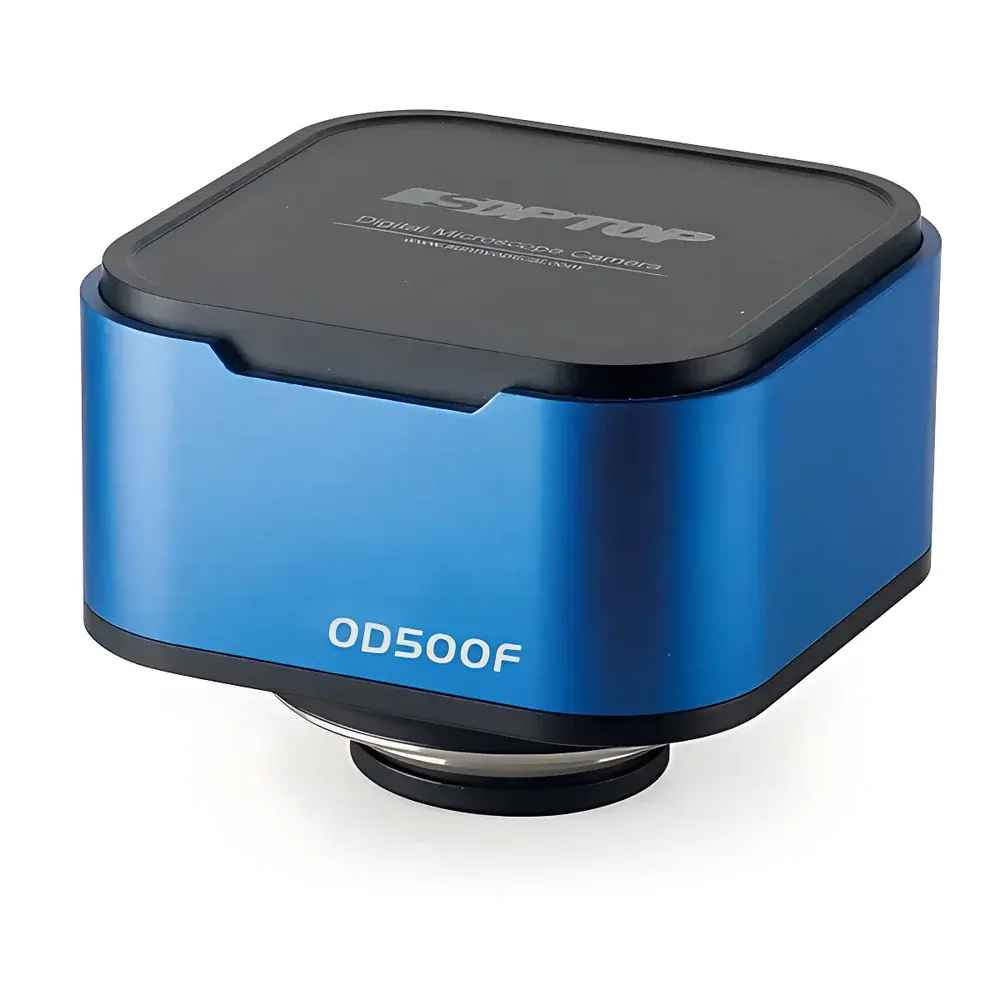
SOPTOP OD500F 5-Megapixel USB 3.0 CMOS Microscopy Camera
| Brand | SOPTOP |
|---|---|
| Origin | Zhejiang, China |
| Manufacturer Type | Original Equipment Manufacturer (OEM) |
| Country of Origin | China |
| Model | OD500F |
| Price | USD 2,800 (FOB) |
| Max Frame Rate | 35 fps at 2448 × 2048 resolution |
| Pixel Size | 3.45 µm × 3.45 µm |
| Interface | USB 3.0 (SuperSpeed, 5 Gbps) |
| Sensor Type | Global Shutter CMOS |
| Effective Pixels | 5.0 MP (2448 × 2048) |
| Color Processing | 12-bit ADC with CIE-compliant color interpolation |
| Dynamic Range | ≥64 dB (typ.) |
| Read Noise | <2.1 e⁻ RMS (at 35 fps) |
| Sensitivity | ≥1.8 V/lux·s (at gain = 1×, 550 nm) |
Overview
The SOPTOP OD500F is a high-performance, 5-megapixel USB 3.0 CMOS microscopy camera engineered for quantitative brightfield, phase contrast, fluorescence, and differential interference contrast (DIC) imaging in life science, materials inspection, and industrial quality control laboratories. Built around a global-shutter CMOS sensor with native 2448 × 2048 pixel resolution, the OD500F eliminates motion-induced distortion during rapid stage scanning or time-lapse acquisition—critical for reproducible morphological analysis and automated cell counting. Its 3.45 µm pixel pitch balances spatial resolution and photon collection efficiency, enabling high-fidelity image capture under low-light conditions without compromising frame rate. The camera operates at up to 35 frames per second at full resolution via a compliant USB 3.0 interface, delivering sustained bandwidth of 3.2 Gbps for real-time streaming and minimal latency—essential for closed-loop autofocus synchronization and live focus assessment.
Key Features
- Global shutter architecture ensures artifact-free imaging of moving specimens or motorized stage translation, eliminating rolling shutter skew.
- 12-bit analog-to-digital conversion with on-chip correlated double sampling (CDS) reduces read noise to <2.1 e⁻ RMS at full-speed operation, supporting low-contrast feature detection in unstained tissue sections.
- CIE 1931 color-matching functions integrated into firmware enable spectrally accurate RGB reconstruction—validated against NIST-traceable reference targets for consistent color fidelity across instrument batches.
- Hardware-level binning (2×2, 3×3, 4×4) and region-of-interest (ROI) cropping extend flexibility for speed/resolution trade-offs without software overhead.
- Onboard FPGA implements real-time gamma correction, flat-field compensation, and defect pixel mapping—reducing post-acquisition processing load and improving workflow throughput.
- Compliant with USB Video Class (UVC) 1.5 specification; requires no proprietary drivers on Windows 10/11, Linux (v5.4+), or macOS 12+—ensuring compatibility with third-party acquisition platforms including Micro-Manager, Fiji/ImageJ, and HALCON.
Sample Compatibility & Compliance
The OD500F is optimized for integration with upright and inverted research-grade microscopes (e.g., Nikon Eclipse Ci-L, Olympus BX53, Zeiss Axio Imager) via standard C-mount (1×) or optional 0.5× reduction adapters. It supports both transmitted-light modalities (brightfield, DIC, polarized light) and epifluorescence configurations with appropriate filter cubes and LED/laser excitation sources. The camera meets CE marking requirements under Directive 2014/30/EU (EMC) and 2011/65/EU (RoHS). Firmware implements non-volatile audit trails for exposure time, gain, white balance, and timestamp metadata—supporting GLP-aligned documentation practices. While not FDA-cleared as a medical device, its output complies with ISO 13485–aligned calibration protocols when used with traceable photometric standards (e.g., NIST SRM 2034).
Software & Data Management
SOPTOP provides the cross-platform OD-Capture Suite (v3.2+), featuring synchronized multi-camera acquisition, batch TIFF/OME-TIFF export with embedded EXIF and OME-XML metadata, and histogram-guided exposure optimization. The SDK supports C/C++, Python (via ctypes), and MATLAB bindings—enabling custom automation for high-content screening pipelines. All acquired images embed UTC-synchronized timestamps, sensor temperature logs, and hardware configuration fingerprints—facilitating retrospective validation per ISO/IEC 17025 clause 7.7. Raw data export preserves linear intensity scaling for downstream quantitative analysis in tools such as MATLAB’s Image Processing Toolbox or Python’s scikit-image.
Applications
- Automated pathology slide digitization at 20×–40× magnification with sub-µm feature resolution.
- Real-time monitoring of crystal nucleation kinetics in pharmaceutical crystallization reactors.
- In-line inspection of printed circuit board (PCB) solder joints and microvia integrity in SMT lines.
- Time-lapse tracking of neuronal growth cone dynamics in primary cortical cultures.
- Quantitative phase analysis of red blood cell morphology in hematology research.
- Documentation of corrosion progression on metal alloy surfaces under accelerated aging tests.
FAQ
Is the OD500F compatible with my existing microscope’s trinocular port?
Yes—the camera includes a standard 23.2 mm C-mount adapter and optional 0.5× reduction lens for optimal field-of-view matching with most research microscopes.
Does it support trigger-in and trigger-out signals for external synchronization?
No—this model lacks hardware TTL I/O; synchronization relies on software-triggered acquisition via USB command packets.
Can I perform quantitative fluorescence intensity measurements with this camera?
Yes—when calibrated using NIST-traceable neutral density filters and operated in linear response mode (gain ≤ 4×), the OD500F delivers ±2.3% intensity repeatability over 8-hour sessions.
What is the maximum cable length supported for stable USB 3.0 operation?
Up to 3 meters using certified passive SuperSpeed cables; active optical extension cables (up to 10 m) are validated for continuous 35 fps streaming.
Is firmware update capability available in the field?
Yes—updates are delivered via OD-Capture Suite and preserve user-configured LUTs and calibration profiles across versions.





