
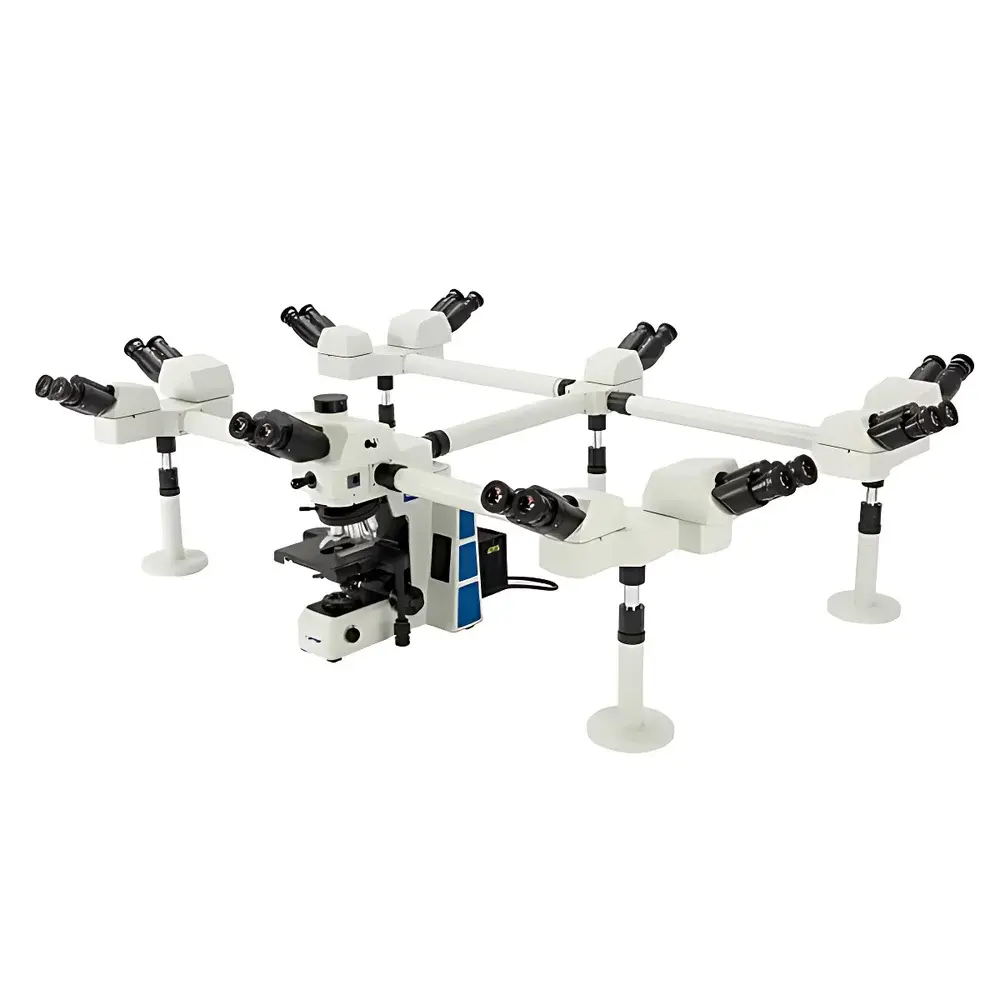
SOPTOP RX50DO10 Ten-Station Shared-View Biological Microscope
| Brand | SOPTOP |
|---|---|
| Origin | Zhejiang, China |
| Manufacturer Type | Direct Manufacturer |
| Product Category | Domestic (China-Made) |
| Model | RX50DO10 |
| Instrument Type | Upright Microscope |
| Eyepiece Configuration | Trinocular |
| Price Range | USD 21,000 – 35,000 (FOB China) |
| Target Application | Collaborative Research, Pathology Education, Life Science Teaching |
Overview
The SOPTOP RX50DO10 is an upright, trinocular biological microscope engineered specifically for collaborative visual analysis in academic, clinical, and research environments. It implements a shared-view optical architecture based on high-fidelity beam-splitting optics and synchronized parfocal illumination pathways—enabling up to ten observers to simultaneously view the identical field of view without parallax or image disparity. Unlike conventional multi-head adapters that degrade resolution or introduce chromatic aberration, the RX50DO10 integrates a precision-machined optical manifold with individually calibrated viewing stations, each equipped with independent diopter adjustment and ergonomic eyepiece positioning. Its optical design conforms to ISO 8578:2017 standards for microscope optical performance, delivering diffraction-limited resolution across all viewing ports when used with standard 10×/20×/40×/100× objective lenses (oil immersion compatible). The system is optimized for transmitted brightfield, phase contrast, and optional DIC configurations—making it suitable for live-cell observation, histopathological slide review, and routine microbiological examination.
Key Features
- Simultaneous ten-station viewing via optically balanced beam-splitting manifold—no image duplication latency or geometric distortion
- Trinocular head with dedicated C-mount port for digital imaging integration (1× or 0.5× reduction lens options)
- Ergonomic dual-hand control stage: 187 mm × 168 mm mechanical stage with bi-directional linear rail mechanism and retractable left/right hand controls
- LED pointer synchronization system: real-time directional arrow overlay visible identically across all viewing stations and digital output
- Human-centered materials engineering: anti-static, low-thermal-conductivity polymer housing with matte-textured surface finish (ISO 14155-compliant tactile interface)
- Integrated 3W adjustable LED Köhler illumination with intensity memory function and color temperature stabilization (5,500 K ± 150 K)
- Modular base design supporting optional motorized Z-drive, fluorescence filter cubes, or camera-triggered shutter synchronization
Sample Compatibility & Compliance
The RX50DO10 accommodates standard 1″ × 3″ (25 × 75 mm) glass slides and 15 mm diameter coverslips; compatible with aqueous, glycerol, and immersion oil mounting media. Stage travel range: 76 mm × 52 mm (X–Y), 25 mm fine-focus travel (1 µm graduation scale). Complies with IEC 61000-6-3 (EMC emissions), IEC 61000-6-1 (immunity), and UL 61010-1 safety requirements for laboratory equipment. Optical components meet ISO 10934-1 (microscope terminology) and ISO 8578 (optical performance testing) specifications. Designed for GLP-aligned workflows: all mechanical adjustments include lockable positions; focus knobs feature torque-limiting clutches to prevent accidental drift during extended observation sessions.
Software & Data Management
The microscope interfaces seamlessly with SOPTOP’s proprietary ImagePro™ Suite v4.2 (Windows 10/11, 64-bit), supporting USB 3.0–connected CMOS cameras (up to 20 MP resolution). Software features include time-lapse acquisition with hardware-triggered frame synchronization, multi-user annotation layers with timestamped metadata embedding, and DIC/phase contrast quantification modules compliant with ASTM E2877-22 (digital image analysis for biological specimens). Export formats include TIFF (16-bit), JPEG2000, and OME-TIFF for interoperability with OMERO, QuPath, and ImageJ/Fiji pipelines. Audit trail functionality logs user ID, timestamp, magnification setting, illumination intensity, and camera exposure parameters—meeting FDA 21 CFR Part 11 requirements when deployed with validated domain authentication.
Applications
- Medical education: Real-time pathology case review with synchronized annotation across teaching stations
- Cell biology labs: Collaborative identification of mitotic stages, organelle dynamics, or transfection efficiency scoring
- Parasitology training: Multi-observer consensus assessment of protozoan morphology and motility patterns
- Tumor board preparation: Side-by-side comparison of H&E, IHC, and special stain slides under identical optical conditions
- Genetic screening programs: High-throughput karyotype analysis with distributed workload allocation across observer stations
- Regulatory training: FDA/EMA inspector readiness drills simulating GLP-compliant slide review protocols
FAQ
How many users can observe simultaneously without image degradation?
Up to ten users view the exact same optical field with <0.5% inter-station luminance variance and <1.2 arcmin angular deviation—verified per ISO 8578 Annex D test procedures.
Is the system compatible with third-party digital cameras and software?
Yes—USB 3.0 UVC-compliant interface supports Thorlabs, Lumenera, and Basler cameras; TWAIN and GenICam drivers included.
Can the RX50DO10 be integrated into existing LIMS or ELN platforms?
Metadata export (XML/JSON) supports direct ingestion into LabVantage, Benchling, and Veeva systems via REST API or SFTP protocols.
What maintenance intervals are recommended for long-term optical stability?
Annual calibration of beam-splitting alignment and LED intensity uniformity is advised; no consumables required beyond standard objective cleaning.
Does the system support fluorescence applications out-of-the-box?
Fluorescence capability requires optional filter cube turret and mercury/xenon lamp or LED excitation module—configured at time of order.




