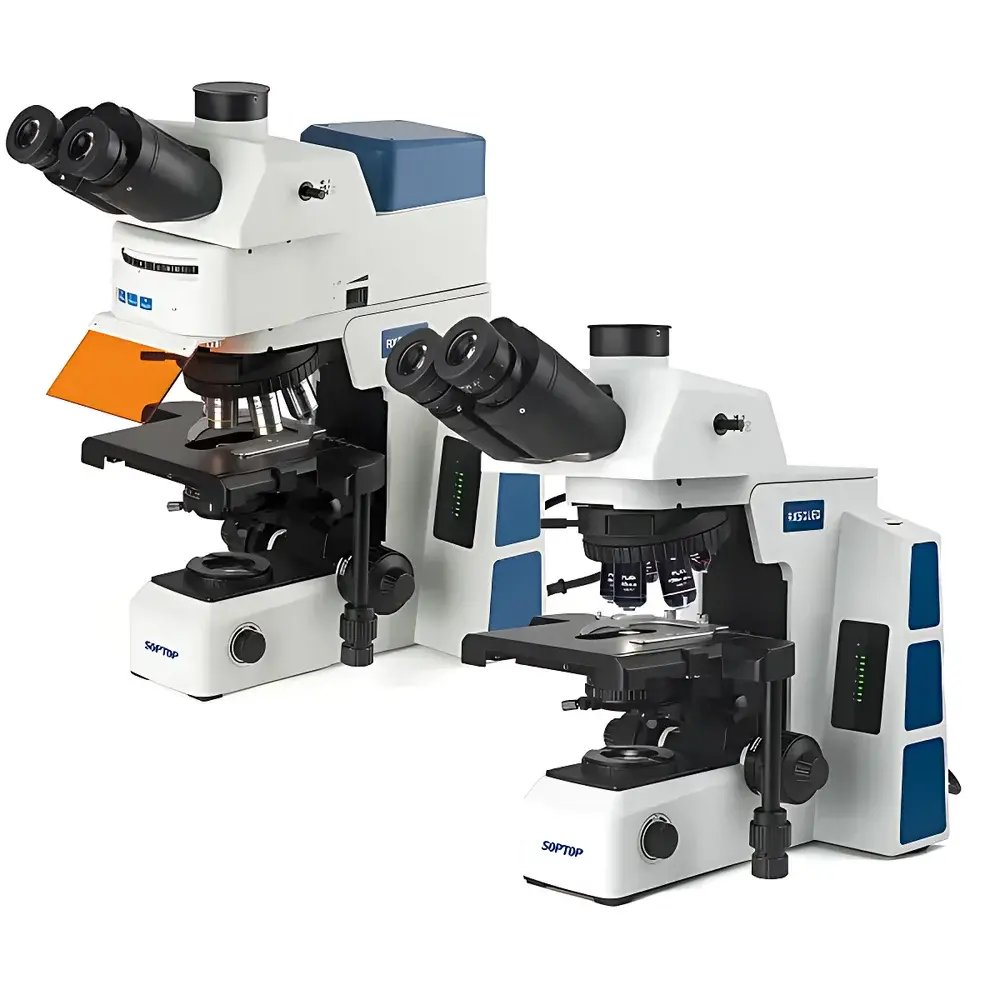
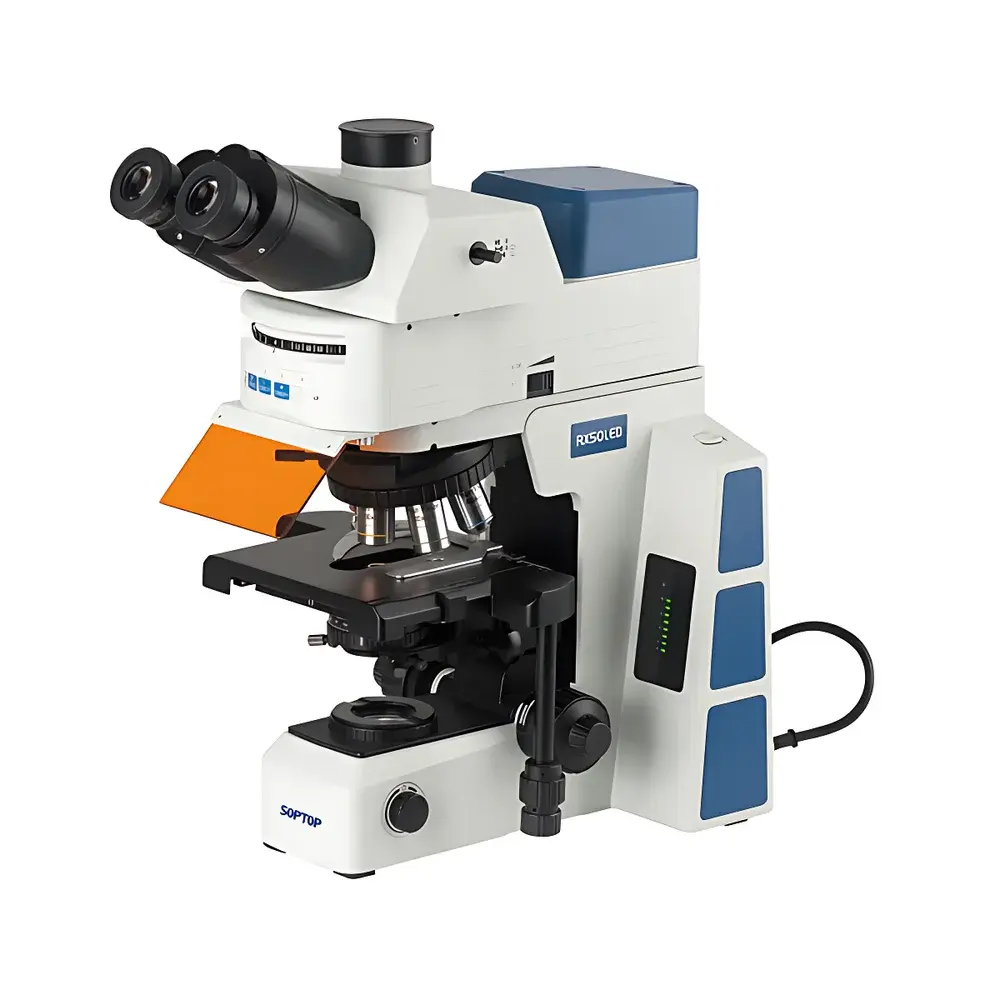
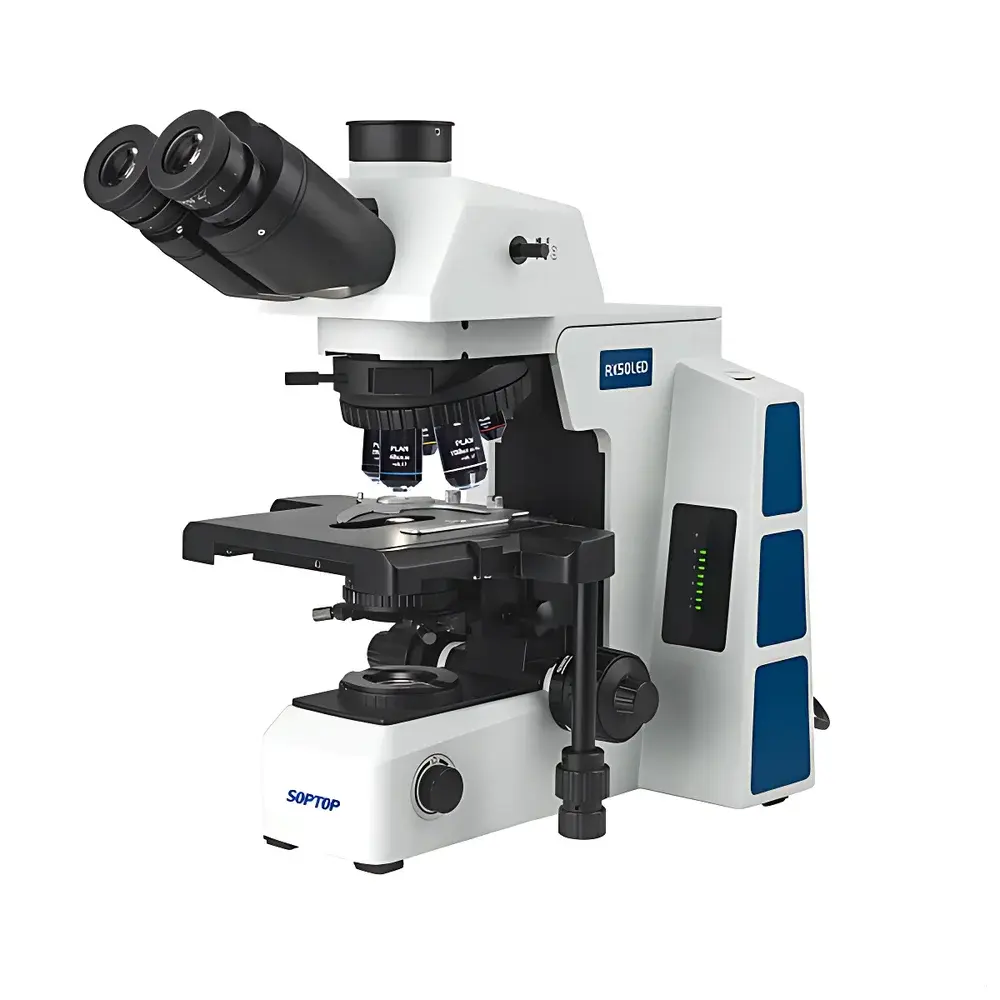
SOPTOP RX50LED Research-Grade Upright Fluorescence Microscope
| Brand | SOPTOP |
|---|---|
| Origin | Zhejiang, China |
| Manufacturer Type | Direct Manufacturer |
| Product Category | Domestic |
| Model | RX50LED |
| Instrument Type | Upright Fluorescence Microscope |
| Excitation Source | High-Intensity LED Illumination (Not Mercury Arc Lamp) |
| Medical Device Classification | Not a Regulated Medical Device |
| Microscope Class | Research-Grade |
| Eyepieces | High-Eye-Point Wide-Field Plan Eyepieces PL10X/25mm with Adjustable Diopter |
| Objective Lenses | Plan Achromatic (4×, 10×, 20×, 40×, 60×, 100× Oil) |
| Fluorescence Module | Integrated LED-Based Excitation System with Multi-Band Filter Sets |
| Transmitted Light Source | 12V/100W Halogen Lamp Housing with Pre-Centered Alignment and Continuously Adjustable Intensity |
| Control Mode | Manual Operation |
| Focusing Mechanism | Low-Position Coaxial Coarse/Fine Focus Assembly |
| Condenser | Universal Condenser (NA 1.1) with Built-in Polarizer, Compatible with Phase Contrast, Darkfield, and DIC Annuli |
| Observation Tube | Infinity-Corrected Trinocular Hinged Head (Binocular or Trinocular Configurations Available) |
| DIC Compatibility | Nosepiece with DIC Slot |
| Stage | 187 × 166 mm Dual-Layer Mechanical Stage with 80 mm × 55 mm Travel Range, 0.1 mm Resolution, Imported Precision Linear Rails, Bidirectional Motion, Adjustable Tension, Left/Right Hand Configurable |
Overview
The SOPTOP RX50LED is an upright research-grade fluorescence microscope engineered for high-fidelity cellular and tissue imaging in academic, clinical pathology, and pharmaceutical research laboratories. It employs an infinity-corrected optical architecture optimized for fluorescence contrast and resolution across visible and near-UV excitation bands. Unlike traditional mercury arc-based systems, the RX50LED integrates a solid-state LED illumination platform—offering stable, flicker-free, and spectrally defined excitation without thermal drift or hazardous lamp disposal requirements. Its Köhler illumination system features a fly-eye lens array to ensure uniform field illumination at all magnifications, eliminating edge dimming and enhancing quantitative image consistency. The microscope’s mechanical stability, precision-ground optical pathways, and modular design support long-duration time-lapse experiments, multi-channel fluorescence acquisition, and correlative brightfield–fluorescence workflows—all within a compact footprint suitable for standard laboratory benchtops (≤600 mm depth).
Key Features
- LED-based fluorescence excitation system with selectable multi-band filter cubes (e.g., DAPI/FITC/TRITC/Cy5), delivering consistent intensity, minimal phototoxicity, and >20,000-hour source lifetime.
- Universal apochromatic objectives (up to 100× oil immersion, NA 1.45) with anti-reflective coatings optimized for wide-spectrum transmission (350–750 nm) and reduced spherical/chromatic aberration in multi-label imaging.
- 6-position encoded nosepiece with automatic brightness memory per objective—retains user-defined LED intensity settings to eliminate manual recalibration during magnification changes.
- NA 1.1 universal condenser with integrated polarizer and accessory slots for phase contrast, darkfield, and differential interference contrast (DIC), enabling multimodal contrast generation without hardware reconfiguration.
- Ergonomic low-handled coaxial focusing mechanism with 1 µm fine-focus graduation and 15 mm coarse travel—designed for extended operator use with minimal fatigue.
- 187 × 166 mm dual-layer mechanical stage with linear rail guidance, 0.1 mm positional repeatability, and torque-adjustable motion control—compatible with motorized upgrade paths for automated scanning.
Sample Compatibility & Compliance
The RX50LED accommodates standard glass slides (1 × 3 inches), petri dishes (35–100 mm), multi-well plates (6–96-well), and live-cell chambers (e.g., chambered coverslips, perfusion systems). Its transmitted-light halogen source supports brightfield, phase contrast, and DIC imaging of unstained or lightly stained specimens—including blood smears, histological sections, and embryonic tissues. While not certified as a medical device under FDA 21 CFR Part 820 or EU MDR Annex II, the system complies with IEC 61000-6-3 (EMC emissions) and IEC 61000-6-2 (immunity), and meets ISO 13485-aligned manufacturing quality controls. All optical components are traceably calibrated per ISO 10110 standards, and documentation supports GLP-compliant instrument qualification (IQ/OQ/PQ) protocols.
Software & Data Management
The RX50LED interfaces seamlessly with third-party imaging software platforms—including NIS-Elements (Nikon), ZEN (Zeiss), and open-source tools such as Fiji/ImageJ—via USB 3.0 or HDMI output. Optional SOPTOP ImagePro™ Suite provides real-time Z-stack acquisition, multi-channel overlay registration, intensity profile analysis, and ROI-based fluorescence quantification. Audit trail functionality logs user actions, exposure parameters, and objective selection timestamps—supporting compliance with FDA 21 CFR Part 11 when deployed with validated electronic signature modules. Raw image formats include TIFF (16-bit), PNG, and proprietary .SPF metadata-rich containers embedding objective ID, magnification, illumination settings, and filter cube configuration.
Applications
- Cell biology: Subcellular localization studies (e.g., nuclear translocation, mitochondrial dynamics) using GFP/RFP-tagged constructs.
- Pathology: Routine fluorescence-based immunohistochemistry (IHC-F) and in situ hybridization (FISH) on formalin-fixed paraffin-embedded (FFPE) tissue sections.
- Neuroscience: Morphometric analysis of neuronal dendritic spines and synaptic puncta in primary cultures or brain slices.
- Microbiology: Viability assessment via SYTO/PI dual staining and bacterial biofilm architecture imaging.
- Pharmaceutical development: High-content screening (HCS) assay validation for compound-induced phenotypic changes in adherent cell lines.
FAQ
Is the RX50LED compliant with FDA 21 CFR Part 11 for electronic records?
Yes—when paired with validated third-party imaging software (e.g., NIS-Elements AR v5.21+) and configured with role-based access control, digital signatures, and audit trail logging, the system supports Part 11 compliance for regulated environments.
Can the RX50LED be upgraded for motorized Z-axis or stage control?
Yes—SOPTOP offers factory-installed motorized focus drives (±5 mm travel, 10 nm step resolution) and programmable XY stages compatible with TTL-triggered acquisition synchronization.
What fluorescence filter sets are included by default?
Standard configuration includes three filter cubes: DAPI (350/460 nm), FITC (480/535 nm), and TRITC (540/605 nm); additional cubes (e.g., Cy5, mCherry, CF405S) are available as optional accessories.
Does the system support oil immersion objectives with correction collars?
All 60× and 100× oil immersion objectives feature adjustable correction collars for compensation across varying cover glass thicknesses (0.13–0.22 mm) and mounting media refractive indices.
Is DIC alignment supported out-of-the-box?
Yes—the universal condenser includes pre-aligned DIC annuli, and the nosepiece-integrated DIC slider enables rapid Wollaston prism insertion without realignment of the optical train.
Related Products