
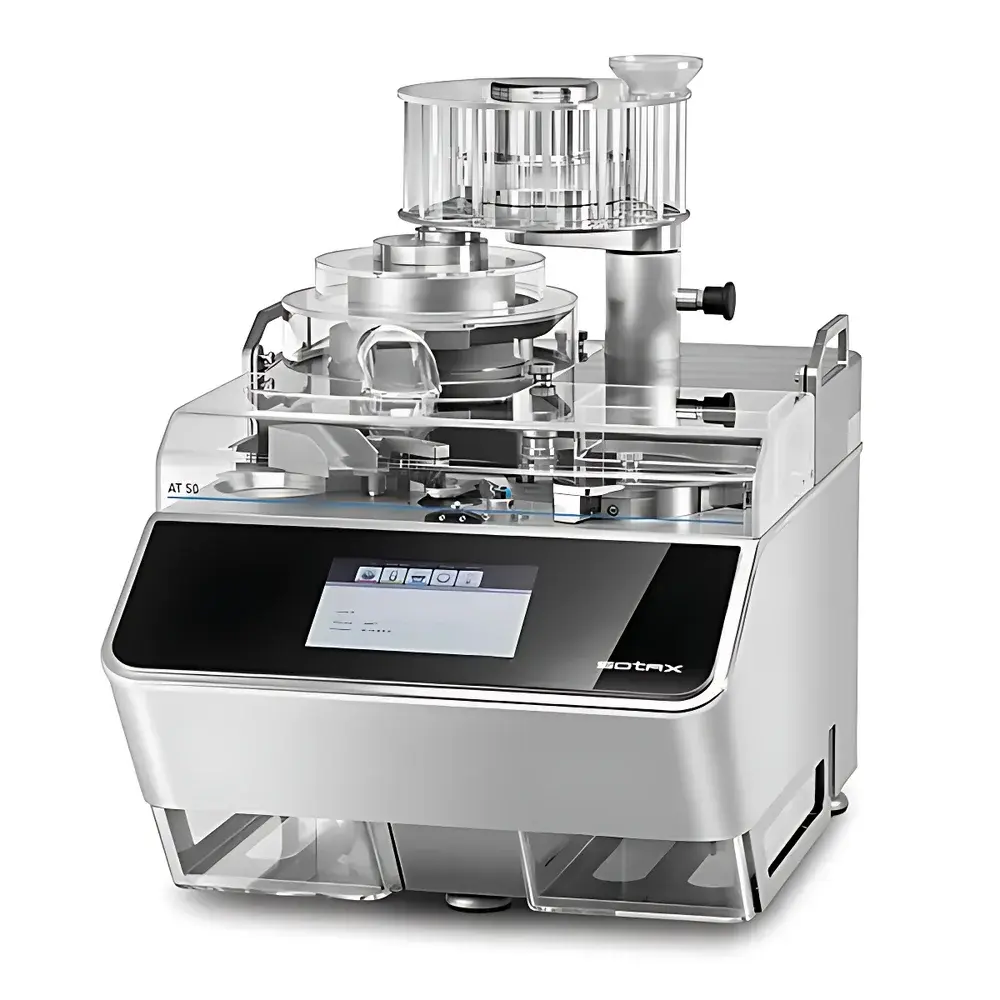
SOTAX AT50 Automated Tablet Tester
| Brand | SOTAX |
|---|---|
| Origin | Switzerland |
| Model | AT50 |
| Instrument Type | Oscillating Hardness Tester |
| Compliance | FDA 21 CFR Part 11 Ready |
| Sample Throughput | Up to 10 distinct products per run |
| Measurement Parameters | Weight, Thickness, Width/Diameter/Length, Hardness |
| Alignment Technology | AutoAlign™ and SmartAlign™ |
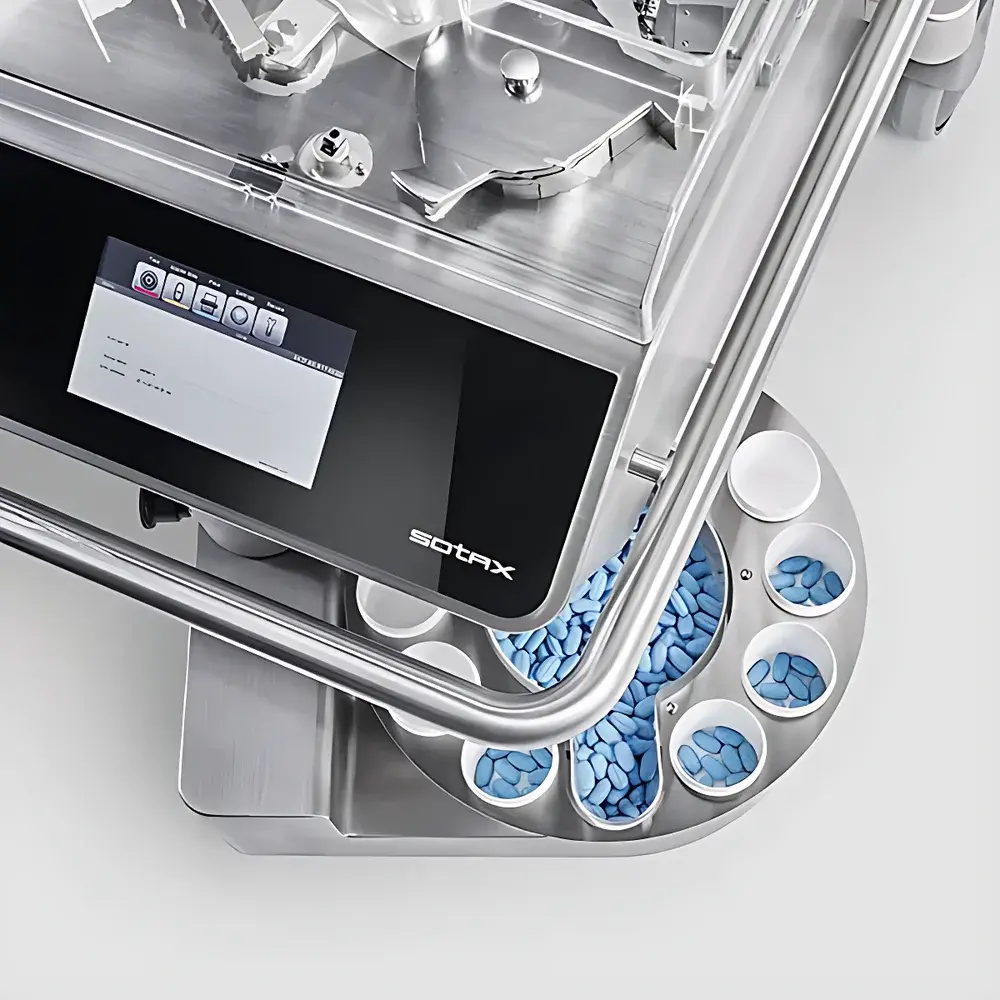
| Feeding System | Multi-compartment magazine feeder (10 slots) |
| Weighing Platform | Vibration-damped, auto-centering |
| Rejection Mechanism | Real-time fragment & doublet detection |
| Software Integration | q-doc® LIMS-ready data management |
Overview
The SOTAX AT50 Automated Tablet Tester is an integrated physical property testing platform engineered for high-throughput, regulatory-compliant quality control of solid oral dosage forms in pharmaceutical development, manufacturing, and QC laboratories. Based on oscillating hardness measurement principles—aligned with USP and Ph. Eur. 2.9.8—it delivers synchronized, non-destructive assessment of five critical tablet attributes: weight, thickness, width (or diameter/length), hardness, and dimensional consistency. Unlike manual or semi-automated testers, the AT50 employs a closed-loop mechanical architecture that eliminates operator-dependent variability, ensuring high reproducibility across batches, shifts, and operators. Its design supports both standalone laboratory use and seamless integration with tablet presses via OPC UA or analog I/O interfaces, enabling real-time in-process control (IPC) and continuous process verification (CPV) strategies aligned with ICH Q5A and Q8(R2) guidance.
Key Features
- Oscillating Hardness Measurement: Complies with pharmacopoeial definitions for tablet hardness using controlled oscillatory force application—minimizing fracture risk while preserving mechanical integrity for downstream analysis.
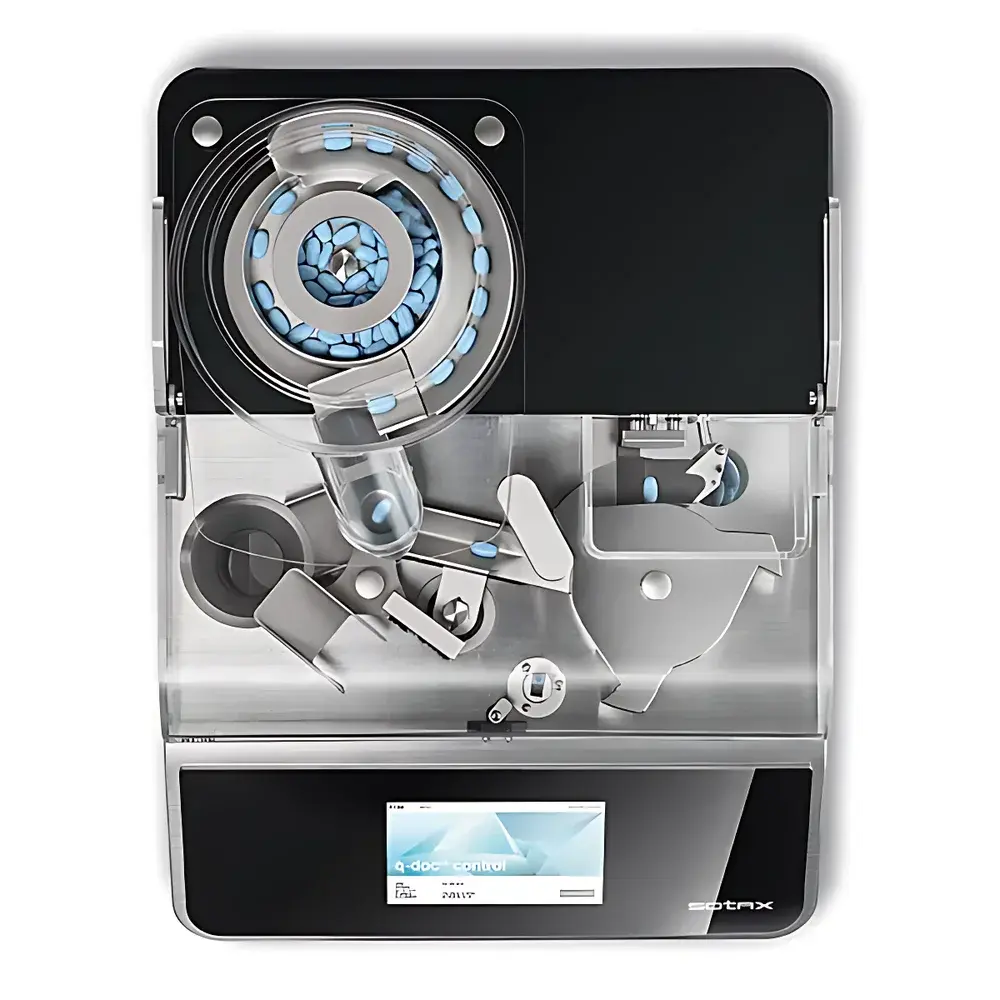
- AutoAlign™ and SmartAlign™ Dual Vision System: Combines high-resolution top-view imaging with dynamic orientation logic to identify and rotate tablets to their optimal measurement plane—ensuring consistent positioning for width/diameter, length, and hardness axes regardless of convexity, bevel, or irregular geometry (e.g., bi-layer, oval, or capsule-shaped tablets).
- Vibration-Damped Precision Weighing Platform: Integrates electromagnetic force compensation (EMFC) load cells with active anti-vibration isolation, delivering ±0.1 mg repeatability under ambient lab conditions without external bench stabilization.
- Multi-Product Magazine Feeder: 10-slot programmable carousel enables unattended batch switching; each slot stores pre-configured test protocols—including tolerance limits, pass/fail criteria, and statistical sampling rules—supporting Design of Experiments (DOE) workflows and multi-formulation stability studies.
- Real-Time Defect Rejection Logic: Simultaneous optical and force-signal analysis detects fragments, doublets, and edge-chipped units prior to hardness testing, preventing erroneous data generation and maintaining statistical validity of Cpk/Ppk calculations.
- Linear Orientation Conveyor: Ensures tablets arrive at the thickness sensor with convex surface upward—critical for accurate laser triangulation-based thickness measurement per USP .
Sample Compatibility & Compliance
The AT50 accommodates tablets ranging from 3 mm to 25 mm in diameter (or length), including round, oblong, oval, triangular, and custom-shaped dosage forms. It supports immediate transition between coated and uncoated tablets, film-coated, sugar-coated, enteric-coated, and effervescent formulations without recalibration. All hardware and firmware comply with ISO 9001:2015, ISO 13485:2016, and EU Annex 11 requirements for computerized systems. Data acquisition, audit trail, electronic signatures, and role-based access control are fully enabled per FDA 21 CFR Part 11 and EU GMP Annex 11—validated through IQ/OQ/PQ documentation packages available upon request.
Software & Data Management
The AT50 operates natively with SOTAX q-doc®—a 21 CFR Part 11-compliant data management suite supporting ALCOA+ principles (Attributable, Legible, Contemporaneous, Original, Accurate, Complete, Consistent, Enduring, Available). q-doc® provides automated report generation (PDF/CSV/XML), configurable dashboards with SPC charts (X̄-R, Cpk), deviation tracking, and seamless integration with enterprise LIMS, MES, and ERP systems via RESTful API or ODBC. All raw sensor data—including force-time curves, image metadata, and alignment coordinates—are archived with immutable timestamps and user attribution, satisfying GLP and GMP audit readiness requirements.
Applications
- Pre-formulation screening and excipient compatibility studies
- Compression parameter optimization during tech transfer
- Batch release testing per pharmacopoeial monographs (USP, EP, JP)
- In-process monitoring during scale-up and commercial manufacturing
- Stability program tablet characterization (0-, 3-, 6-, 12-month timepoints)
- Root cause analysis of capping, lamination, or chipping failures
- Support for Quality-by-Design (QbD) initiatives and control strategy development
FAQ
Does the AT50 require calibration certificates traceable to NIST or PTB standards?
Yes—factory calibration includes full traceability to national metrology institutes, with optional annual recalibration services and certificate renewal.
Can the AT50 export raw data for third-party statistical analysis (e.g., JMP, Minitab)?
Yes—q-doc® supports direct export of structured CSV files containing all measured parameters, timestamps, instrument IDs, and operator metadata.
Is the AutoAlign™ system validated for irregularly shaped extended-release tablets?
Yes—validation reports include performance data for >15 non-standard geometries, including toroidal, biconvex asymmetric, and scored bi-layer tablets.
What is the mean time between failures (MTBF) for the magazine feeder mechanism?
Based on field data from >200 installed units, MTBF exceeds 12,000 operating hours under standard 2-shift usage.
How does the AT50 handle tablets with high friability or surface coatings prone to abrasion?
The contact-free thickness sensor and low-acceleration handling path minimize mechanical stress; hardness probes feature interchangeable polymer-tipped anvils to prevent coating damage.



