
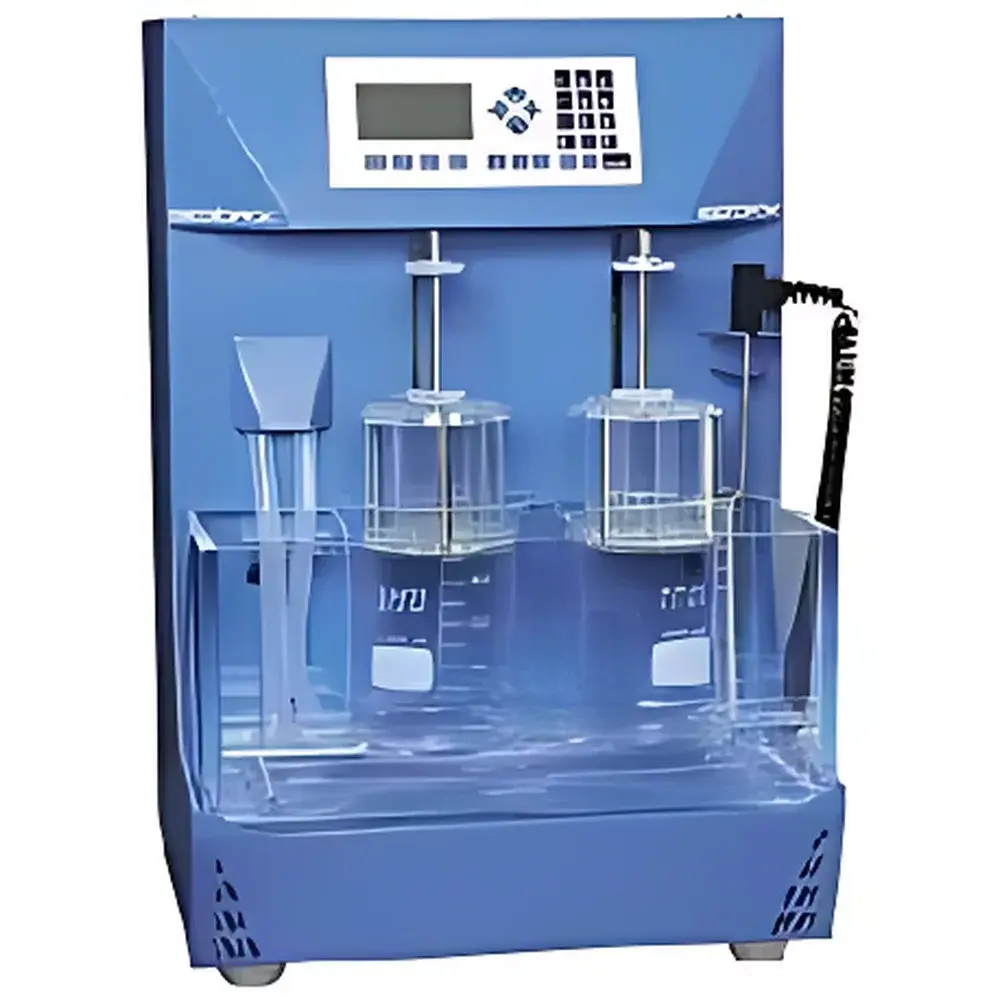
SOTAX DT2 Disintegration Tester
| Brand | SOTAX |
|---|---|
| Origin | Switzerland |
| Model | DT2 |
| Number of Disintegration Baskets | 2 |
| Bath Volume | 5.5 L |
| Temperature Range | 20–60 °C |
| Stroke Frequency | 30 ± 1 cycles/min |
| Detection Principle | Conductivity-based tablet contact sensing with USP-compliant stainless steel mesh |
Overview
The SOTAX DT2 Disintegration Tester is a precision-engineered, benchtop instrument designed to perform automated disintegration testing of solid oral dosage forms in full compliance with pharmacopoeial standards—including United States Pharmacopeia (USP) <701>, European Pharmacopoeia (Ph. Eur.) 2.9.1, and Japanese Pharmacopoeia (JP) 6.07. Unlike manual visual observation methods—prone to subjectivity, inter-operator variability, and limitations in turbid or highly viscous media—the DT2 implements a robust conductivity-based endpoint detection system. When a disintegrating tablet or capsule makes physical contact with the standardized stainless steel mesh (typically 10 mesh, 2.0 mm aperture per USP), an electrical circuit is completed, triggering precise termination of the test cycle. This objective, repeatable endpoint determination eliminates ambiguity associated with visual assessment, particularly for coated tablets, gelatin capsules, or formulations containing opacifying excipients.
Key Features
- Automated disintegration endpoint detection via conductive mesh contact sensing—fully eliminating reliance on subjective visual interpretation.
- Dual-basket configuration enables parallel testing of two samples under identical thermal and mechanical conditions, improving throughput and intra-batch comparability.
- Precisely controlled water bath with 5.5 L capacity ensures stable thermal uniformity across the entire test zone; temperature regulation accuracy is maintained within ±0.2 °C over the 20–60 °C operating range.
- Programmable stroke frequency of 30 ± 1 cycles per minute, compliant with USP <701> requirements for vertical basket movement amplitude (55–60 mm) and timing fidelity.
- Integrated LCD interface supports intuitive parameter setup, real-time monitoring of elapsed time and temperature, and immediate access to test status indicators.
- RS-232 serial port enables direct connection to external thermal printers for GLP-compliant hardcopy output of test records—including date/time stamp, setpoint values, and pass/fail outcome.
Sample Compatibility & Compliance
The DT2 accommodates standard USP-compliant disintegration baskets (18 mm diameter × 40 mm height) and accepts all conventional solid oral dosage forms: uncoated and film-coated tablets, hard and soft gelatin capsules, enteric-coated dosage units, and orodispersible tablets. Its design conforms to the mechanical and dimensional specifications defined in USP <701> and Ph. Eur. 2.9.1. The stainless steel mesh assembly is constructed from corrosion-resistant 316L stainless steel, ensuring long-term integrity in aqueous and mildly acidic/alkaline dissolution media. All wetted parts meet ISO 8573-1 Class 3 purity requirements for compressed air compatibility, supporting integration into regulated GMP environments where auditability and material traceability are mandatory.
Software & Data Management
While the DT2 operates as a standalone instrument without proprietary PC software, its embedded firmware supports full 21 CFR Part 11–ready data handling when interfaced with validated laboratory information management systems (LIMS) or electronic lab notebooks (ELN). The RS-232 output transmits ASCII-formatted test logs containing operator ID (if entered), start/stop timestamps, actual bath temperature (±0.1 °C resolution), cycle count, and final pass/fail determination. Audit trail functionality—including user login events and parameter modification history—is retained in non-volatile memory for ≥1,000 test cycles. Optional SOTAX-certified printer drivers ensure alignment with ALCOA+ principles (Attributable, Legible, Contemporaneous, Original, Accurate, Complete, Consistent, Enduring, Available).
Applications
- Quality control release testing of commercial tablet and capsule batches against pharmacopoeial disintegration limits.
- Formulation development support—comparative evaluation of binder type, compression force, and coating polymer impact on disintegration kinetics.
- Stability program monitoring—tracking disintegration performance changes across accelerated and long-term storage conditions.
- Regulatory submission support—generating objective, instrument-generated data for ANDA, NDA, and MAA dossiers requiring ICH Q5C and Q5D alignment.
- Supplier qualification—verifying consistency of excipient functionality (e.g., superdisintegrants such as croscarmellose sodium or sodium starch glycolate) across multiple lots.
FAQ
Does the DT2 comply with USP <701> and Ph. Eur. 2.9.1 mechanical requirements?
Yes—the basket dimensions, mesh aperture, stroke frequency, amplitude, and temperature control tolerances are fully aligned with both monographs.
Can the DT2 be integrated into a networked QC laboratory environment?
Yes—via RS-232, it supports integration with LIMS, ELN, or SCADA systems using standard Modbus RTU or ASCII protocols.
Is calibration verification supported by documented procedures?
SOTAX provides a Factory Calibration Certificate (FCC) traceable to METAS (Swiss Federal Institute of Metrology) and a User Verification Protocol (UVP) for routine operational qualification.
What maintenance is required for long-term reliability?
Annual verification of temperature sensor accuracy and mechanical stroke repeatability is recommended; no consumables beyond standard USP mesh replacements are required.
How does conductivity-based detection compare to optical or weight-loss methods?
Conductivity detection offers superior robustness in opaque media and avoids interference from residual gelatin or insoluble coatings that compromise optical transmission or gravimetric accuracy.






