
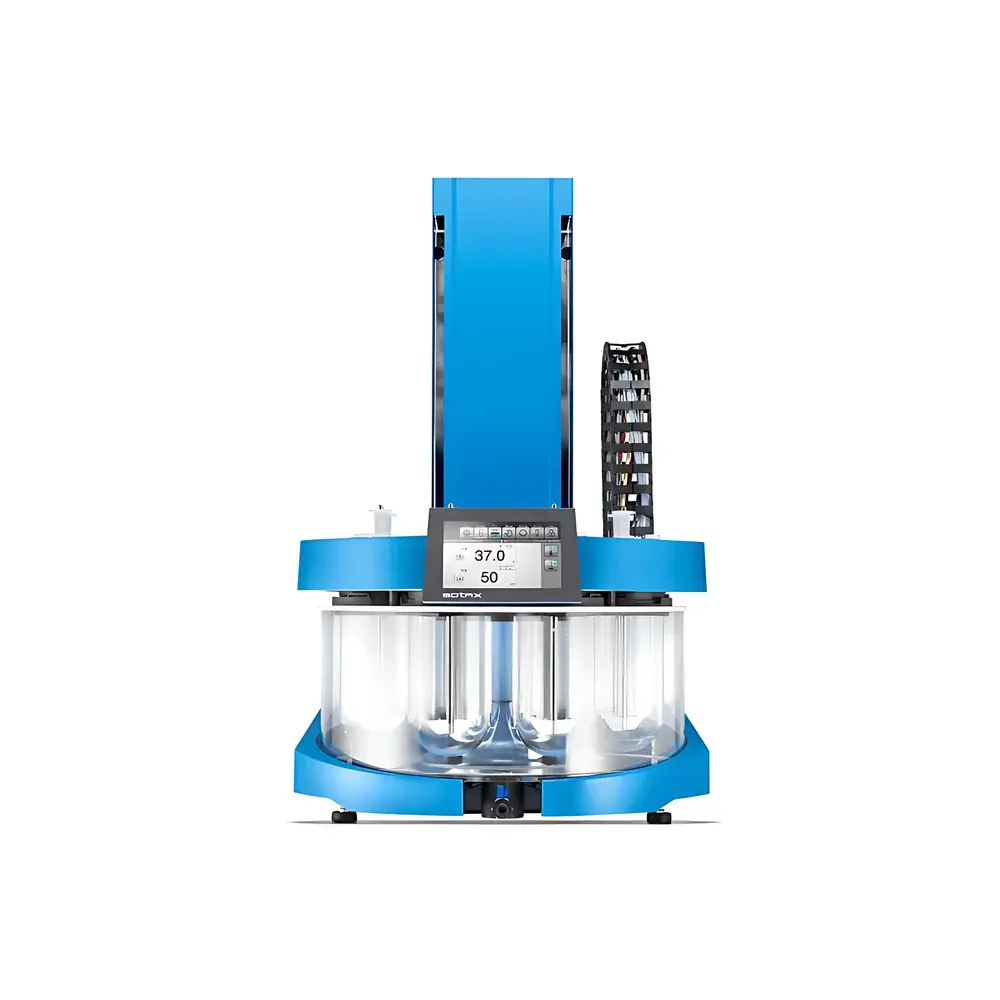
SOTAX AT Xtend Automated Dissolution Testing System
| Brand | SOTAX |
|---|---|
| Origin | Switzerland |
| Model | AT Xtend |
| Instrument Type | Online Dissolution Tester |
| Number of Vessels | 6–8 |
| Temperature Range | 30–40 °C |
| Rotational Speed Accuracy | ±1 rpm |
| Regulatory Compliance | 21 CFR Part 11–compliant software control |
| Applicable USP Methods | USP <711> (Apparatus 1, 2, 5, 6) |
Overview
The SOTAX AT Xtend Automated Dissolution Testing System is a fully integrated, modular platform engineered for precision, regulatory compliance, and long-term adaptability in pharmaceutical dissolution testing. Built upon the proven architecture of the SOTAX AT 7smart, the AT Xtend implements Couette-flow hydrodynamics and temperature-controlled fluid dynamics principles to deliver high reproducibility across USP Apparatus 1 (basket), Apparatus 2 (paddle), Apparatus 5 (reciprocating cylinder), and Apparatus 6 (rotating cylinder) configurations. Its core function is to automate the complete dissolution workflow—from dissolution medium preparation and degassing to vessel loading, sampling, filtration, analysis integration, and data reporting—without operator intervention during runtime. Designed for QC laboratories, formulation development units, and regulatory submission support teams, the system operates within a tightly controlled thermal environment (30–40 °C, ±0.2 °C stability) and maintains rotational speed accuracy of ±1 rpm across all vessels, ensuring adherence to ICH Q5A and USP performance verification requirements.
Key Features
- Modular, future-proof architecture enabling seamless expansion from 6- to 8-vessel configurations without hardware replacement or software revalidation.
- Auto-centering vessel positioning system with motorized vertical water bath closure—available in manual or electromechanical actuation—ensuring repeatable immersion depth and minimal mechanical drift.
- Integrated quick-lock mechanism for rapid tooling changeover between USP 1 and USP 2 assemblies, including sinker basket compatibility for modified-release dosage forms.
- Pre-aligned paddle and basket shafts eliminate manual centering adjustments; each vessel features independent calibration traceability per ASTM E2503 and USP mechanical verification protocols.
- Robust stainless-steel water bath with optimized flow distribution and low-turbulence heating elements to minimize thermal gradients (<±0.15 °C across all vessels).
- Real-time monitoring interface with vessel-level status indicators (temperature, rotation, sampling position, medium level) supporting OOS root-cause investigation and visual R&D observation.
Sample Compatibility & Compliance
The AT Xtend accommodates standard USP-compliant dissolution vessels (1000 mL, 900 mL, and 250 mL), as well as non-standard geometries used in early-stage formulation screening. It supports solid oral dosage forms—including immediate-release tablets, extended-release capsules, transdermal patches, and buccal films—under both sink and non-sink conditions. All operational parameters are governed by WinSOTAXplus software, which is fully compliant with FDA 21 CFR Part 11 (electronic signatures, audit trail, role-based access control, and data integrity safeguards). The system meets GLP and GMP documentation standards, with full traceability of method versions, instrument calibration logs, user actions, and raw dissolution profiles. Validation documentation aligns with ASTM E2503, USP , and ISO/IEC 17025 requirements for testing and calibration laboratories.
Software & Data Management
WinSOTAXplus serves as the validated control and data acquisition engine for the AT Xtend. It provides a secure, multi-user environment with configurable workflows, automated report generation (PDF, CSV, XML), and direct export to LIMS or chromatography data systems (CDS). Audit trails record every parameter change, sample event, and user login with timestamp, IP address, and action type—retained for ≥30 years per configurable retention policy. Electronic signatures comply with ALCOA+ principles (Attributable, Legible, Contemporaneous, Original, Accurate, Complete, Consistent, Enduring, Available). Method templates are version-controlled, and deviations trigger automatic alerting and electronic deviation handling workflows aligned with CAPA procedures.
Applications
- QC release testing of commercial batches against pharmacopoeial monographs (USP, EP, JP).
- Comparative dissolution profiling for generic product development and biowaiver justification per WHO and FDA guidance.
- Formulation optimization studies involving pH-dependent release, polymer erosion kinetics, and surfactant effects.
- Stability-indicating dissolution method development with integrated UV/Vis or HPLC coupling.
- OOS investigations requiring high-resolution temporal sampling and vessel-level diagnostic overlays (e.g., temperature vs. release rate correlation).
- Regulatory filing support with fully auditable, 21 CFR Part 11–compliant datasets for ANDA, NDA, and MAA submissions.
FAQ
Does the AT Xtend support USP Apparatus 5 and 6?
Yes—the system is preconfigured for reciprocating cylinder (USP 5) and rotating cylinder (USP 6) operation via interchangeable drive modules and vessel fixtures.
Can existing AT 7smart accessories be reused on the AT Xtend?
Most mechanical components—including baskets, paddles, and vessel holders—are cross-compatible; however, firmware and software updates are required to ensure full functional parity.
Is temperature calibration traceable to NIST standards?
Yes—each unit ships with a certificate of calibration referencing NIST-traceable RTD probes, and in-house recalibration follows ASTM E2503 Annex A3 procedures.
What sampling intervals are supported?
Programmable intervals from 15 seconds to 24 hours, with up to 100 timepoints per run and staggered sampling across vessels.
How is data integrity ensured during power failure or network interruption?
The system employs local redundant storage (RAID-1 SSD array) with automatic failover; all critical events—including sampling triggers and temperature excursions—are logged to non-volatile memory prior to transmission.





