
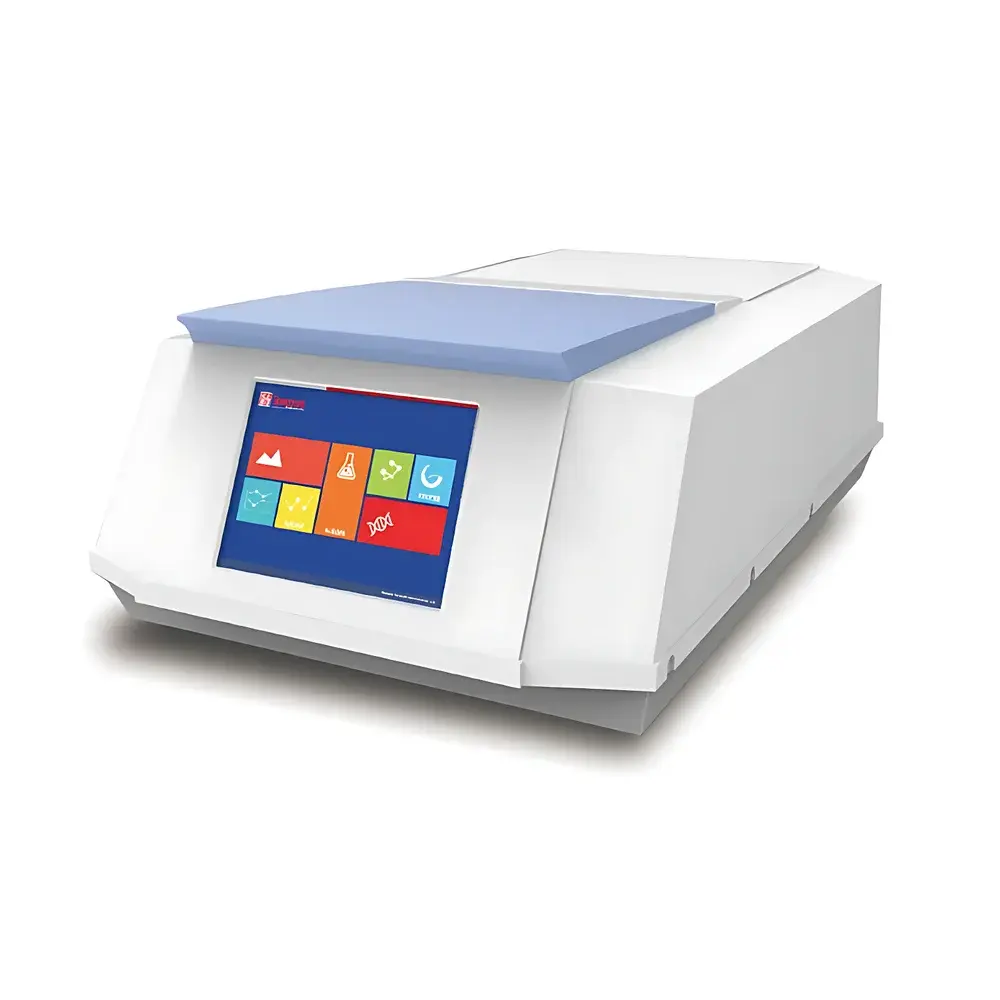
SP-1920 Dual-Beam Ultraviolet-Visible Spectrophotometer
| Brand | Shanghai Spectrum |
|---|---|
| Origin | Shanghai, China |
| Model | SP-1920 |
| Optical Design | Dual-beam, spatially separated, asymmetric vertical optical path |
| Detector Type | Digital dual high-performance photodiodes |
| Wavelength Range | 190–1100 nm |
| Spectral Bandwidth | 1.8 nm (typical) |
| Wavelength Accuracy | ±0.5 nm |
| Stray Light | ≤0.05% T at 220 nm (NaI) and 340 nm (NaNO₂) |
| Display | 8-inch color capacitive touchscreen |
| Light Sources | 6V/10W halogen lamp (2000 h lifetime), deuterium lamp (1000 h lifetime) |
| Sample Compartment | Fixed 100 mm pathlength cuvette holder |
| Power Supply | 110/220 VAC, 50/60 Hz, ±10% |
| Dimensions (W×D×H) | 655 × 420 × 265 mm |
| Compliance | Meets ISO 9001 manufacturing standards |
Overview
The SP-1920 Dual-Beam Ultraviolet-Visible Spectrophotometer is an engineered analytical instrument designed for high-stability quantitative and qualitative analysis across the ultraviolet (190 nm) to near-infrared (1100 nm) spectral range. It employs a patented spatially separated dual-beam optical architecture with an asymmetric vertical measurement path—distinct from conventional time-shared or beam-splitter-based dual-beam systems. This configuration enables true simultaneous reference and sample beam detection without mechanical chopper modulation, eliminating temporal drift and enhancing photometric reproducibility. The optical system integrates a high-efficiency 1800 grooves/mm holographic diffraction grating monochromator, precision-aligned collimating optics, and thermally stabilized dual photodiode detectors. Designed for routine laboratory environments—including QC labs, academic teaching facilities, and pharmaceutical R&D units—the SP-1920 delivers robust baseline stability (<0.001 A/h at 500 nm), low noise performance (≤0.0005 A RMS), and rapid wavelength scanning (up to 3000 nm/min) without sacrificing photometric accuracy.
Key Features
- Patented asymmetric vertical dual-beam optical path ensures real-time, simultaneous reference/sample measurement—eliminating mechanical chopper artifacts and improving long-term signal stability.
- High-lifetime light sources: imported 6V/10W tungsten-halogen lamp (rated for 2000 hours) and deuterium lamp (1000 hours), both pre-aligned and thermally decoupled to minimize thermal drift during operation.
- 8-inch full-color capacitive touchscreen interface with intuitive Windows-based software navigation—no external PC required for basic operation, method recall, or report generation.
- Digital dual photodiode detection system with on-board analog-to-digital conversion (16-bit resolution) and automatic gain control for optimal dynamic range (0–3.5 A) across absorbance and transmittance modes.
- Fixed 100 mm optical pathlength cuvette compartment accommodating standard 10 mm, 20 mm, 50 mm, and 100 mm square or rectangular cells—compatible with automated sample changers via optional RS-232 or USB control interface.
- Comprehensive self-diagnostic suite including lamp energy monitoring, wavelength calibration verification, and detector linearity validation—each logged with timestamp and operator ID for audit readiness.
Sample Compatibility & Compliance
The SP-1920 accommodates liquid samples in quartz, fused silica, or high-transmission UV-grade glass cuvettes (10–100 mm pathlength), as well as solid thin films mounted on transparent substrates using optional reflectance accessories. It supports standard volumetric dilution protocols, kinetic assays (time-scan mode), multi-wavelength quantitation, and fixed-wavelength endpoint measurements. Instrument design and firmware comply with ISO 9001-certified manufacturing practices. Data acquisition and reporting workflows support Good Laboratory Practice (GLP) requirements, including electronic signature capability, user access levels (admin/operator/auditor), and immutable audit trails compliant with FDA 21 CFR Part 11 when operated with validated software configurations. Measurement traceability aligns with ASTM E275 (Standard Practices for Description of Ultraviolet, Visible, and Near-Infrared Spectrophotometers) and USP General Chapter (Spectrophotometry and Light-Scattering).
Software & Data Management
The embedded Windows-based application provides native support for method creation, calibration curve fitting (linear, quadratic, cubic, and non-linear regression), limit checking, and export to CSV, PDF, or XML formats. All raw spectral data are stored with metadata—including date/time stamp, operator ID, instrument serial number, lamp usage hours, and calibration history. Optional network connectivity enables centralized data archiving via secure FTP or SMB protocol. Software modules include compliance-ready features: electronic signatures, role-based permissions, change control logs, and automatic backup to external storage media. Raw absorbance spectra are saved in vendor-neutral JCAMP-DX format for third-party spectral library integration or chemometric analysis.
Applications
The SP-1920 serves critical roles in pharmaceutical quality control (e.g., assay of active pharmaceutical ingredients per USP monographs), environmental water testing (nitrate, phosphate, COD determination), food and beverage analysis (colorimetric quantification of antioxidants, preservatives), polymer characterization (UV stability screening), and academic research (enzyme kinetics, ligand-binding studies, nanoparticle size estimation via surface plasmon resonance). Its stable dual-beam architecture makes it especially suitable for extended-duration kinetic experiments and high-throughput batch analysis where inter-sample consistency is essential.
FAQ
Does the SP-1920 support GLP-compliant data integrity?
Yes—when configured with validated software and appropriate user access controls, it meets core GLP and 21 CFR Part 11 requirements for audit trail, electronic signature, and data immutability.
Can the instrument perform kinetic measurements?
Yes—it offers time-scan mode with adjustable interval (0.01–600 s) and up to 10,000 data points per run, suitable for enzyme activity or reaction rate studies.
Is external PC connectivity required for operation?
No—the integrated touchscreen workstation enables full standalone operation; however, a PC is optional for advanced data export, remote diagnostics, or LIMS integration.
What cuvette pathlengths are supported?
Standard 10 mm cells are default; the 100 mm fixed-path compartment accepts 10, 20, 50, and 100 mm square or rectangular cuvettes without mechanical adjustment.
How often does the wavelength calibration require verification?
The built-in holmium oxide and didymium filters allow daily verification; full recalibration is recommended every 6 months or after lamp replacement.
Related Products





