
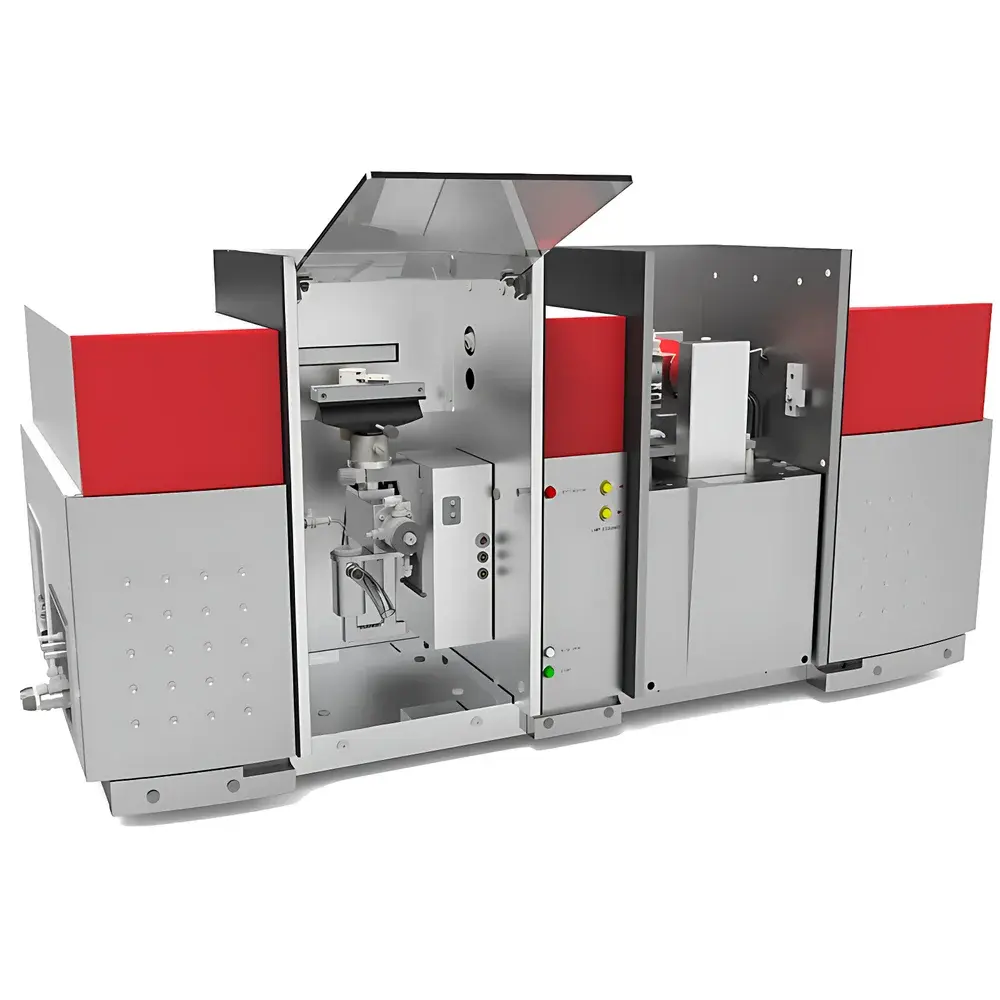
SP-3882AAS Zeeman Atomic Absorption Spectrometer (Flame-GF AAS) by Shanghai Spectrum
| [Brand | Shanghai Spectrum |
|---|---|
| Origin | Shanghai, China |
| Model | SP-3882AAS |
| Instrument Type | Flame and Graphite Furnace Atomic Absorption Spectrometer |
| Optical System | Dual-beam |
| Detector | Photomultiplier Tube (PMT) |
| Background Correction | Deuterium Lamp, Self-absorption, and Transverse Zeeman Effect |
| Atomizer Configuration | Integrated Flame-GF Platform (No Mechanical Switching Required) |
| Burner Head | Titanium Alloy |
| Nebulizer | High-efficiency Glass Nebulizer with Optional Ceramic Upgrade |
| Graphite Furnace | Longitudinally Heated with Transverse Magnetic Field |
| Lamp System | 8-position Automatic Lamp Carousel |
| Lamp Control | Gap-controlled Hollow Cathode Lamp Power Supply |
| Safety Features | Graphite Tube Purge Gas Flow Monitoring with Auto-alarm and Interlock] |
Overview
The SP-3882AAS Zeeman Atomic Absorption Spectrometer is a dual-mode, integrated flame-graphite furnace (GF) atomic absorption system engineered for trace metal quantification in complex matrices—particularly optimized for regulatory-grade analysis of lead (Pb) and cadmium (Cd) in food, environmental, and clinical samples. Operating on the principle of atomic absorption spectroscopy (AAS), the instrument measures ground-state atom absorption at element-specific wavelengths following thermal atomization in either an air-acetylene flame or a longitudinally heated graphite tube under transverse Zeeman magnetic field modulation. The Zeeman effect enables high-fidelity background correction without spectral interference from structured molecular bands or scattering, making it especially suitable for high-salt, high-acid, or particulate-laden samples common in food digestates and biological fluids. Unlike conventional AAS systems requiring manual mode switching, the SP-3882AAS features a mechanically fixed, coaxial optical path shared between flame and furnace atomizers—eliminating alignment drift and ensuring measurement continuity across analytical workflows.
Key Features
- Triple Background Correction Architecture: Simultaneous support for deuterium lamp, self-absorption (HCL-based), and transverse Zeeman background correction—enabling method-specific optimization for diverse sample types and matrix interferences.
- Integrated Flame-GF Platform: Single optical train accommodates both atomization modes without mechanical reconfiguration; eliminates recalibration downtime and maintains long-term photometric stability.
- Gap-Controlled Hollow Cathode Lamp (HCL) Drive: Dynamically adjusts discharge current and cathode gap to stabilize emission intensity and extend lamp lifetime by up to 10× versus conventional drivers—reducing consumable cost and improving signal reproducibility.
- Optical Noise Suppression System: Combines UV-enhanced optical coatings with active stray-light monitoring and real-time correction algorithms to improve baseline stability and expand linear dynamic range beyond 3 orders of magnitude.
- Longitudinal Graphite Furnace with Transverse Zeeman Field: Uniform axial heating profile minimizes analyte loss during pyrolysis; transverse magnetic field orientation ensures optimal Zeeman splitting geometry for high-resolution background discrimination.
- Automated 8-Lamp Carousel & Precision Positioning: Motorized turret supports rapid lamp exchange with sub-micron repeatability; lamp alignment maintained via optical feedback loop independent of ambient temperature fluctuations.
Sample Compatibility & Compliance
The SP-3882AAS is validated for direct analysis of acid-digested food homogenates (e.g., rice, infant formula, seafood), soil extracts (EPA Method 3050B/3051A), water samples (EPA 200.9), and whole blood/urine matrices following dilution or chelation pretreatment. Its triple background correction capability meets performance criteria outlined in ISO 11170, AOAC 999.10, and GB 5009.12–2023 (Chinese National Standard for Pb in Foods) and GB 5009.15–2014 (Cd in Foods). The system supports GLP-compliant operation through configurable audit trails, user access levels, electronic signature support, and data integrity safeguards aligned with FDA 21 CFR Part 11 requirements when paired with compliant LIMS or standalone acquisition software.
Software & Data Management
Control and data processing are executed via a Windows-based platform supporting ASTM E1382-compliant calibration protocols—including linear, quadratic, cubic, logarithmic, exponential, and spline curve fitting—as well as standard addition and internal standard quantitation. All raw absorbance/time profiles, furnace temperature ramp logs, and background-corrected signals are stored in vendor-neutral ASCII formats with embedded metadata (operator ID, timestamp, method name, instrument configuration). Software modules include automated QC flagging (e.g., drift detection, lamp energy thresholds), customizable reporting templates (PDF/Excel), and export compatibility with third-party statistical packages (R, JMP, Minitab). Audit trail functionality records all parameter changes, calibration events, and result modifications with immutable timestamps and operator attribution.
Applications
The SP-3882AAS delivers reliable quantification of Pb and Cd at sub-µg/L levels in routine testing environments where regulatory compliance and method robustness are paramount. Primary use cases include: screening of heavy metals in cereal-based infant foods per EU Commission Regulation (EU) No 1881/2006; validation of remediation efficacy in contaminated agricultural soils per China’s GB/T 22105.2–2008; occupational exposure assessment via blood Pb monitoring (CDC reference level ≤3.5 µg/dL); and quality control of dietary supplements for Cd contamination per USP . Its flame-GF versatility also supports broader elemental analysis of Cu, Zn, Mn, Fe, and Cr in nutritional and toxicological studies without hardware modification.
FAQ
Does the SP-3882AAS require physical reconfiguration to switch between flame and graphite furnace modes?
No—the system employs a fixed, coaxial optical path with dual atomizer positioning. Mode selection is fully software-controlled; no manual alignment or hardware adjustment is necessary.
Can the instrument comply with FDA 21 CFR Part 11 for electronic records and signatures?
Yes—when operated with enabled audit trail, role-based access control, and electronic signature modules, the system meets core technical requirements for regulated laboratory environments.
What is the expected lifetime of hollow cathode lamps under gap-controlled operation?
Typical operational life extends to ≥5,000 mAh cumulative discharge capacity—approximately 10× longer than standard constant-current operation—without significant spectral line broadening or intensity decay.
Is the graphite furnace compatible with platform-assisted stabilization and integrated continuum source background correction?
The furnace supports platform-assisted temperature programming and Zeeman-based background correction only; it does not incorporate continuum-source (e.g., xenon arc) background measurement.
How is safety ensured during graphite furnace operation?
Real-time monitoring of argon purge gas flow rate triggers audible/visual alarms and halts temperature ramping if flow falls below user-defined thresholds; interlocks prevent furnace power activation unless proper gas supply is confirmed.



