
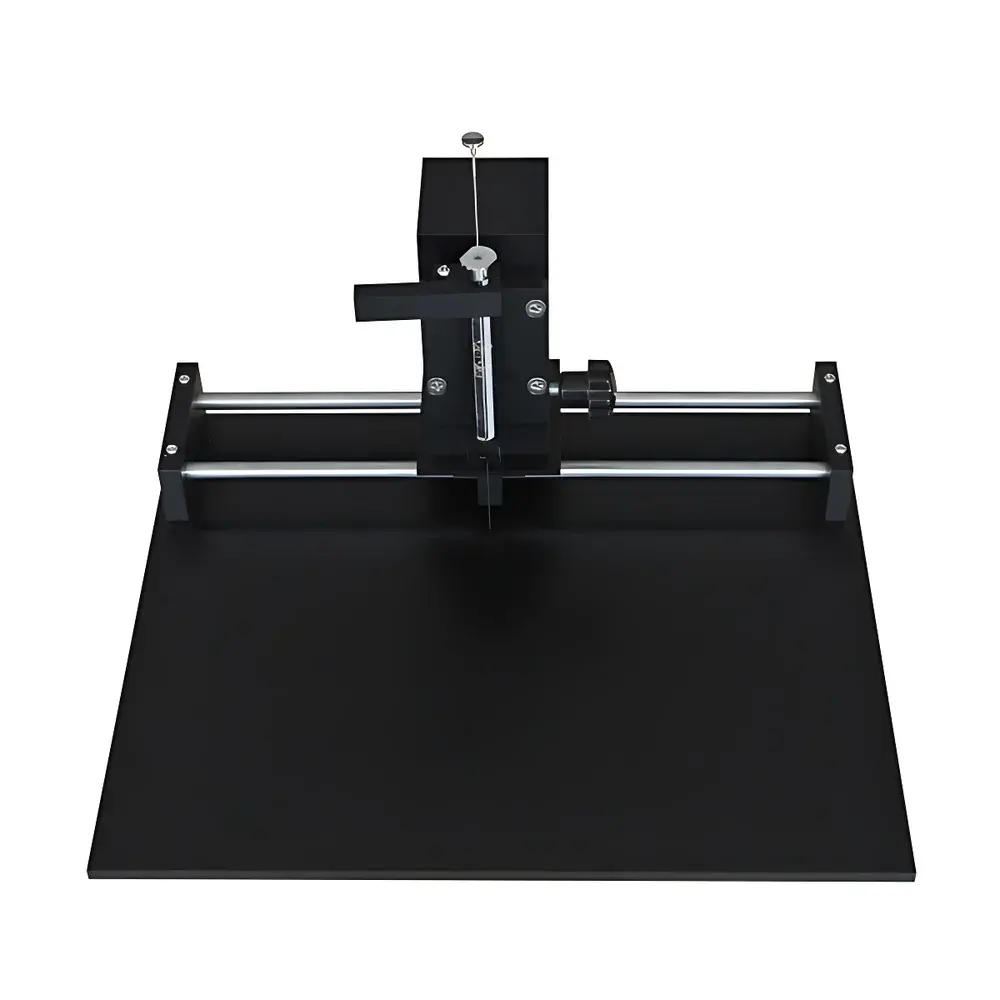
SP-I Manual Thin-Layer Chromatography (TLC) Sample Spotter
| Brand | KEZHE SHANGHAI |
|---|---|
| Origin | Shanghai, China |
| Manufacturer Type | Direct Manufacturer |
| Model | SP-I |
| Instrument Category | TLC Sample Spotter |
| Spotting Uniformity | < 0.2 mm |
| Maximum Plate Size | 200 mm × 200 mm |
| Spotting Mechanism | Capillary or Microsyringe-Based Manual Deposition |
| Plate Protection Feature | Non-penetrating Tip Design |
| Compliance | Designed for GLP-aligned manual sample preparation workflows |
Overview
The SP-I Manual Thin-Layer Chromatography (TLC) Sample Spotter is an engineered tool designed for precise, reproducible, and contamination-minimized sample application onto silica gel, aluminum oxide, or cellulose-coated TLC plates. Unlike automated spotters requiring complex calibration or software integration, the SP-I operates on a purely mechanical principle—leveraging calibrated vertical travel, fixed-height sample delivery, and tactile feedback to ensure consistent spot geometry across manual workflows. It is optimized for laboratories performing routine qualitative analysis, method development, or preparative TLC where cost-efficiency, operational simplicity, and plate integrity are primary considerations. The device does not incorporate optical detection, spectral measurement, or motorized motion; its function is strictly confined to physical sample deposition under user control—making it compliant with ISO 17025 clause 6.4.3 (equipment suitability) when used within defined procedural limits.
Key Features
- Mechanically stabilized spotting height: Fixed vertical clearance between tip and plate surface prevents accidental puncture of fragile stationary-phase layers—even on soft-backed or low-binder-content plates.
- Dual-mode applicator compatibility: Supports both capillary tubes (e.g., Drummond Microcaps® or equivalent) and standard 10–100 µL microsyringes (e.g., Hamilton Gastight®), enabling flexibility across solvent polarity and viscosity ranges.
- Uniform spot formation: Achieves ≤ 0.2 mm positional deviation across repeated deposits when operated with steady hand technique and aligned plate positioning—validated per internal protocol KEZHE-TLC-SP1-VER2.1.
- Universal plate support frame: Accommodates standard 200 mm × 200 mm TLC plates (including 100 mm × 100 mm and 200 mm × 100 mm variants) with adjustable lateral stops and non-slip rubberized base.
- Tool-free maintenance design: All contact surfaces are accessible without disassembly; stainless-steel guide rods resist corrosion from common organic solvents (e.g., chloroform, ethyl acetate, methanol).
Sample Compatibility & Compliance
The SP-I is compatible with all commercially available pre-coated TLC plates—including silica gel 60 F254, aluminum oxide, reversed-phase C18, and chiral stationary phases—regardless of backing material (glass, aluminum, or polyester). Its non-invasive spotting action preserves plate surface homogeneity, reducing edge effects and improving Rf reproducibility in subsequent development. While the instrument itself carries no electrical certification (e.g., CE or UL), its passive mechanical architecture eliminates electromagnetic interference concerns during concurrent UV visualization or densitometric scanning. For regulated environments, documented use of the SP-I falls under “manual sample handling equipment” per FDA 21 CFR Part 11 Annex A guidance, provided operator training records and spotting SOPs (e.g., SOP-TLC-SP1-001) are maintained as part of laboratory quality system documentation.
Software & Data Management
The SP-I requires no embedded firmware, drivers, or proprietary software. Spotting parameters—including applied volume, number of deposits per lane, and inter-spot spacing—are recorded manually in laboratory notebooks or integrated into LIMS via standardized template fields (e.g., “TLC_Spotting_Device_ID”, “Operator_Initals”, “Plate_Batch_No”). Traceability is ensured through alignment with ISO/IEC 17025:2017 clause 7.5.2 (control of records), where handwritten entries or scanned logs serve as auditable evidence of manual operation consistency. No electronic audit trail is generated by the device itself; however, its use is fully compatible with GLP-compliant data capture when paired with validated digital notebook systems (e.g., LabArchives or Benchling).
Applications
- Routine purity checks of synthetic intermediates and final APIs in pharmaceutical QC labs.
- Reaction monitoring in organic synthesis, especially for unstable or air-sensitive compounds unsuitable for autosampler exposure.
- Method scouting for HPTLC or preparative TLC, where rapid iteration of mobile phase composition demands flexible, low-footprint spotting tools.
- Educational settings—undergraduate chemistry labs—where students develop manual dexterity and fundamental chromatographic intuition prior to transitioning to automated platforms.
- Field-deployable screening in environmental or forensic labs using portable TLC development chambers and handheld UV lamps.
FAQ
Does the SP-I require calibration or periodic verification?
Yes—users must perform daily visual inspection of tip alignment and verify consistent spot diameter (via calibrated eyepiece micrometer or digital microscope) before critical analyses. A formal verification record is recommended every 30 operating days per internal QA policy.
Can the SP-I be used with volatile or corrosive solvents?
Yes, provided capillaries or syringes are chemically compatible; the SP-I’s structural components are inert to halogenated, polar aprotic, and protic solvents commonly used in TLC.
Is there a recommended maximum sample volume per spot?
For optimal resolution on 200 µm-thick silica layers, volumes should remain ≤ 2 µL per deposit; higher loads may cause tailing or streaking regardless of spotting precision.
Does KEZHE provide traceable certification for the SP-I?
No—the device is classified as Class I general-purpose lab equipment under Chinese NMPA guidelines and does not require metrological certification; however, dimensional conformity reports (e.g., plate size tolerance ±0.5 mm) are available upon request.
How is operator variability controlled when using the SP-I?
Through documented SOPs specifying finger pressure duration, vertical descent speed, and dwell time at contact point—training is validated via side-by-side comparison of Rf spread across three operators using identical reference standards.





