
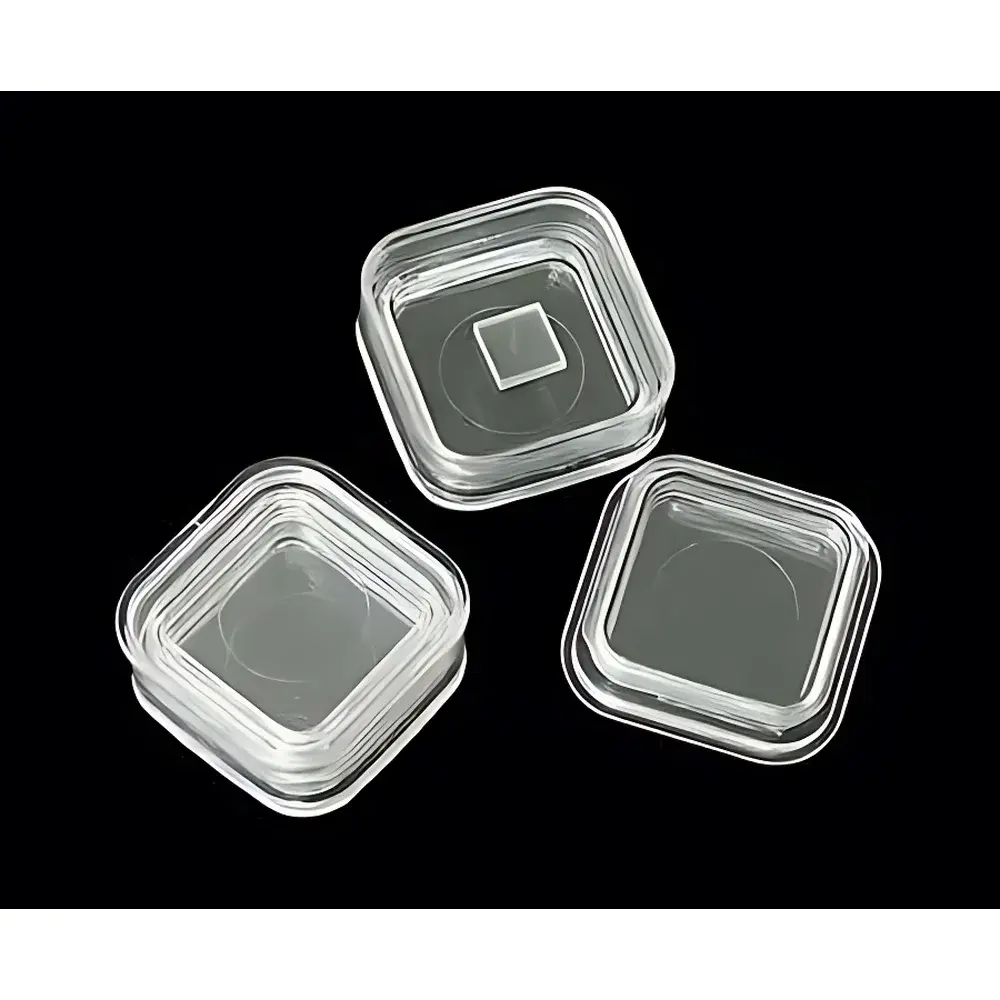
SP3-3818 Quartz Crystal Microbalance (QCM) Sensor Holder with Vibration-Damping Mount
| Brand | Hefei Kejing |
|---|---|
| Origin | Anhui, China |
| Manufacturer Type | Authorized Distributor |
| Origin Category | Domestic (China) |
| Model | SP3-3818 |
| Pricing | Upon Request |
Overview
The SP3-3818 Quartz Crystal Microbalance (QCM) Sensor Holder is an engineered mechanical interface designed specifically for high-precision QCM-based mass sensing systems. It functions as a passive, non-electronic mounting platform that secures AT-cut quartz crystal resonators—typically 5–10 MHz fundamental frequency devices—within vacuum-compatible or ambient-gas electrochemical cells, liquid-phase flow cells, or controlled-environment deposition chambers. Unlike active QCM electronics, the SP3-3818 does not perform signal generation or frequency measurement; rather, it ensures mechanical stability, minimizes parasitic energy dissipation, and preserves the intrinsic electromechanical coupling of the quartz crystal by isolating it from external vibrational noise and thermal drift. Its design adheres to standard QCM sensor footprint conventions used in commercial QCM-D (Quartz Crystal Microbalance with Dissipation monitoring) systems and electrochemical QCM (EQCM) configurations.
Key Features
- Vibration-damping elastomeric membrane structure engineered to attenuate mechanical resonance transmission across frequencies up to 10 kHz, critical for sub-nanogram mass resolution in dynamic environments.
- Optimized clamping geometry accommodating standard 14 mm or 25 mm diameter AT-cut quartz crystals with gold or platinum electrodes, while maintaining uniform pressure distribution over the active electrode area.
- Compact footprint (40 mm × 40 mm × 18 mm) and shallow profile enable integration into multi-sensor arrays, glovebox-integrated EQCM cells, and thin-film sputtering or ALD reaction chambers.
- Optically transparent membrane (28 mm × 28 mm clear aperture) facilitates real-time optical monitoring—including simultaneous ellipsometry, surface plasmon resonance (SPR), or fluorescence imaging—without requiring optical window modifications.
- Chemically inert construction using high-purity polyether ether ketone (PEEK) housing and silicone-free fluorosilicone membrane ensures compatibility with organic solvents, aqueous electrolytes, and corrosive vapors encountered in battery research, corrosion studies, and polymer film growth.
Sample Compatibility & Compliance
The SP3-3818 supports quartz crystals with standard BNC or SMB coaxial feedthroughs and is compatible with industry-standard QCM electronics platforms including Q-Sense Biolin, MaxiQCM, and custom-built lock-in amplifier systems. It accommodates both air-gap and liquid-cell configurations, with O-ring-sealed variants available for hermetic operation under nitrogen or argon purge. While the holder itself carries no regulatory certification, its materials and dimensional tolerances comply with ASTM E2917 (Standard Practice for Calibration of Resonant Frequency Devices) and ISO/IEC 17025-aligned laboratory practices for sensor mounting reproducibility. When integrated into GLP/GMP-compliant EQCM workflows—for instance, in pharmaceutical thin-film dissolution kinetics or battery SEI layer formation studies—the SP3-3818 contributes to measurement traceability by minimizing inter-run mechanical variability.
Software & Data Management
As a purely mechanical component, the SP3-3818 requires no firmware, drivers, or software integration. However, its consistent mounting performance directly enhances data integrity in time-series frequency (Δf) and dissipation (ΔD) measurements acquired via third-party QCM control software such as QTools (Biolin), QCM-IQ (Ivium), or LabVIEW-based custom acquisition modules. The holder’s low hysteresis and repeatable contact force support audit-ready experimental protocols where sensor swap reproducibility must meet FDA 21 CFR Part 11 requirements for electronic records—particularly when paired with timestamped, user-logged calibration reports and sensor history tracking.
Applications
- In-situ monitoring of solid-electrolyte interphase (SEI) evolution during Li-ion battery cycling in half-cell configurations.
- Real-time quantification of protein adsorption/desorption kinetics on functionalized gold electrodes under physiological buffer conditions.
- Gas-phase detection of volatile organic compounds (VOCs) using polymer-coated QCM sensors in environmental sensor arrays.
- Controlled thin-film deposition studies (e.g., polyelectrolyte multilayers, MOFs, or conductive polymers) with simultaneous QCM-D and electrochemical impedance spectroscopy (EIS).
- Corrosion inhibitor film formation analysis on steel or copper substrates in simulated cooling water matrices.
FAQ
Is the SP3-3818 compatible with 10 MHz QCM crystals?
Yes—its clamping mechanism and cavity depth are dimensionally optimized for standard 5 MHz and 10 MHz AT-cut quartz discs with 14 mm or 25 mm diameters.
Can it be used in liquid electrochemical cells?
Yes, provided appropriate sealing accessories (e.g., Viton O-rings and compression fittings) are employed; optional liquid-cell adapter kits are available separately.
Does it include electrical feedthroughs or wiring?
No—the SP3-3818 is a passive mechanical mount only; all electrical connections must be made externally via standard coaxial connectors or spring-loaded pins.
What is the maximum operating temperature?
The fluorosilicone membrane is rated for continuous use up to 120 °C; PEEK housing remains dimensionally stable up to 180 °C in inert atmospheres.
Is calibration required before use?
No calibration is needed for the holder itself, but users must verify baseline frequency stability and noise floor using a reference crystal prior to each experimental series per ISO 14644-1 cleanroom-grade practice.




