
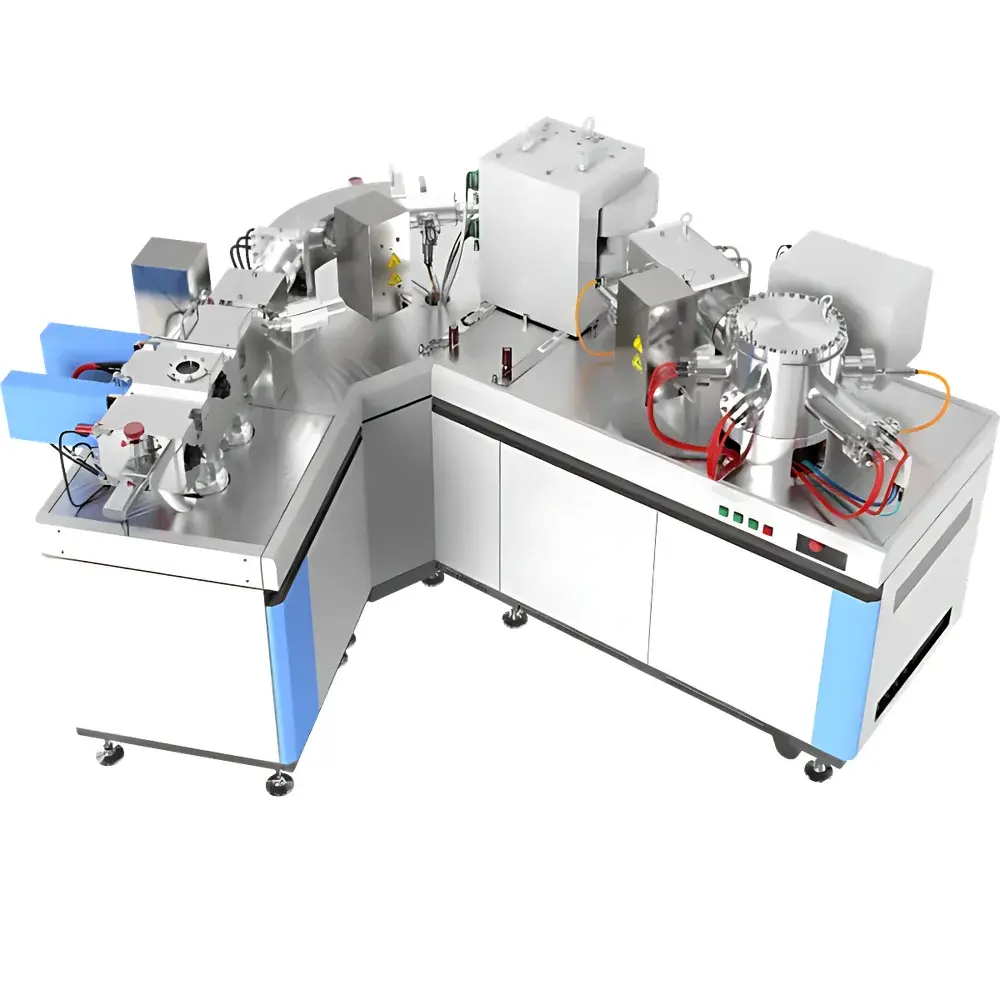
Sparkle Glow Discharge Mass Spectrometer (GDMS) by Kunyuan Instruments
| Brand | Kunyuan Instruments |
|---|---|
| Origin | Tianjin, China |
| Manufacturer Type | Authorized Distributor |
| Regional Origin | Domestic (China) |
| Model | Sparkle |
| Price Range | USD 810,000 – 910,000 (based on exchange rate of ¥1 = USD 0.14) |
Overview
The Sparkle Glow Discharge Mass Spectrometer (GDMS) is a high-performance solid-sample elemental and isotopic analysis system engineered for ultra-trace quantification in conductive and semi-conductive materials. Operating on the principle of radiofrequency (RF) or direct-current (DC) glow discharge ionization coupled with double-focusing magnetic sector mass spectrometry, the Sparkle GDMS enables direct solid sampling without dissolution or digestion—minimizing contamination risk and preserving spatial integrity. Its core architecture is optimized for high mass resolution, low background noise, and exceptional signal stability, making it suitable for certification of reference materials, impurity profiling in electronic-grade substrates, and isotopic ratio measurements in nuclear-grade components.
Key Features
- Ultra-low-temperature ion source: Cryogenically cooled to <−180 °C using ambient-pressure liquid nitrogen, suppressing residual gas interference and enabling stable sputtering of low-melting-point metals (e.g., Ga, In, Sn, Sb) without thermal degradation.
- Triple-resolution magnetic sector analyzer: Switchable mass resolution modes (R = 400, 4,000, and 10,000) with <1 s transition time; maintains near-constant ion transmission efficiency across resolution settings—enabling simultaneous high-sensitivity screening and high-accuracy isotope ratio determination.
- Hybrid detector system: Integrated Faraday cup and discrete-dynode electron multiplier delivering 12-decade linear dynamic range—from major matrix elements (100 wt%) down to sub-ppt level trace impurities.
- Rapid sample interchange: Tool-free, vacuum-integrated sample stage allows full sample replacement in ≤60 seconds; compatible with bulk metals, wafers, powders, wires, chips, and pressed pellets without pre-tuning.
- Low-consumption operation: Argon consumption as low as 0.3 mL/min during analysis; optional integration with inert-atmosphere gloveboxes for air-sensitive or radioactive samples.
- Sub-micron depth profiling capability: Combined with controlled sputter rate calibration, supports quantitative layer-by-layer analysis with depth resolution down to 0.5 nm per data point under optimized conditions.
Sample Compatibility & Compliance
The Sparkle GDMS accepts electrically conductive, semi-conductive, and insulating solids—including high-purity silicon wafers, sputtering targets (Al, Cu, Ta, Ti), rare-earth oxides, nuclear graphite, ceramic coatings, and battery cathode precursors (e.g., NMC, LFP). Sample preparation is minimal: flat polishing to ≤0.1 µm surface roughness is recommended for quantitative depth profiling. The instrument meets ISO/IEC 17025 technical requirements for testing laboratories and supports audit-ready data handling compliant with FDA 21 CFR Part 11 (electronic records/signatures), GLP, and GMP documentation workflows. All calibration protocols align with ASTM E2623–22 (Standard Guide for GDMS Analysis of Metals and Alloys) and ISO 11929:2019 (determination of detection limits).
Software & Data Management
The proprietary SparkleControl software suite provides end-to-end workflow automation—from vacuum pump-down sequence validation and plasma ignition diagnostics to real-time peak centroiding, isotope ratio calculation (with dead-time correction and abundance sensitivity compensation), and automated report generation in PDF/CSV/XLSX formats. It features built-in spectral deconvolution algorithms for polyatomic interference removal (e.g., 40Ar16O+ on 56Fe+), multi-point internal standard normalization, and semi-quantitative mode with relative sensitivity factors (RSFs) library covering 78 elements. Audit trails log all parameter changes, user actions, and instrument status events with time stamps and operator ID—fully traceable for regulatory submissions.
Applications
- Semiconductor manufacturing: Ultra-trace metal contamination mapping in Si, SiC, and GaN wafers; dopant uniformity verification; epitaxial layer purity assessment.
- Advanced electronics: Impurity speciation in PVD sputtering targets (Ti, Al, Ta, Ru); oxygen/nitrogen content in Al2O3 and AlN substrates.
- Energy materials: Transition metal leaching analysis in Li-ion cathodes; boron/phosphorus segregation in solar-grade silicon ingots.
- Aerospace & defense: Trace element distribution in Ni-based superalloys (e.g., Inconel 718); coating adhesion layer chemistry (e.g., CrN/TiN multilayers).
- Nuclear technology: Isotopic composition of U/Pu in fuel pellets; impurity screening in reactor-grade graphite moderators.
- Metallurgy & rare earths: Rare earth element (REE) purity certification (≥99.9999%); interstitial gas (O, N, C, H) quantification in Mg and Zr alloys.
FAQ
What types of gases are required for operation?
High-purity argon (≥99.9995% Ar, O₂ < 0.1 ppm, H₂O < 0.1 ppm) is mandatory for analytical mode; technical-grade argon (≥99.99%) may be used for rough pumping or conditioning. Compressed dry air (oil-free, dew point < −40 °C) is required for pneumatic actuators.
Is matrix-matched calibration necessary for quantitative analysis?
Matrix-matched standards are recommended for highest accuracy (<5% uncertainty), but the Sparkle GDMS supports robust semi-quantitative analysis using RSF libraries—even for uncharacterized matrices—with typical deviation <30% in absence of certified references.
Can the system perform isotopic ratio measurements?
Yes. With R = 10,000 mode and Faraday cup detection, the Sparkle GDMS achieves long-term precision of ≤0.05% RSD for isotope ratios (e.g., 208Pb/206Pb), meeting requirements for geochemical and nuclear forensic applications.
What are the facility requirements for installation?
A vibration-isolated concrete floor, ambient temperature control (18–24 °C ±0.5 °C), humidity 40–60% RH, dedicated 220 V AC / 50 Hz supply with grounding resistance <2 Ω, and external chiller (500 W cooling capacity) for turbo-molecular pumps and magnet cooling.
How is depth resolution achieved in profiling mode?
Depth resolution is governed by sputter yield consistency, ion beam energy stability, and crater geometry control. Under optimized RF-GD conditions (13.56 MHz, 30–100 W), sub-nanometer depth increments are attainable via real-time sputter rate calibration using SRM 2137 (Si wafer with implanted 15N).





