
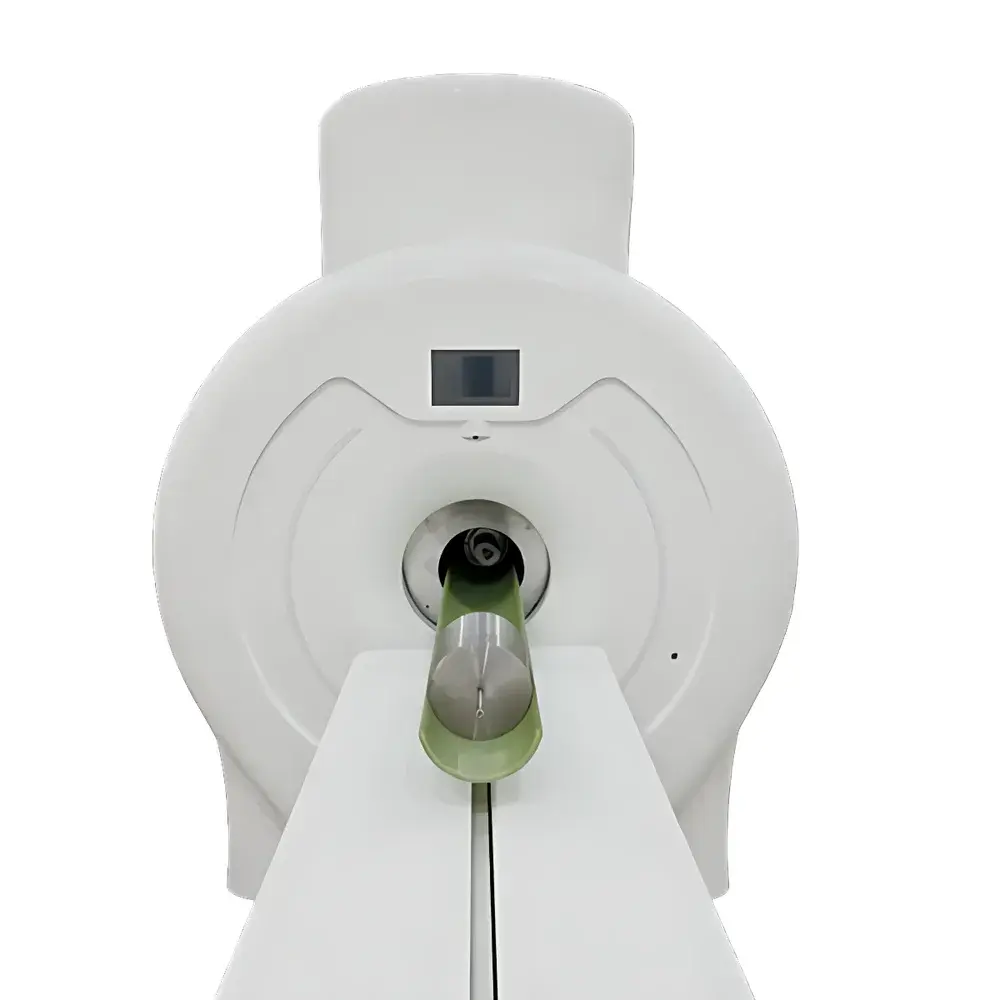
SPEC-3015V Superconducting High-Temperature High-Pressure NMR Imaging System
| Brand | SPEC (Beijing Spark) |
|---|---|
| Origin | Beijing, China |
| Model | SPEC-3015V |
| Instrument Type | Magnetic Resonance Imaging (MRI) System |
| Sample Compatibility | Solid–Liquid Dual-Phase Core Samples |
| Operating Mode | Pulsed Fourier Transform (PFT) |
| Magnet Bore Diameter | 300 mm |
| Field Strength Range | 0.05–1.5 T (Tunable) |
| Maximum Operating Temperature | 150 °C |
| Maximum Confining Pressure | 100 MPa |
| Supported Nuclei | ¹H, ²³Na, ¹⁹F, ¹³C |
| Cryogen Requirement | Cryogen-Free (Zero-Liquid-Helium) |
Overview
The SPEC-3015V Superconducting High-Temperature High-Pressure NMR Imaging System is a purpose-engineered platform for quantitative, non-invasive characterization of reservoir rock cores under geologically realistic subsurface conditions. Based on pulsed Fourier transform nuclear magnetic resonance (PFT-NMR) and spatially resolved MRI principles, the system enables direct measurement of fluid saturation, pore geometry, permeability proxies, and multi-phase flow dynamics within intact or partially saturated rock specimens. Its superconducting magnet operates without liquid helium consumption—leveraging cryocooler-based conduction cooling—and supports continuous field tuning across 0.05–1.5 T, allowing optimization of signal-to-noise ratio (SNR), spectral resolution, and relaxation contrast for diverse nuclei (¹H, ²³Na, ¹⁹F, ¹³C). The 300 mm horizontal bore accommodates standard and custom core plugs (up to 100 mm in length and 50 mm in diameter), while integrated high-temperature–high-pressure (HTHP) probe hardware maintains thermal and mechanical stability during dynamic displacement experiments up to 150 °C and 100 MPa confining pressure.
Key Features
- Cryogen-free superconducting magnet with active field stabilization and <0.01 ppm/h field drift over 24 h, ensuring long-term spectral reproducibility.
- Variable-field architecture enabling precise adjustment of Larmor frequency and relaxation weighting—critical for differentiating bound vs. mobile fluid phases and quantifying wettability effects.
- Multi-nuclear capability with broadband RF amplifiers and tunable probes, supporting simultaneous or sequential acquisition from ¹H (for water/oil distribution), ²³Na (for brine salinity mapping), and ¹³C (for hydrocarbon speciation).
- Integrated HTHP core holder with dual-piston confining pressure control, independent pore-fluid injection lines, and real-time temperature monitoring via calibrated Pt-100 sensors embedded in the sample chamber wall.
- Adaptive k-space sampling and compressed sensing reconstruction algorithms reduce imaging time by up to 40% without sacrificing spatial fidelity (typical in-plane resolution: 50–100 µm).
- Ruggedized RF shielding and gradient coil design compliant with IEC 61000-6-3 EMC standards, minimizing interference in shared laboratory environments.
Sample Compatibility & Compliance
The SPEC-3015V accepts cylindrical rock core samples (standard sizes: Ø25.4 mm × 50 mm, Ø38.1 mm × 76 mm, Ø50.8 mm × 100 mm) as well as artificial sandstone or carbonate analogs. It supports both static saturation experiments and dynamic drainage/imbibition protocols under controlled stress–strain conditions. All HTHP operational modes comply with ASTM D4542 (Standard Test Method for Determination of Rock Permeability Using Nuclear Magnetic Resonance) and ISO 17892-12 (Geotechnical investigation and testing — Laboratory testing of soil — Part 12: Determination of water content and density using NMR). Data acquisition workflows are structured to support GLP-compliant audit trails, including operator ID logging, parameter versioning, and raw FID storage in vendor-neutral NIfTI-1 format.
Software & Data Management
The system runs on SparkNMR v4.2—a Linux-based acquisition and processing suite developed in accordance with FDA 21 CFR Part 11 requirements for electronic records and signatures. Key modules include: (i) Pulse sequence editor with drag-and-drop pulse library (CPMG, IR-CPMG, SPRITE, RARE); (ii) Real-time relaxation spectrum inversion (NNLS and SVD-based); (iii) Multi-parametric co-registration of T₂, D (diffusion), and T₁ρ maps; (iv) Export to SEG-Y and HDF5 for integration with petrophysical modeling platforms (e.g., CMG, PETREL, TOUGH2). All processed datasets include embedded metadata compliant with the MIAME and MINSEQ standards for reproducible NMR experimentation.
Applications
- Quantification of pore-size distribution and capillary pressure curves in shale, tight sandstone, and carbonate reservoirs using T₂ cutoff calibration against mercury intrusion porosimetry (MIP).
- In-situ monitoring of CO₂–brine–oil three-phase displacement efficiency during EOR screening studies at reservoir-relevant P/T conditions.
- Assessment of clay-bound water (CBW) and movable fluid volume (MFV) under thermal stress to evaluate steam-assisted gravity drainage (SAGD) feasibility.
- Time-resolved imaging of fracture propagation and proppant embedment in hydraulic fracturing simulations using ¹H–¹⁹F dual-nucleus labeling.
- Validation of digital rock physics (DRP) models through direct comparison of simulated and experimentally derived effective permeability tensors.
FAQ
Does the SPEC-3015V require liquid nitrogen or liquid helium for operation?
No—it utilizes a closed-cycle cryocooler system to maintain the superconducting state of the magnet windings, eliminating routine cryogen refills and associated infrastructure.
Can the system be integrated with existing core-flooding apparatus?
Yes—the HTHP probe features standardized Swagelok and VCR ports compatible with most commercial core holders and fluid delivery systems (e.g., Hassler-type cells, triaxial rigs).
Is remote operation supported for unattended overnight experiments?
Yes—SparkNMR v4.2 includes SSH-enabled scheduler functionality, email alerts upon completion/failure, and encrypted cloud backup of raw data to on-premise NAS or validated AWS S3 buckets.
What level of technical support is provided for method development?
SPEC offers application engineering support—including pulse sequence customization, relaxation model fitting, and petrophysical interpretation training—under annual maintenance contracts aligned with ISO/IEC 17025 competency requirements.
Related Products





