
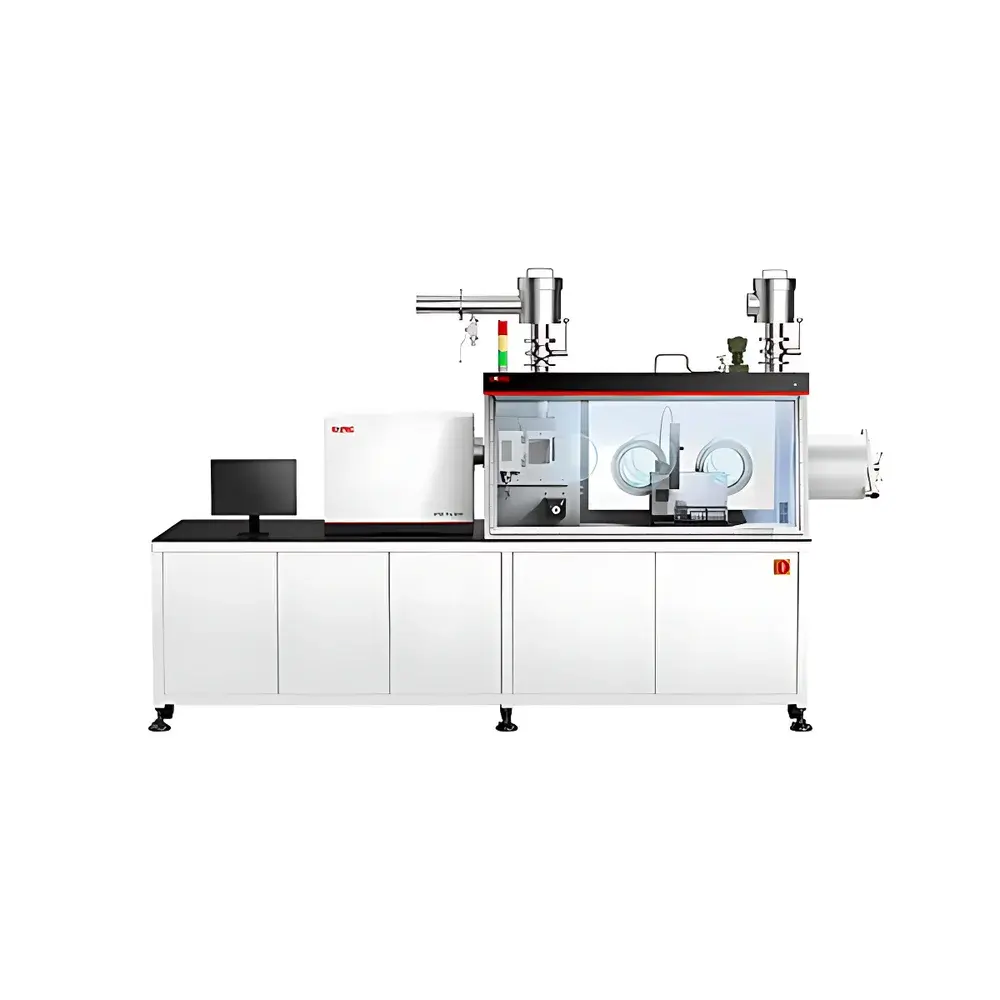
SPEC Pro 6000 Protective Inductively Coupled Plasma Optical Emission Spectrometer (ICP-OES) by EXPEC
| Brand | EXPEC |
|---|---|
| Origin | Zhejiang, China |
| Manufacturer Type | Direct Manufacturer |
| Product Category | Domestic |
| Model | SPEC Pro 6000 |
| Instrument Type | Full-Spectrum Simultaneous Readout |
| Safety Integration | Integrated Glovebox System |
| RF Generator Architecture | Separated Solid-State RF Source |
| Optical System | Echelle Grating with Thermally Stabilized Optics |
| Detector | Back-Illuminated High-Speed CCD with Anti-Blooming Design |
| RF Power Range | 700–1600 W (Continuously Adjustable) |
| RF Cooling | Water-Cooled |
| Power Stability | <0.1% |
| Gas Control | Multi-Channel Digital Mass Flow Controllers (Accuracy: ±0.01 L/min) |
| Nebulization System | 12-Rotor, 4-Channel Peristaltic Pump with Optional Internal Standard/Standard Addition Capability |
| Torch Design | Modular, Self-Aligning, Center-Tube-Replaceable Echelle Torch |
| Software Platform | Element V (Fully Localized Chinese Interface with GLP-Compliant Audit Trail) |
Overview
The SPEC Pro 6000 Protective Inductively Coupled Plasma Optical Emission Spectrometer (ICP-OES) is an engineered solution for elemental analysis of hazardous, radioactive, or biocontainment-sensitive samples. Unlike conventional ICP-OES systems, the SPEC Pro 6000 implements a rigorously validated split-system architecture: the plasma source, optical spectrometer, and RF generator remain outside a Class II/III compliant glovebox, while only sample introduction components—including nebulizer, spray chamber, torch, and associated tubing—are housed within the sealed inert-atmosphere workspace. This physical segregation ensures that high-energy plasma emissions, volatile analyte species, and potential aerosolized contaminants never compromise the core analytical hardware. The system operates on fundamental ICP-OES principles—sample aerosols are atomized and ionized in a ~6,000–10,000 K argon plasma; emitted photons from excited atomic/ionic species are dispersed via a thermally balanced echelle grating and detected simultaneously across the full UV–VIS spectral range (typically 165–900 nm) using a back-illuminated CCD. Its design meets stringent operational requirements for nuclear facilities, defense laboratories, and BSL-3/4 biosafety environments where personnel exposure minimization and cross-contamination control are non-negotiable.
Key Features
- Split-system glovebox integration: Plasma source and spectrometer remain external to containment, enabling standard maintenance access without breaching containment integrity.
- 8 mm tempered borosilicate viewing window with radiation-shielded polymer gloves (lead-equivalent or equivalent neutron-absorbing composite), certified for alpha/beta/gamma handling per IAEA SSG-46 and ANSI N13.3.
- Dual-chamber transfer lock system: Separate large and small airlocks isolate sample transfer from tool exchange, preventing pressure transients and maintaining internal atmosphere purity (O₂ < 1 ppm, H₂O < 0.1 ppm).
- Thermally stabilized echelle optical bench: Maintained at 36 °C ± 0.1 °C via active Peltier control to suppress thermal drift and ensure long-term wavelength calibration stability.
- Argon fluid dynamics-optimized purge path: Computational fluid dynamics (CFD)-guided gas routing reduces argon consumption by ~35% during UV-range operation and achieves <90 s purge-to-stable baseline.
- Full-digital, water-cooled solid-state RF generator: 700–1600 W continuous power adjustment with real-time impedance matching, internal overtemperature/power fault interlocks, and <0.1% RMS power fluctuation under load.
Sample Compatibility & Compliance
The SPEC Pro 6000 accommodates liquid, digested solid, and slurry samples introduced via concentric glass or quartz nebulizers, with optional micro-flow or desolvation accessories compatible with glovebox port geometry. It supports analysis of radionuclides (e.g., U, Pu, Am isotopes via elemental proxies), toxic metals (As, Cd, Hg, Tl), and biologically relevant trace elements (Fe, Zn, Cu, Se) under ISO 17025-accredited workflows. Hardware and software comply with key regulatory frameworks including IAEA Technical Reports Series No. 479 (Radiological Protection in Analytical Laboratories), ASTM D5683 (ICP-OES for Nuclear Materials), and EU Directive 2013/59/Euratom. All firmware and Element V software support audit trail logging per FDA 21 CFR Part 11 and GLP Annex 11 requirements, with role-based user permissions and electronic signature capability.
Software & Data Management
Element V is a fully localized Chinese-language platform built on a modular architecture supporting method development, sequence management, QC monitoring, and report generation. It includes pre-validated method templates for nuclear fuel cycle analysis (e.g., ASTM C1287), clinical toxicology (CLIA-compliant), and geological reference material certification (e.g., NIST SRM 2711a). Key capabilities include adaptive integration time allocation per emission line, multi-point internal standard correction (e.g., Y, Sc, In), matrix-matched standard addition, and spectral interference modeling using empirically derived correction coefficients. Raw spectral data are stored in vendor-neutral HDF5 format with embedded metadata (instrument parameters, gas flows, torch position, calibration history), ensuring FAIR (Findable, Accessible, Interoperable, Reusable) data stewardship.
Applications
- Nuclear industry: Quantitative assay of actinides and fission products in spent fuel reprocessing streams, uranium enrichment verification, and environmental swipe sample screening.
- Defense R&D: Trace metal profiling in propellants, explosives residues, and armor-grade alloys under radiological containment.
- Biosafety & medical research: Elemental mapping of radiolabeled pharmaceuticals, analysis of heavy metal accumulation in tissue biopsies under BSL-3 conditions.
- Geoscience: Analysis of oxygen-sensitive samples (e.g., reduced ore leachates, anaerobic sediment extracts) via vacuum/nitrogen-purged glovebox variants.
- Regulatory compliance labs: Accredited testing for RoHS, WEEE, and REACH restricted substances in electronics and polymers containing hazardous additives.
FAQ
Does the SPEC Pro 6000 require special facility infrastructure beyond standard ICP-OES installation?
Yes. It requires dedicated electrical supply (≥32 A, 208–240 VAC), chilled water loop (15–25 °C, ≥3 L/min flow), and compressed argon (≥99.998% purity, dew point ≤ –70 °C) with dual-stage pressure regulation. Glovebox inert gas supply must be independently monitored for O₂/H₂O content.
Can standard ICP-OES calibration standards be used inside the glovebox?
Yes—certified multi-element standards (e.g., Inorganic Ventures ICV, SPEX CertiPrep) are compatible. All calibration solutions must be transferred via validated airlock protocols and handled using glovebox-certified volumetric glassware.
Is remote operation supported for high-containment configurations?
Element V supports full remote desktop control via TLS-encrypted LAN/WAN connections, including real-time spectral visualization, method editing, and instrument status monitoring—without compromising audit trail integrity.
What maintenance intervals apply to the glovebox-integrated components?
Nebulizer and spray chamber cleaning is recommended after every 10–20 sample batches; torch center tube replacement frequency depends on matrix load (typically 50–200 hours); glove integrity testing per ISO 10648-2 is required quarterly.
How is wavelength calibration verified under containment?
A sealed, glovebox-compatible Hg/Ar hollow cathode lamp is mounted on the optical interface flange. Automated calibration routines execute without breaking glovebox integrity, referencing NIST-traceable emission lines at 194.227 nm, 253.652 nm, and 404.656 nm.
Related Products




