
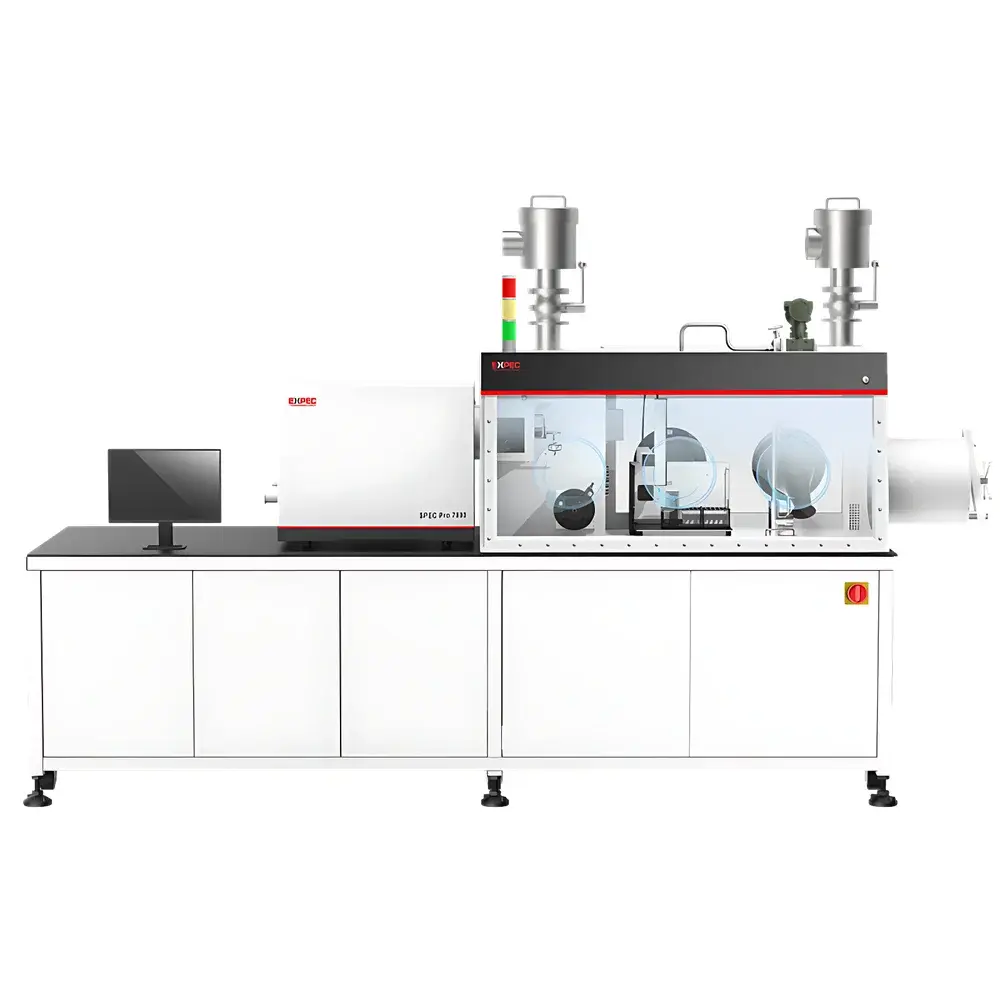
SPEC Pro 7000 Protective Inductively Coupled Plasma Mass Spectrometer (ICP-MS)
| Brand | EXPEC (Hangzhou Puyu Technology Co., Ltd.) |
|---|---|
| Origin | Zhejiang, China |
| Instrument Type | Quadrupole ICP-MS |
| Configuration | Integrated Glovebox-Coupled System |
| Application Environment | Laboratory-Based Elemental Analysis |
| Regulatory Compliance | Designed for GLP/GMP-aligned workflows, compatible with ISO/IEC 17025 method validation frameworks |
| Sample Handling | Fully enclosed, operator-isolated glovebox integration (vacuum/negative-pressure/ultra-clean operation) |
| Matrix Tolerance | Direct analysis of up to 10% total dissolved solids (TDS) |
| Detection Limit | Sub-ppt (ng/L) for key isotopes under optimized conditions |
| Ion Source | Self-excited all-solid-state RF generator with argon plasma stabilization |
| Interface Design | Aerodynamically optimized ion optics at plasma–vacuum boundary |
| Collision/Reaction Cell | Integrated dynamic reaction cell (DRC) with multi-gas capability (He, H₂, NH₃, O₂) |
| Automation Readiness | Compatible with EXPEC automated inorganic sample preparation platforms |
Overview
The SPEC Pro 7000 Protective Inductively Coupled Plasma Mass Spectrometer (ICP-MS) is an engineered solution for ultra-trace elemental analysis under stringent containment conditions. Unlike conventional benchtop ICP-MS systems, the SPEC Pro 7000 integrates a fully sealed, operator-isolated glovebox directly with the plasma source and mass spectrometer interface. This configuration ensures that all sample introduction components—including nebulizer, spray chamber, torch, and interface cones—reside entirely within a controlled environment capable of maintaining vacuum, negative pressure, or inert atmosphere (e.g., N₂ or Ar). The system operates on the fundamental principle of inductively coupled plasma ionization followed by quadrupole mass filtering, enabling simultaneous detection and quantification of isotopes across the periodic table (Li to U) at sub-part-per-trillion (sub-ppt) concentration levels. Its design addresses critical operational constraints encountered in nuclear materials characterization, radiological safety protocols, high-purity semiconductor chemistry, and anaerobic biological trace metal studies—where ambient contamination, operator exposure risk, or atmospheric interference must be eliminated at the hardware level.
Key Features
- Glovebox-integrated architecture: All sample-contact surfaces—including concentric nebulizer, Scott-type spray chamber, alumina torch, and Ni or Pt sampling/cone assemblies—are housed inside a Class 100 (ISO 5) clean glovebox with dual-layer sintered metal filters and real-time particulate monitoring.
- Aerodynamically optimized ion interface: Computational fluid dynamics (CFD)-informed design of the skimmer and sampler cones minimizes ion scattering at the atmospheric–vacuum transition zone, delivering 3–5× higher transmission efficiency compared to standard ICP-MS interfaces.
- Robust matrix tolerance: Achieved through a combination of off-axis ion beam path (two-stage deflection), pressurized collision/reaction cell with programmable gas selection, self-excited solid-state RF generator (27.12 MHz, 1.5 kW nominal), and integrated argon online dilution module for real-time sample stream modulation.
- Modular glovebox customization: Each unit supports application-specific glovebox configurations—such as ultra-high vacuum (<10⁻⁶ mbar), oxygen-free (<1 ppm O₂), or controlled-humidity environments—with independent pressure regulation, solvent vapor scrubbing, and HEPA/ULPA filtration.
- Interoperability with EXPEC automated sample preparation: Seamless data handshake with EXPEC’s line of robotic acid digestion, microwave-assisted extraction, and hydride generation systems enables end-to-end unattended workflow execution from solid sample to quantitative report.
Sample Compatibility & Compliance
The SPEC Pro 7000 accommodates liquid samples (aqueous, organic, HF-digested), laser-ablation aerosols (via optional LA-ICP-MS coupling), and gaseous standards (e.g., Kr, Xe, SF₆) introduced through the glovebox manifold. It supports direct analysis of high-salinity matrices—including seawater analogs, geological leachates, and nuclear fuel cycle solutions—without offline dilution. From a regulatory standpoint, the system is structured to support audit-ready documentation per ISO/IEC 17025:2017 clause 7.7 (result reporting), ASTM D5673 (trace element analysis in water), and USP / (elemental impurities in pharmaceuticals). Its closed-loop operation inherently satisfies ALARA (As Low As Reasonably Achievable) principles for radiological handling and aligns with IAEA Safety Standards Series No. SSG-46 for analytical laboratories managing radioactive materials.
Software & Data Management
Control and data acquisition are managed via EXPEC’s proprietary MassHunter-compatible platform (v4.2+), featuring instrument method templating, isotope ratio drift correction, internal standard normalization (e.g., ¹¹⁵In, ²⁰⁹Bi), and spectral interference modeling using polyatomic prediction algorithms. Raw data files adhere to ANDI/netCDF format for third-party reprocessing (e.g., in Iolite or Glitter). Audit trails record all parameter changes, calibration events, and user logins with time-stamped digital signatures—fully compliant with FDA 21 CFR Part 11 requirements when deployed with validated electronic signature modules. Data export supports LIMS integration via ASTM E1482-compliant XML schemas.
Applications
- Nuclear forensics and fuel cycle analysis: Quantitative determination of actinide isotopic ratios (²³⁵U/²³⁸U, ²⁴⁰Pu/²³⁹Pu) and fission product signatures (¹³⁷Cs, ⁹⁰Sr) in shielded glovebox environments.
- High-purity material certification: Trace-level contaminant screening (Fe, Ni, Cr, Cu) in 6N–9N semiconductor-grade silicon, quartz, and lithium compounds used in battery electrolytes.
- Bioinorganic research under anaerobic conditions: Metalloprotein metal stoichiometry (Fe, Mo, Ni, Co) without oxidative artifact formation during sample aspiration.
- Geochronology and cosmochemistry: U–Pb, Lu–Hf, and Re–Os isotope dilution analyses requiring ultra-low procedural blanks and inert-atmosphere dissolution.
- Medical radioisotope production QC: Real-time batch verification of ⁶⁸Ga, ⁸⁹Zr, and ¹⁷⁷Lu radionuclidic purity and metallic impurity profiles.
FAQ
Does the SPEC Pro 7000 require external vacuum pumps or gas supply infrastructure?
Yes—it requires a dedicated roughing pump (dual-stage oil-free scroll type), turbomolecular pump array (≥800 L/s total speed), and high-purity argon (99.999% min) with regulated delivery at 12–18 L/min. Optional gases (He, H₂, NH₃) require separate mass flow controllers.
Can the glovebox accommodate solid samples for direct laser ablation?
Yes—the glovebox includes a motorized XYZ stage mount compatible with commercial excimer or Nd:YAG LA systems (e.g., CETAC LSX-213, New Wave UP213), with optical feedthroughs and ablation cell exhaust routing to the ICP torch inlet.
Is remote diagnostics and software update supported?
Yes—EXPEC provides secure TLS 1.3-enabled remote access for firmware updates, spectral library patches, and diagnostic log retrieval, subject to customer-configured firewall policies and IT governance approval.
What is the typical installation footprint and facility requirement?
Minimum floor space: 3.2 m × 2.4 m (including glovebox, ICP-MS frame, and service corridor). Required utilities: 208–240 VAC, 60 A, 3-phase power; chilled water (15–20°C, 2.5 L/min); compressed dry air (7 bar, oil-free); and dedicated exhaust ducting (≥1200 m³/h, corrosion-resistant liner).
How does the system handle calibration stability over extended unattended runs?
The platform employs continuous internal standard monitoring (e.g., ¹¹⁵In spiked post-nebulization), real-time mass axis recalibration using ¹⁰³Rh and ²⁰³Tl reference peaks, and automatic cone cleaning cycles triggered by signal decay thresholds—enabling >24-hour autonomous operation with ≤2% RSD for certified reference materials (e.g., NIST SRM 1640a).





