Specialty Optical Filter
| Origin | USA |
|---|---|
| Manufacturer Type | Distributor |
| Origin Category | Imported |
| Model | Multiple Models Available |
| Pricing | Upon Request |
Overview
Specialty optical filters are precision thin-film interference components engineered to selectively transmit, reflect, or block specific wavelength bands with high spectral fidelity. Designed for demanding applications in laser systems, fluorescence microscopy, Raman spectroscopy, and optical sensing, these filters operate on the principle of constructive and destructive interference within multilayer dielectric coatings deposited on high-quality fused silica or BK7 substrates. Unlike broadband or neutral-density filters, specialty filters—including notch and edge types—exhibit steep transition slopes, deep blocking (high optical density), and minimal wavefront distortion, ensuring compatibility with diffraction-limited optical setups.
Key Features
- High-performance dielectric coating architecture optimized for angle-of-incidence stability (0°–10° typical specification)
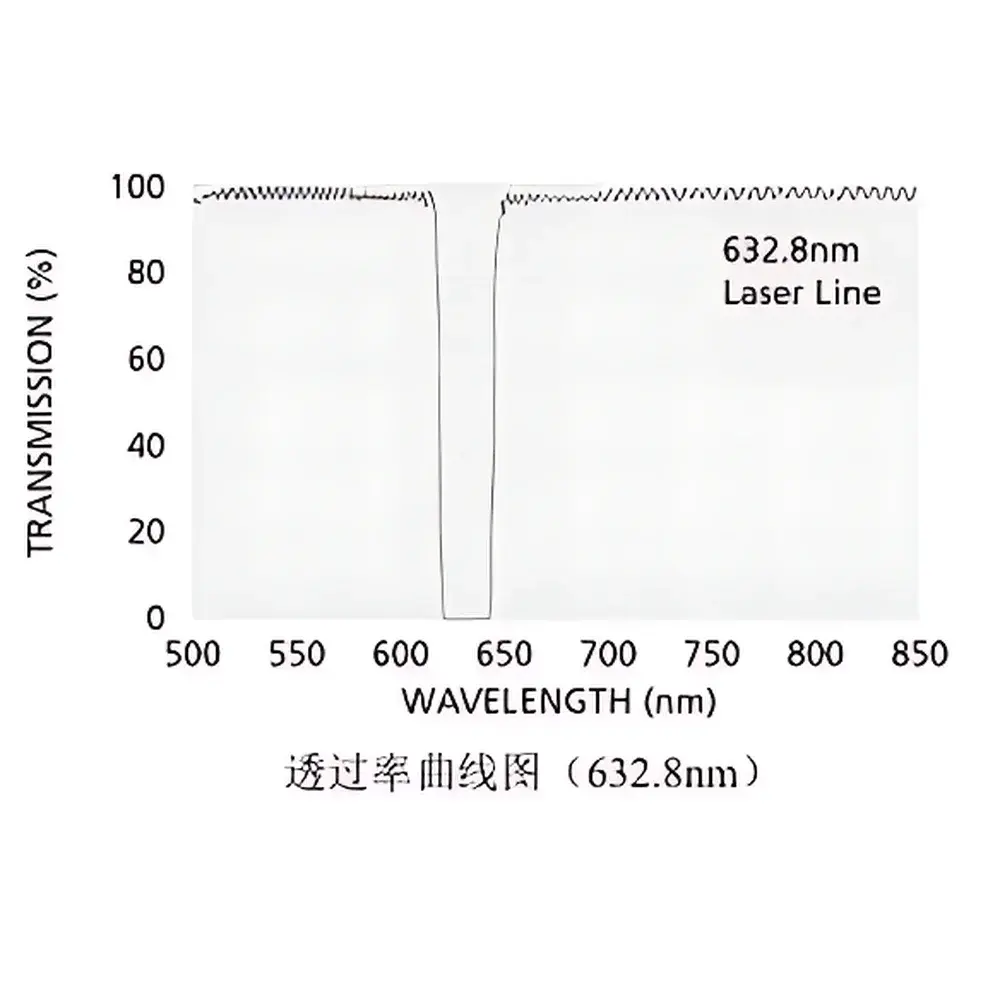
- Notch filters provide >OD6 attenuation at center wavelength (e.g., 532 nm) with <1.5 nm full-width-at-half-maximum (FWHM) bandwidth options
- Long-pass and short-pass edge filters feature sharp cut-on/cut-off transitions (<1% transmission change over ≤5 nm)
- Substrate materials include UV-grade fused silica (185–2100 nm) and IR-optimized CaF₂ or Ge for extended spectral coverage
- Surface quality rated at 10–5 scratch-dig per MIL-PRF-13830B; transmitted wavefront error <λ/4 @ 633 nm
- Custom coating designs support multi-band rejection (e.g., dual-notch for 532/1064 nm lasers) and polarization-insensitive performance
Sample Compatibility & Compliance
These filters are compatible with standard optomechanical mounts (e.g., SM1, C-mount, or custom flanges) and integrate seamlessly into OEM laser cavities, confocal microscope filter cubes, and spectrometer entrance optics. All filters comply with ISO 9022-3 for environmental durability (including humidity cycling and thermal shock testing). Coating adhesion meets MIL-C-48497A requirements. For regulated laboratory environments, documentation packages include batch-specific spectral transmittance/reflectance reports traceable to NIST-calibrated spectrophotometers. Filters intended for clinical or pharmaceutical instrumentation may be supplied with material declarations supporting ISO 10993 biocompatibility assessments where applicable.
Software & Data Management
While inherently passive components, each filter shipment includes a digital spectral data package in CSV and SDF (Spectral Data Format) compliant with ASTM E275-21 standards. These files contain measured transmission curves (200–1600 nm, 0.5 nm resolution), incident-angle-dependent performance maps, and coating layer stack specifications. Integration with optical design software (e.g., Zemax OpticStudio, CODE V, FRED) is supported via built-in import modules. For GxP-regulated workflows, optional IQ/OQ documentation kits include calibration verification protocols aligned with USP and FDA 21 CFR Part 11 requirements for electronic records and signatures.
Applications
- Laser safety and harmonic separation in DPSS and ultrafast laser systems
- Autofluorescence suppression and excitation/emission isolation in widefield and TIRF microscopy
- Background rejection in surface-enhanced Raman spectroscopy (SERS) and tip-enhanced Raman (TERS)
- Spectral calibration reference in hyperspectral imaging and remote sensing platforms
- Wavelength stabilization feedback loops in tunable external-cavity diode lasers (ECDLs)
- Interference mitigation in LiDAR receivers operating in NIR/SWIR atmospheric windows
FAQ
What is the typical damage threshold for these filters under CW and pulsed laser irradiation?
For standard fused silica substrates with high-LIDT coatings, CW thresholds exceed 5 kW/cm² at 532 nm (10.6 mm beam diameter, TEM₀₀); for nanosecond pulses (10 ns, 10 Hz), thresholds range from 5–10 J/cm² depending on coating design and incidence angle.
Can custom center wavelengths or edge slopes be manufactured?
Yes—custom designs are available for center wavelengths from 248 nm (excimer) to 10.6 µm (CO₂), with edge slopes as steep as 0.1% transmission change per 0.2 nm near cutoff regions.
Do you provide mounting solutions or optical alignment fixtures?
Standard unmounted filters (diameter: 12.7 mm, 25.4 mm, 50.8 mm) are supplied; kinematic mounts, cage-compatible holders, and motorized filter wheels are available through partner integration partners.
Are these filters suitable for vacuum or UHV environments?
Yes—low-outgassing variants with ion-beam-sputtered coatings meet ASTM E595 total mass loss (TML) <0.5% and collected volatile condensable materials (CVCM) <0.05%, certified for use in UHV optical chambers down to 10⁻⁹ Torr.
How is spectral performance verified prior to shipment?
Every filter undergoes full-spectrum measurement on a double-monochromator spectrophotometer (PerkinElmer Lambda 1050+ with integrating sphere) across its operational band; raw data and uncertainty budgets are included in the certificate of conformance.