
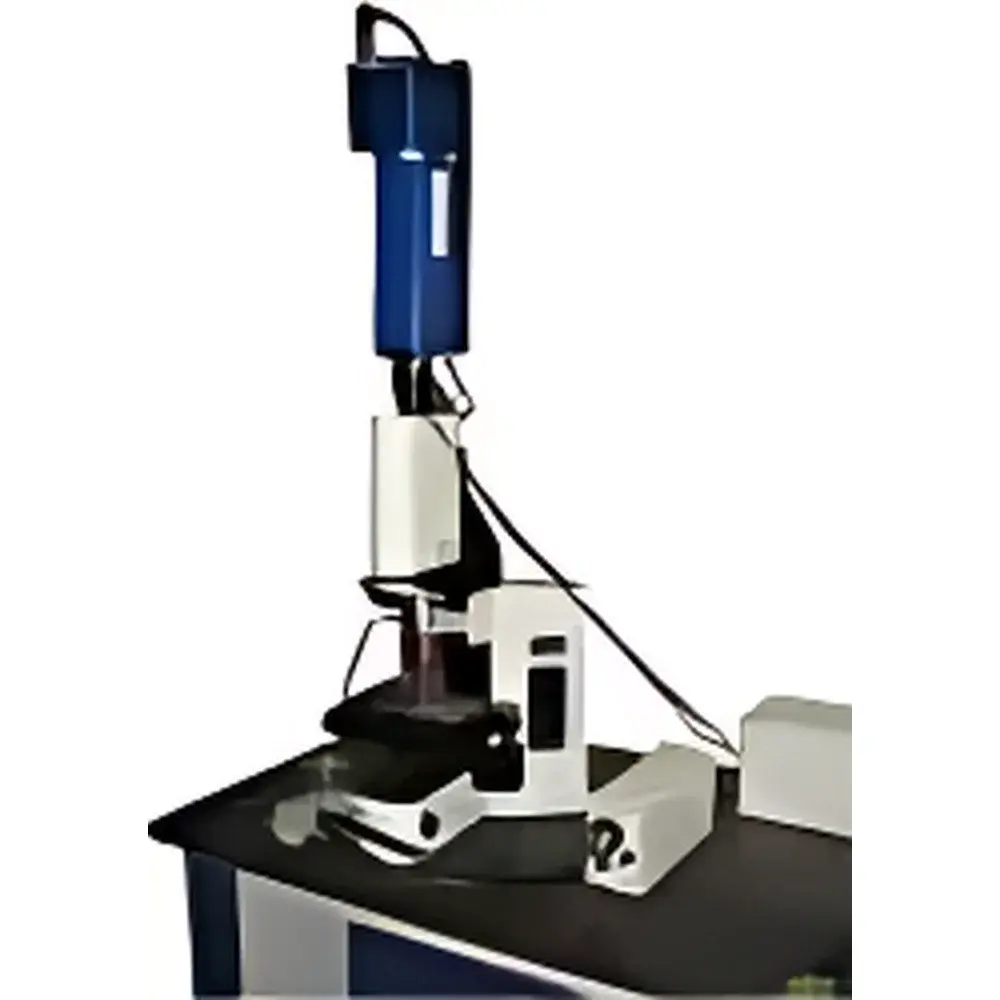
Specim CNT-NIR Hyperspectral Imaging & Photoluminescence/Electroluminescence Spectroscopy System
| Origin | Finland |
|---|---|
| Manufacturer Type | Authorized Distributor |
| Origin Category | Imported |
| Model | CNT-NIR Series |
| Price | Upon Request |
Overview
The Specim CNT-NIR Hyperspectral Imaging & Photoluminescence/Electroluminescence Spectroscopy System is a purpose-engineered platform for quantitative, spatially resolved optical characterization of carbon nanotubes (CNTs) in the near-infrared (NIR) spectral region. Leveraging push-broom hyperspectral imaging technology based on high-throughput transmission gratings and InGaAs focal plane array detection, the system enables simultaneous acquisition of full spectral cubes (x, y, λ) across 970–2500 nm — with extended sensitivity optimized for the critical 900–1700 nm window where semiconducting single-walled CNTs exhibit characteristic excitonic transitions. Unlike conventional point-scanning spectrometers, this architecture delivers intrinsic pixel-to-pixel spectral calibration stability and high signal-to-noise ratio (SNR) under low-flux excitation conditions, essential for non-destructive mapping of CNT chirality distribution, defect density gradients, and interfacial charge transfer dynamics in thin-film devices, aligned arrays, or solution-processed networks.
Key Features
- High-sensitivity InGaAs-based hyperspectral camera with thermoelectric cooling (−10 °C), enabling sub-100 µW/cm² excitation detection limits
- Integrated NIR micro-optical platform featuring infinity-corrected 10×/0.25 NA and 50×/0.42 NA objectives, compatible with reflective and transmissive illumination geometries
- Precision piezoelectric nanopositioning stage (X-Y-Z, 100 × 100 × 20 µm travel, <5 nm step resolution) for diffraction-limited raster scanning and focus stacking
- Dual-excitation capability: configurable LED or laser diode sources (e.g., 532 nm, 635 nm, 785 nm) for photoluminescence (PL); integrated voltage biasing interface (±100 V, 100 mA max) for electroluminescence (EL) studies
- Real-time spectral cube acquisition at up to 120 fps (full frame, 640 × 512 pixels), with on-board dark current and flat-field correction
- Modular design compliant with ISO 17025 traceable calibration workflows; NIST-traceable spectral calibration certificate included
Sample Compatibility & Compliance
The system accommodates diverse CNT-based samples including freestanding films, CVD-grown substrates (SiO₂/Si, quartz, sapphire), inkjet-printed patterns, polymer composites, and liquid dispersions in cuvette holders. Sample mounting interfaces conform to standard SEM stubs and microscope slide dimensions (76 × 26 mm). All optical and electronic subsystems meet CE marking requirements per Directive 2014/30/EU (EMC) and 2014/35/EU (LVD). Data acquisition protocols support audit-ready documentation per FDA 21 CFR Part 11 (electronic signatures, change control logs) when deployed in GLP/GMP-regulated environments. Spectral data formats comply with ASTM E131-22 (Standard Terminology Relating to Molecular Spectroscopy) and ISO/IEC 17025:2017 Clause 7.5.2 (data integrity and traceability).
Software & Data Management
Bundled Specim INSIGHT software provides end-to-end workflow management: hardware synchronization, spectral preprocessing (dark subtraction, radiometric calibration, stray-light correction), chemometric analysis (PCA, MCR-ALS, spectral unmixing), and spatial-spectral visualization (false-color band ratio maps, spectral library matching). Raw data are saved in vendor-neutral HDF5 format with embedded metadata (wavelength grid, exposure time, objective ID, excitation source parameters). Export modules support MATLAB (.mat), Python (NumPy .npy), and ENVI-compatible BIL/BIP formats. Optional integration with Thermo Fisher OMNIC or Bruker OPUS via API enables cross-platform spectral database alignment and multivariate model portability.
Applications
- Chirality-resolved mapping of (n,m) species distribution in as-grown CNT forests and post-sorted thin films
- Quantification of non-radiative recombination pathways via PL quantum yield imaging under controlled ambient and inert atmospheres
- Spatial profiling of EL onset voltage, spectral redshift, and efficiency roll-off in CNT-based light-emitting transistors (LETs)
- In situ monitoring of doping-induced spectral shifts during electrochemical gating or gas exposure experiments
- Correlative analysis of CNT dispersion homogeneity and local strain fields in polymer nanocomposites using peak position and FWHM metrics
- Validation of large-area CNT film uniformity for IR photodetector and modulator fabrication (per ISO 10110-5 surface quality standards)
FAQ
What spectral resolution is achievable across the 900–1700 nm range?
Spectral sampling interval is 2.5 nm with effective optical resolution (FWHM) ≤5.0 nm, verified by Hg-Ne lamp line profiling per ISO 12233 Annex D.
Can the system perform time-resolved PL decay measurements?
No — this is a steady-state hyperspectral imager. For lifetime analysis, integration with time-correlated single-photon counting (TCSPC) modules requires external synchronization via TTL triggers (available as optional add-on).
Is vacuum or cryogenic operation supported?
The base platform operates at ambient pressure and temperature (15–30 °C). A vacuum-compatible sample chamber and liquid nitrogen cold finger adapter are available as certified accessories (specify model CNT-NIR-VAC or CNT-NIR-CRYO at order entry).
How is spectral calibration maintained during long-term operation?
An internal tungsten-halogen reference source enables automated daily recalibration; drift compensation algorithms track pixel-wise responsivity changes using built-in non-uniformity correction (NUC) tables updated per ASTM E1421-20 Section 8.3.
Does the system comply with laboratory information management system (LIMS) integration requirements?
Yes — RESTful API and OPC UA server interfaces are provided for bidirectional data exchange with major LIMS platforms (e.g., LabVantage, Thermo SampleManager), supporting structured metadata ingestion per ISO/IEC 17025:2017 Annex A.3.
Related Products






