
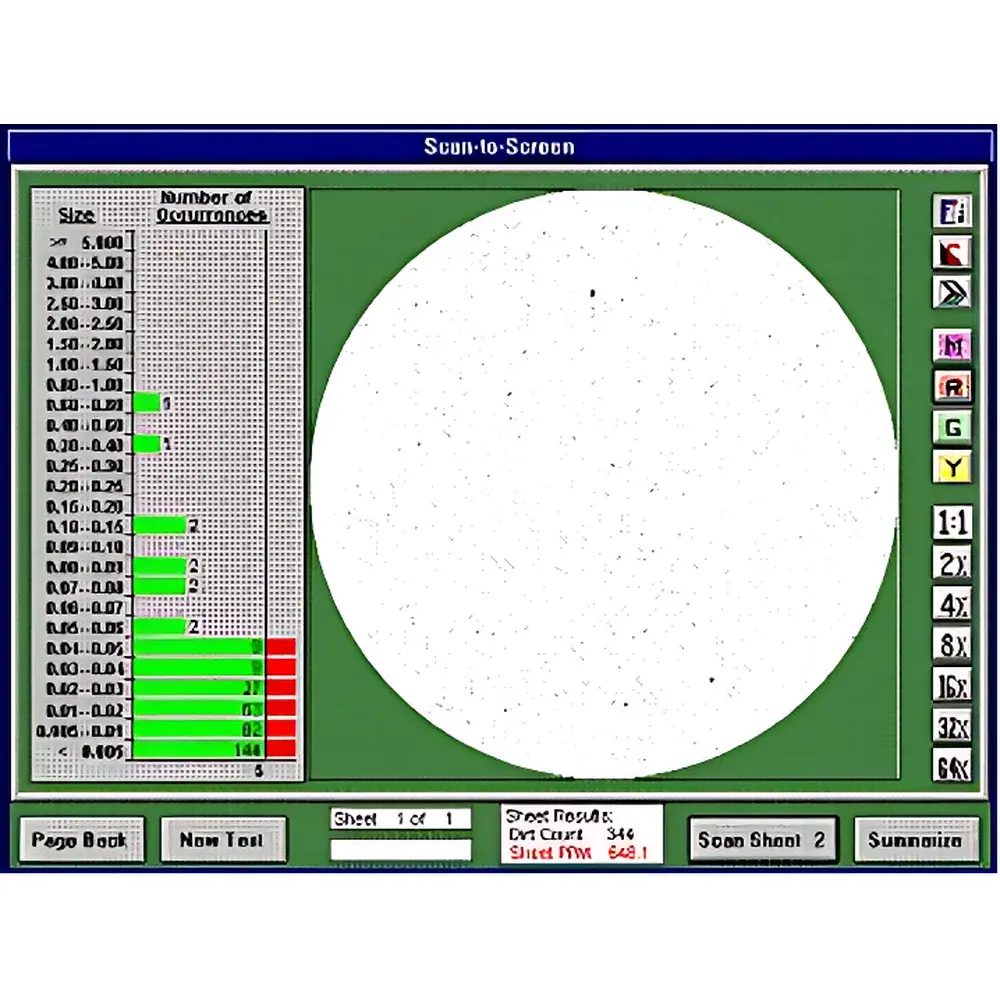
T/A Spec&Scan 2000 Dust and Contaminant Analyzer
| Brand | T/A |
|---|---|
| Origin | USA |
| Manufacturer Type | Authorized Distributor |
| Import Status | Imported |
| Model | Spec&Scan 2000 |
| Pricing | Upon Request |
Overview
The T/A Spec&Scan 2000 Dust and Contaminant Analyzer is a dedicated digital image analysis system engineered for quantitative assessment of foreign particles in pulp, paper, and board substrates. It operates on the principle of high-resolution grayscale image acquisition followed by algorithmic segmentation and morphometric classification—leveraging standardized optical contrast thresholds to distinguish dust specks, fiber bundles, stickies (adhesive contaminants), and other optically distinct particulates from the substrate matrix. Designed in full alignment with TAPPI T437 om-18 (“Dust Count in Paper and Paperboard”), the system delivers traceable, operator-independent measurements essential for process validation, raw material qualification, and regulatory documentation in ISO 9001–certified and GMP-aligned paper manufacturing environments.
Key Features
- Compliant grayscale image analysis platform calibrated to TAPPI T437 methodology for dust count, area quantification, and size distribution profiling
- Multi-class particle recognition engine capable of simultaneous identification and measurement of dust, shives, fiber bundles, and hydrophobic stickies
- Scan-to-screen mode with real-time pan/zoom up to 64× magnification and dynamic grayscale threshold adjustment—enabling discrimination at contrast resolutions exceeding human visual acuity by >10×
- Scan-to-printer “hands-off” operational mode for unattended batch scanning and report generation, supporting throughput optimization in QC laboratories
- Configurable analysis parameters including user-defined minimum/maximum particle area, aspect ratio filters, and grayscale intensity cutoffs
- Integrated reporting suite generating standardized output: particle count per unit area, cumulative size histograms, grayscale distribution statistics, annotated spot maps, and sample summary tables
- USB and SCSI interface compatibility with industry-standard flatbed scanners (e.g., HP ScanJet 74xx series, Epson Perfection V1660/V1680, UMAX PowerLook III)
Sample Compatibility & Compliance
The Spec&Scan 2000 supports standard sheet formats up to A4 (210 × 297 mm) and accommodates basis weights from 30 g/m² (tissue) to 450 g/m² (corrugating medium). Sample preparation follows TAPPI T437 protocols: specimens are placed on a clean, non-reflective black background under controlled ambient lighting (≤50 lux ambient illumination, D65 spectral reference). The system validates conformance to ASTM D5967 (Standard Practice for Digital Image Analysis of Paper Surfaces) and supports audit-ready data integrity through timestamped image archiving and metadata logging. All measurement workflows are compatible with GLP documentation requirements and support 21 CFR Part 11–compliant electronic records when deployed with validated Windows OS configurations and access-controlled user accounts.
Software & Data Management
Spec&Scan 2000 software runs natively on Microsoft Windows platforms (Windows 10/11, 64-bit) and provides native export to CSV, XML, and PDF formats. Its relational database architecture enables seamless integration with enterprise MIS systems—including Excel, Lotus 1-2-3, and dBASE-compatible applications—via ODBC drivers. Each scanned image is stored with embedded EXIF metadata (scan date/time, operator ID, instrument calibration ID, and analysis parameters), ensuring full traceability. Optional database modules support trend analysis across shifts, batches, or supplier lots, with configurable alerts for out-of-spec particle counts or size distribution deviations. Audit trails record all parameter changes, report generations, and image annotations, fulfilling internal QA and external regulatory review requirements.
Applications
- Optimization of pulp screening and cleaning efficiency via real-time feedback on contaminant load reduction
- Cost control in furnish blending through quantitative assessment of recycled fiber contamination (e.g., hot-melt adhesives, PSAs, coating residues)
- Daily QC release testing for coated papers, packaging boards, and specialty grades where dust-induced print defects or web breaks pose production risk
- Root-cause analysis of machine-direction streaks or offline pinholes using spatial clustering metrics derived from annotated spot maps
- Validation of deinking process efficacy in recycled pulp lines by tracking hydrophobic particle removal kinetics
- Supporting R&D studies on filler dispersion uniformity and pigment agglomeration behavior in laboratory handsheets
FAQ
Which scanner models are officially validated for use with Spec&Scan 2000?
HP ScanJet 7400/7450 series, Epson Perfection V1660/V1680, and UMAX PowerLook III (SCSI interface) are factory-tested and documented in the system’s Installation Qualification (IQ) protocol.
Can Spec&Scan 2000 be used for ISO 534 or ISO 536 thickness or grammage correlation?
No—the system performs surface-contaminant imaging only; it does not measure physical sheet properties. Thickness and grammage must be assessed using dedicated instruments compliant with ISO 534 and ISO 536.
Is automatic sample feeding supported?
Yes—an optional motorized auto-feeder module is available for high-throughput labs, enabling sequential scanning of up to 50 sheets per hour without manual intervention.
Does the software support multi-user permission levels?
Yes—administrator, analyst, and viewer roles can be assigned with granular controls over method editing, report generation, database export, and calibration access.
Can Spec&Scan 2000 data be imported into LIMS platforms?
Yes—through its ODBC-compliant database layer and structured CSV/XML exports, the system integrates with major LIMS vendors including LabWare, Thermo Fisher SampleManager, and STARLIMS.



