
SpectraCAM SWIR Series Short-Wave Infrared Multispectral Camera
| Origin | UK |
|---|---|
| Manufacturer Type | Authorized Distributor |
| Origin Category | Imported |
| Model | SpectroCAM SWIR |
| Pricing | Available Upon Request |
Overview
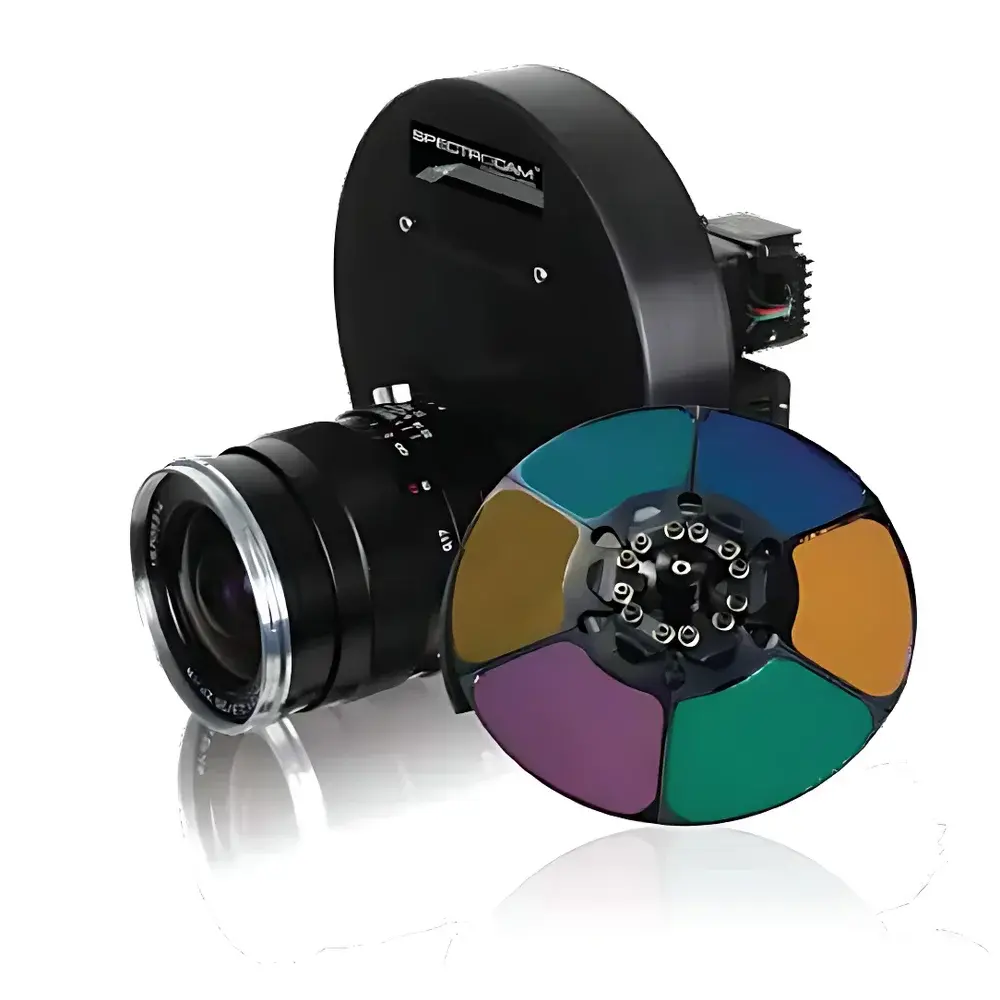
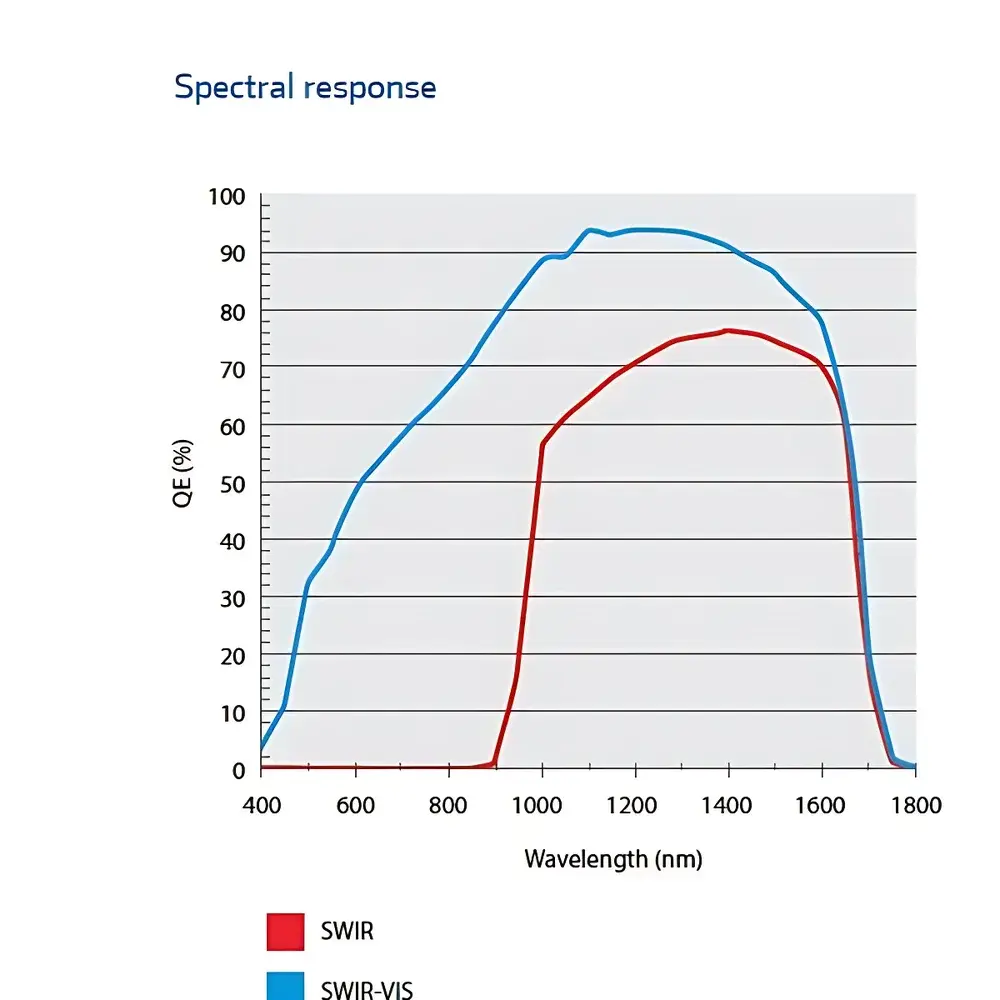
The SpectraCAM SWIR Series is a high-performance short-wave infrared (SWIR) multispectral imaging camera developed by Pixelteq and distributed globally through authorized channels. Engineered for precision spectral discrimination in the 500–1700 nm range, this camera extends the established SpectroCAM rotating filter wheel platform into the SWIR band—bridging visible (VIS), near-infrared (NIR), and short-wave infrared (SWIR) spectral domains within a single compact architecture. It operates on the principle of sequential spectral band acquisition via a motorized, position-accurate filter wheel, enabling synchronized capture of six discrete spectral bands per full frame cycle. With a native spatial resolution of 640 × 512 pixels and a maximum full-frame acquisition rate of 30 frames per second (fps), the system delivers five complete multispectral data cubes per second under optimal timing conditions—making it suitable for dynamic process monitoring, real-time material classification, and laboratory-grade spectral validation.
Key Features
- 6-channel programmable multispectral acquisition across 500–1700 nm, supporting customizable band selection via interchangeable interference filters mounted on a precision stepper-motor-driven filter wheel
- High-sensitivity indium gallium arsenide (InGaAs) focal plane array with 14-bit digitization and integrated non-uniformity correction (NUC) and automatic gain control (AGC) for consistent radiometric performance under variable illumination (including low-light and active SWIR illumination)
- Camera Link interface (Base or Medium configuration) enabling high-throughput data streaming to host systems with deterministic latency and frame synchronization support
- Ruggedized aluminum housing with standardized C-mount lens interface and thermal management design optimized for extended operation in industrial and field-deployable environments
- Factory-calibrated spectral response curves provided per unit, traceable to NIST-traceable reference sources; spectral bandwidth tolerance ±2.5 nm FWHM for standard filters
Sample Compatibility & Compliance
The SpectraCAM SWIR is compatible with reflective, transmissive, and emissive sample types—including agricultural biomass, pharmaceutical tablets, polymer composites, semiconductor wafers, and art conservation substrates. Its broad spectral coverage enables detection of chemical-specific absorption features (e.g., C–H, O–H, N–H overtones and combination bands) critical for qualitative and semi-quantitative analysis. The system complies with CE marking requirements for electromagnetic compatibility (EMC Directive 2014/30/EU) and low-voltage safety (LVD Directive 2014/35/EU). While not certified as medical or aerospace-grade hardware, its firmware architecture supports audit-ready logging and timestamped metadata embedding—facilitating alignment with GLP (Good Laboratory Practice) documentation workflows and ISO/IEC 17025-accredited testing laboratories’ data integrity expectations.
Software & Data Management
Pixelteq provides the SpectroCam Control Suite—a cross-platform application (Windows/Linux) supporting real-time preview, filter wheel sequencing, exposure control, NUC calibration routines, and raw data export in IEEE 754-compliant 16-bit TIFF or HDF5 format. SDKs are available for C/C++, Python (via ctypes bindings), and MATLAB, enabling integration into custom image processing pipelines—including PCA-based spectral unmixing, spectral angle mapper (SAM) classification, and machine learning model inference engines. All acquired datasets include embedded EXIF-like metadata: timestamp (UTC), filter position ID, integration time, sensor temperature, and user-defined ROI tags. The software supports FDA 21 CFR Part 11-compliant optional modules for electronic signatures, audit trail generation, and role-based access control when deployed in regulated QC/QA environments.
Applications
- Industrial sorting: Real-time identification of plastic polymer types (e.g., PET vs. PVC) based on SWIR absorption fingerprints
- Agricultural phenotyping: Quantification of leaf water content, nitrogen status, and stress biomarkers via reflectance ratio indices (e.g., NDWI, NIR/SWIR ratios)
- Pharmaceutical QA: Detection of coating thickness variation and API distribution heterogeneity in tablet film layers
- Cultural heritage imaging: Non-invasive visualization of underdrawings, pigment composition, and varnish degradation beneath visible surface layers
- Defense & security: Covert surveillance using eye-safe SWIR illumination and camouflage detection through vegetation reflectance anomalies
FAQ
What spectral filters are included by default with the SpectroCAM SWIR?
Standard configurations ship with six user-selectable bandpass filters centered at 650 nm, 850 nm, 940 nm, 1050 nm, 1300 nm, and 1550 nm (FWHM ≤ 25 nm); custom filter sets can be ordered to match application-specific absorption features.
Is radiometric calibration provided with the system?
Yes—each unit includes a factory-generated radiometric response curve and optional NIST-traceable calibration certificate upon request. In-field recalibration is supported using uniform SWIR reference sources.
Can the camera operate in triggered or free-run mode?
Yes—the Camera Link interface supports both hardware-triggered acquisition (TTL/LVDS) and continuous streaming modes, with precise frame-to-filter synchronization maintained across all six bands.
Does the system support synchronization with external light sources or motion stages?
Yes—dedicated sync I/O lines allow genlock with pulsed SWIR LEDs, laser line projectors, or linear translation stages for push-broom or hyperspectral scan integration.
What is the operating temperature range and cooling method?
The InGaAs sensor operates uncooled but includes thermoelectric stabilization (±0.1 °C) to minimize dark current drift; ambient operating range is 0–40 °C; storage range is –20 to +60 °C.




