
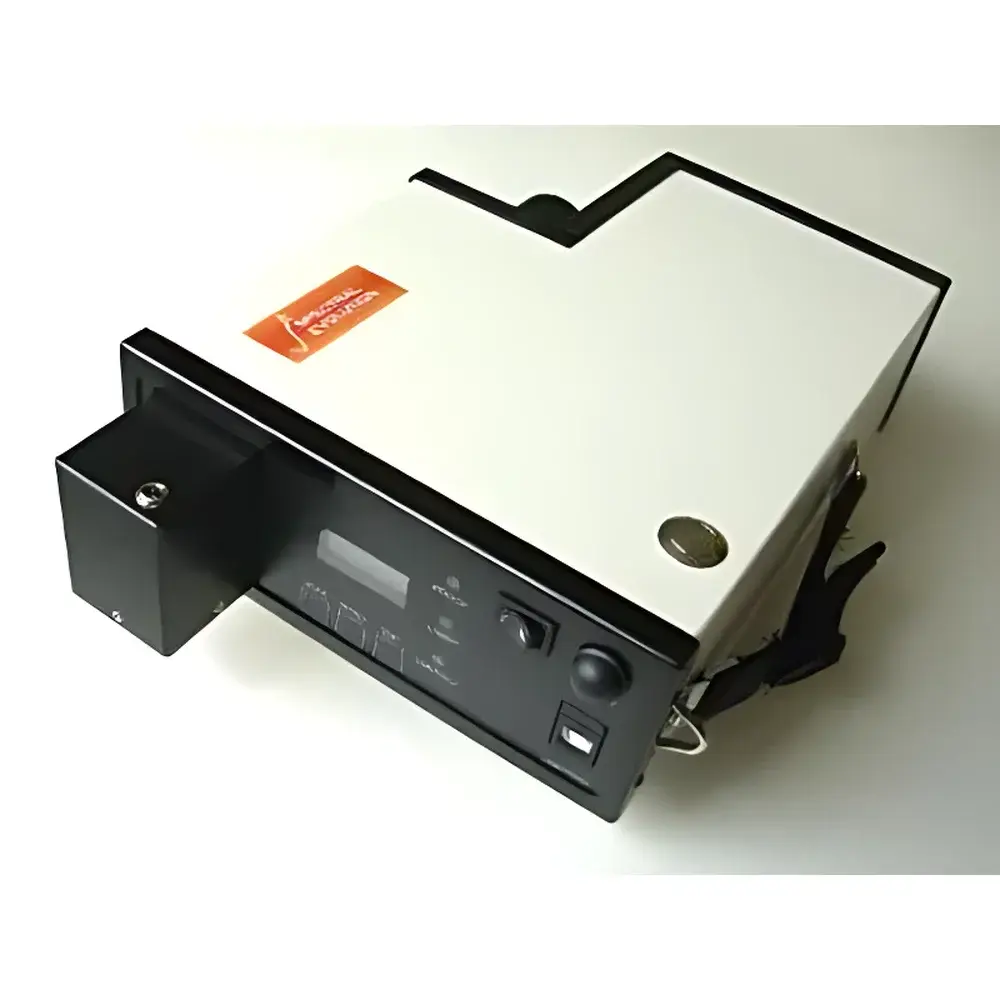
Spectral Evolution PSR-1900 Portable Field Spectroradiometer
| Brand | Spectral Evolution |
|---|---|
| Model | PSR-1900 |
| Spectral Range | 350–1900 nm |
| Detector | 512-pixel Si (350–1000 nm) + 256-pixel cooled InGaAs (970–1910 nm) |
| Spectral Resolution | 3.5 nm (350–1000 nm), 10 nm @ 1900 nm |
| Spectral Sampling Interval | ≤1 nm |
| Optical Interface | Interchangeable fore-optics (4°, 8°, 14° FOV) or fiber optic input |
| Integration Time | Adjustable from 1 ms to 60 s |
| Scan Speed | Full-spectrum acquisition in 100 ms (up to 10 Hz) |
| Wavelength Accuracy | ±0.5 nm (FWHM) |
| Wavelength Repeatability | ±0.1 nm |
| Radiometric Noise (4° lens, 0.5 s integration) | 1.0×10⁻⁹ W/cm²/nm/sr @ 400 nm, 1.5×10⁻⁹ W/cm²/nm/sr @ 1500 nm |
| Calibration Traceability | NIST-traceable |
| Data Storage | Onboard memory for 500 spectra |
| Connectivity | USB 2.0 and Bluetooth 4.0 |
| Power | Dual rechargeable Li-ion batteries (7.4 V, ≥2 h field operation) |
| Dimensions | 21.6 × 29.2 × 8.3 cm |
| Weight | 3.3 kg |
| Compliance | CE, FCC, RoHS |
Overview
The Spectral Evolution PSR-1900 Portable Field Spectroradiometer is a high-performance, NIST-traceably calibrated instrument engineered for precise in-situ measurement of spectral radiance, reflectance, and transmittance across the ultraviolet–visible–near-infrared (UV-VIS-NIR) range (350–1900 nm). Based on a fixed-holographic grating optical design and dual linear array detectors—silicon (Si) for 350–1000 nm and thermoelectrically cooled indium gallium arsenide (InGaAs) for 970–1910 nm—the PSR-1900 eliminates moving optical components, ensuring long-term calibration stability and measurement reproducibility under variable field conditions. Its all-solid-state architecture avoids spectral misregistration risks associated with scanning monochromators or fiber-coupled systems with narrow slits. The instrument operates on the principle of passive spectroradiometry: incident light is collimated via user-selectable fore-optics or fiber input, dispersed by a stable holographic grating, and resolved by synchronized detector arrays with sub-nanometer sampling. Real-time data acquisition at up to 10 spectra per second enables dynamic monitoring of rapidly changing surface or atmospheric conditions—critical for time-series remote sensing validation, vegetation phenology studies, and solar irradiance characterization.
Key Features
- Fixed-grating, full-linear-array optical path with no moving parts—ensures mechanical robustness and calibration integrity across temperature gradients and vibration-prone environments
- NIST-traceable factory calibration with documented uncertainty budgets; supports field recalibration using optional reference panels (e.g., Spectralon®)
- Integrated shutter and drift-lock auto-calibration routine that compensates for thermal and electronic baseline drift during extended deployments
- Interchangeable optical interfaces: modular fore-optics (4°, 8°, or 14° field-of-view lenses) or SMA-905 fiber input—enabling flexible sampling geometries for canopy, soil, water, or material surfaces
- Laser targeting system co-aligned with optical axis for accurate spatial registration of measurement targets
- Onboard 500-spectrum non-volatile memory and intuitive membrane keypad—enables fully autonomous operation without laptop dependency
- Lightweight aluminum chassis (3.3 kg) with ergonomic nylon carrying strap and dual ¼-20 tripod mounts—optimized for single-operator field mobility and mounting stability
- Dual Li-ion battery system (7.4 V, hot-swappable) delivering ≥2 hours continuous operation; compatible with external power banks for multi-day surveys
- USB 2.0 and Bluetooth 4.0 connectivity—supports both wired high-throughput transfer and wireless telemetry to Windows-based tablets or rugged handhelds (e.g., Getac PS236 with integrated GPS, digital camera, and DARWin CE Mobile software)
Sample Compatibility & Compliance
The PSR-1900 is designed for non-contact, non-destructive spectral characterization of natural and engineered surfaces—including vegetation canopies, mineral outcrops, soil profiles, aquatic bodies, photovoltaic materials, and pharmaceutical coatings. Its wide dynamic range (radiometric sensitivity down to 1.0×10⁻⁹ W/cm²/nm/sr) and high linearity accommodate both low-reflectance soils and high-radiance solar-illuminated targets. The instrument complies with international electromagnetic compatibility (EMC) and safety standards (CE, FCC Part 15, RoHS), and its calibration methodology adheres to ASTM E275, ISO 9001:2015, and ISO/IEC 17025 requirements for testing laboratories. While not inherently GLP/GMP-certified, its data provenance—via embedded timestamping, GPS tagging (when paired), and audit-ready metadata export—supports regulatory traceability frameworks such as FDA 21 CFR Part 11 when integrated into validated workflows.
Software & Data Management
Data acquisition and post-processing are supported by Spectral Evolution’s DARWin SP software (Windows desktop) and DARWin CE Mobile (for Windows CE/PDA platforms), both providing real-time spectral visualization, automatic exposure control, dark-current subtraction, and reflectance normalization against reference standards. Raw data are stored in vendor-neutral ASCII (.txt) and industry-standard ENVI-compatible .hdr/.sli formats, enabling seamless import into MATLAB, Python (NumPy/SciPy), ENVI, ArcGIS, and R environments. The software supports batch processing, spectral index calculation (e.g., NDVI, PRI, NDWI), and statistical outlier detection. LabVIEW drivers are available upon request for custom automation in OEM or industrial QA/QC applications. All firmware updates and calibration files are digitally signed and version-controlled to maintain data integrity across instrument lifecycles.
Applications
- Earth observation ground truthing: validation of satellite and airborne hyperspectral sensors (e.g., Sentinel-2, Landsat, AVIRIS-NG)
- Agricultural remote sensing: leaf chlorophyll estimation, nitrogen status mapping, crop stress detection, and yield prediction modeling
- Geological and mining exploration: identification of clay minerals, iron oxides, carbonates, and hydrocarbons via diagnostic absorption features
- Environmental monitoring: turbidity and chlorophyll-a quantification in inland waters; snow albedo and melt timing analysis
- Ecological research: biodiversity assessment through spectral diversity metrics; forest structural parameter retrieval (LAI, fPAR)
- Solar energy: spectral irradiance profiling for PV module performance modeling and soiling loss quantification
- Material science: optical property characterization of coatings, pigments, textiles, and packaging films
- Food and pharmaceutical quality control: non-invasive compositional analysis of grains, fruits, tablets, and capsules
FAQ
What spectral calibration standards are used for the PSR-1900?
The PSR-1900 is calibrated using NIST-traceable standard lamps and reflectance panels. Certificate of Calibration includes wavelength accuracy (±0.5 nm), radiometric uncertainty (±4–5% across VIS-NIR), and spectral resolution verification per ASTM E275.
Can the PSR-1900 measure absolute irradiance?
Yes—when equipped with a cosine-corrected irradiance collector (optional accessory), the instrument delivers calibrated spectral irradiance (W/m²/nm) traceable to NIST SI units.
Is the PSR-1900 suitable for underwater measurements?
Not directly; however, it may be deployed with waterproof housings and fiber-optic probes rated for submerged use (e.g., Ocean Insight UV-VIS-NIR fibers with quartz windows). Contact technical support for marine-rated configuration guidance.
How is thermal drift managed during prolonged field use?
The instrument employs active thermal stabilization of the InGaAs detector and periodic drift-lock calibration cycles triggered automatically or manually—correcting for zero-point drift without interrupting measurement sequences.
Does the PSR-1900 support automated time-series logging?
Yes—DARWin SP allows programmable trigger-based acquisition (e.g., GPS position change, time interval, or external TTL signal), enabling unattended diurnal or seasonal monitoring campaigns.






