
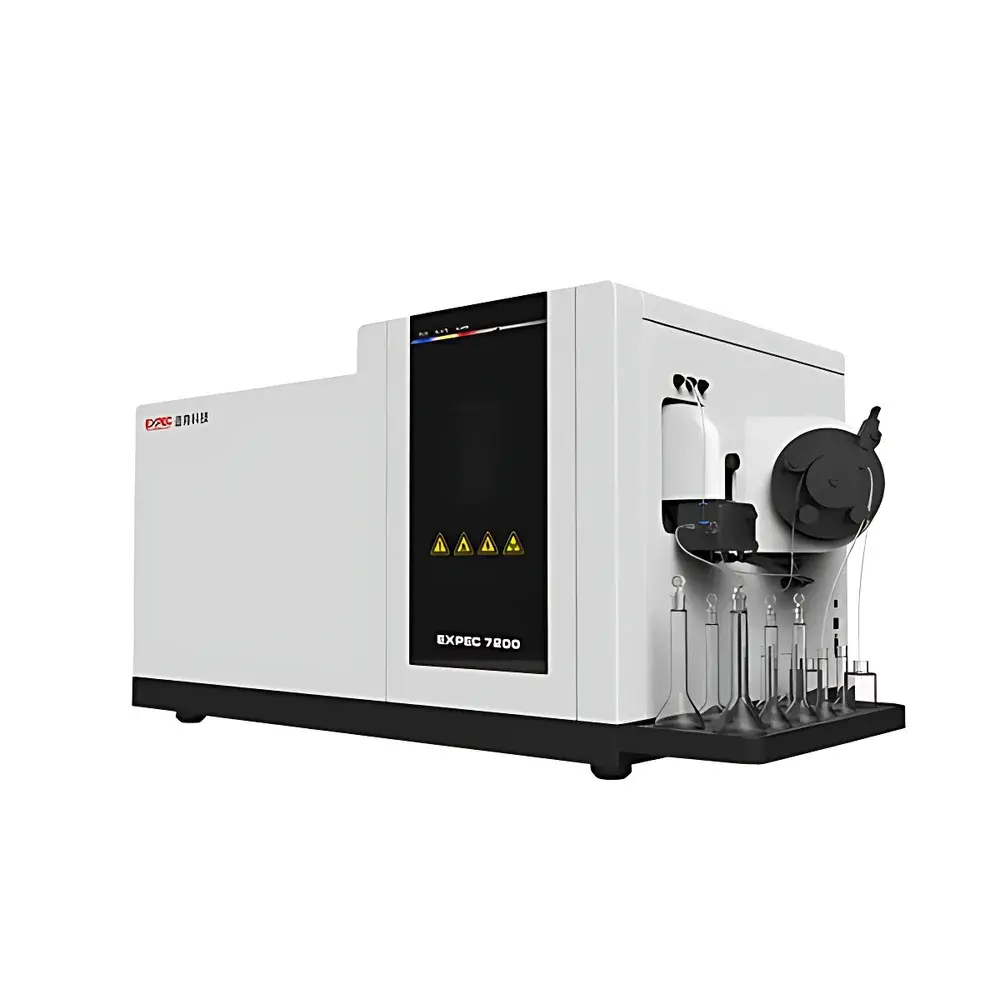
SpectrUM EXPEC 7200 High-Sensitivity Inductively Coupled Plasma Mass Spectrometer
| Brand | SpectrUM / EXPEC |
|---|---|
| Origin | Zhejiang, China |
| Manufacturer Type | Authorized Distributor |
| Origin Category | Domestic (China) |
| Model | EXPEC 7200 |
| Instrument Type | Quadrupole ICP-MS |
| Application Environment | Laboratory |
| Mass Range (amu) | 1–280 |
| Resolution (Unit Mass Resolution, amu) | ≤0.75 |
| Detection Limit (ng·L⁻¹) | <0.05 for ⁹Be, <0.003 for ²³⁸U |
| Sensitivity (Mcps/mg·L⁻¹) | >350 for ²³⁸U |
| Short-Term Stability (RSD, 10 min) | <2% |
| Long-Term Stability (RSD, 2 h) | <3% |
Overview
The SpectrUM EXPEC 7200 is a high-sensitivity quadrupole-based inductively coupled plasma mass spectrometer (ICP-MS) engineered for ultra-trace elemental analysis in research-intensive laboratories. It operates on the fundamental principle of ion generation via high-temperature argon plasma (≈7,000–10,000 K), followed by mass-selective detection using a robust RF-driven quadrupole mass filter and high-gain electron multiplier detection. Designed to meet stringent requirements in method development, reference material certification, and multi-element isotopic ratio analysis, the EXPEC 7200 integrates advanced plasma interface optics, low-noise signal processing electronics, and a thermally stabilized vacuum manifold to ensure consistent ion transmission and long-term measurement fidelity.
Key Features
- High Sensitivity Architecture: Optimized ion optics—including a dual-lens extraction system and extended flight path—deliver >350 Mcps/mg·L⁻¹ sensitivity for uranium (²³⁸U), enabling sub-ppt quantification in aqueous matrices without preconcentration.
- Distributed Collision/Reaction Cell (DCRC): A proprietary orthogonal gas injection design enables uniform spatial distribution of reactive gases (e.g., He, H₂, NH₃) across the entire cell length. This configuration achieves equivalent interference removal at ~30% lower gas flow versus conventional linear cells, minimizing polyatomic oxide formation (e.g., ⁴⁰Ar¹⁶O⁺ on ⁵⁶Fe⁺) while preserving analyte transmission.
- Seven-Channel Gas Management System: Independent mass-flow-controlled delivery of up to seven gases—including Ar (plasma & nebulizer), He (collision), H₂ (reaction), O₂ (oxidation), N₂ (cooling), CH₄ (methylation), and diluent gas—supports dynamic method switching and multi-mode interference mitigation strategies within a single run.
- Low-Power Standby Mode: Maintains plasma torch ignition and vacuum integrity while reducing RF power to ≤600 W and Ar consumption by >40%, significantly lowering operational cost during overnight or inter-run idle periods without compromising restart reproducibility.
- Modular Vacuum Architecture: Dual-stage differential pumping with turbomolecular pumps (≥300 L/s on ion source side; ≥600 L/s on detector side) ensures stable base pressure (<5 × 10⁻⁸ mbar) and rapid pump-down (<12 min from atmosphere), supporting high-throughput batch analysis.
Sample Compatibility & Compliance
The EXPEC 7200 accepts liquid samples via standard concentric nebulizers (e.g., PFA, MicroMist) and desolvating systems (e.g., Aridus III), as well as solid samples through laser ablation (213 nm Nd:YAG compatible), electrothermal vaporization (ETV), and direct solid sampling accessories. It complies with ISO/IEC 17025:2017 analytical validation requirements and supports full audit trails per FDA 21 CFR Part 11 when operated with validated software configurations. Routine performance verification follows ASTM D5673 (trace metals in water) and EPA Method 6020B (elemental analysis by ICP-MS), including daily tuning checks (sensitivity, oxide ratio, doubly charged ratio), drift correction via internal standards (e.g., ¹¹⁵In, ²⁰⁹Bi), and certified reference material (CRM) cross-validation (e.g., NIST SRM 1640a, SLRS-6).
Software & Data Management
Control and data reduction are performed using SpectrUM ICP-MS Suite v4.x—a Windows-based platform featuring instrument control, real-time spectrum visualization, kinetic energy discrimination (KED) and reaction mode setup wizards, isotope ratio calculation with propagated uncertainty estimation (k = 2), and customizable reporting templates aligned with GLP/GMP documentation standards. Raw data files (.raw) are stored in vendor-neutral HDF5 format, enabling third-party integration with LIMS (e.g., LabWare, Thermo SampleManager) and statistical packages (e.g., R, Python pandas). All user actions—including method edits, calibration updates, and QC flagging—are timestamped and logged with operator ID for full traceability.
Applications
- Environmental Monitoring: Quantification of As, Cd, Pb, U, and rare earth elements (REEs) in drinking water (EPA 1638), seawater (GEOTRACES protocols), soils (ISO 11466), and airborne particulate matter (PM₂.₅/PM₁₀ filters) with isotopic fingerprinting capability (e.g., ²⁰⁶Pb/²⁰⁷Pb ratios for source apportionment).
- Food Safety & Authenticity: Multi-element screening in wine (Cu, Sr isotopes for geographic origin), infant formula (As, Sb, Tl), and tobacco (Cd, Ni, Pb) with compliance to EU Commission Regulation (EU) No 2023/915 and Chinese GB 5009.268–2016.
- Clinical & Biomonitoring: Trace metal profiling in serum, urine, and hair (e.g., Se, Zn, Co, Cr) for nutritional assessment and toxicology studies; supported by CLIA-waived workflows and reference range alignment with CDC’s NHANES database.
- Materials Science: Impurity mapping in high-purity Si wafers (<10¹² atoms/cm² detection), isotopic composition analysis of nuclear fuel simulants (²³⁵U/²³⁸U), and dissolution kinetics of alloy corrosion products (e.g., Fe-Cr-Ni matrix).
FAQ
What regulatory standards does the EXPEC 7200 support for routine compliance testing?
The system meets method requirements under EPA 6020B, ISO 17294-2, and ASTM D5673, with built-in tools for QC acceptance criteria (e.g., calibration R² ≥0.999, continuing calibration verification ±10%).
Can the EXPEC 7200 perform isotope ratio measurements with certified uncertainty?
Yes—when operated with multi-collector optional upgrade and calibrated against NIST SRMs, it delivers δ-value precision ≤0.15‰ (2SD) for light isotopes (e.g., Mg, Ca) and ≤0.05‰ for heavy isotopes (e.g., Pb, U).
Is remote monitoring and troubleshooting supported?
Standard Ethernet/IP connectivity enables secure remote access via TLS-encrypted VNC or TeamViewer (IT-admin approved), with real-time vacuum status, plasma impedance logs, and detector gain history accessible from off-site locations.
How is mass calibration maintained over extended operation?
Automated daily calibration uses ⁸⁹Y, ¹¹⁵In, and ²⁰³Tl solutions; mass drift compensation is applied dynamically during acquisition using real-time peak centering algorithms embedded in the quadrupole RF generator firmware.
What consumables require scheduled replacement?
Nebulizer tips (every 3–6 months depending on matrix), sampler/skimmer cones (6–12 months), and electron multiplier (2–3 years typical lifetime at <10⁶ cps average count rate); all carry serialized tracking in the software maintenance log.




