
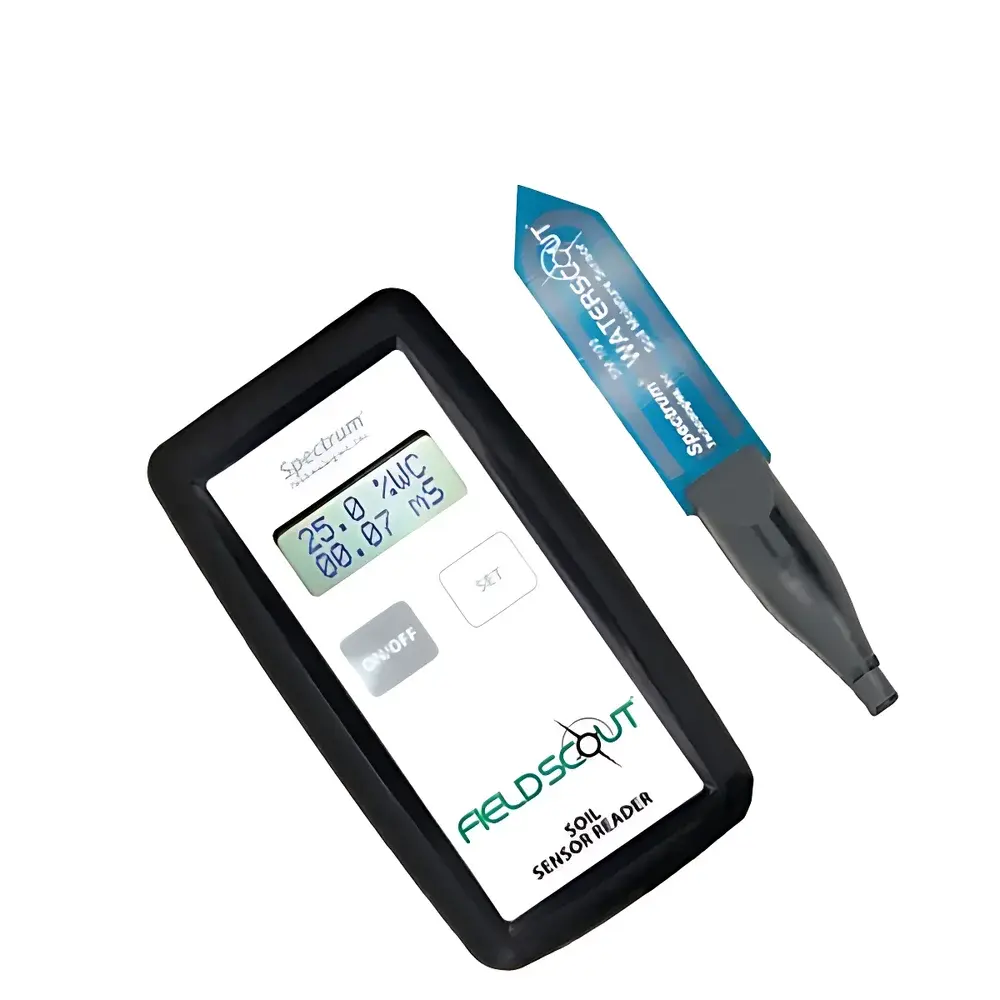
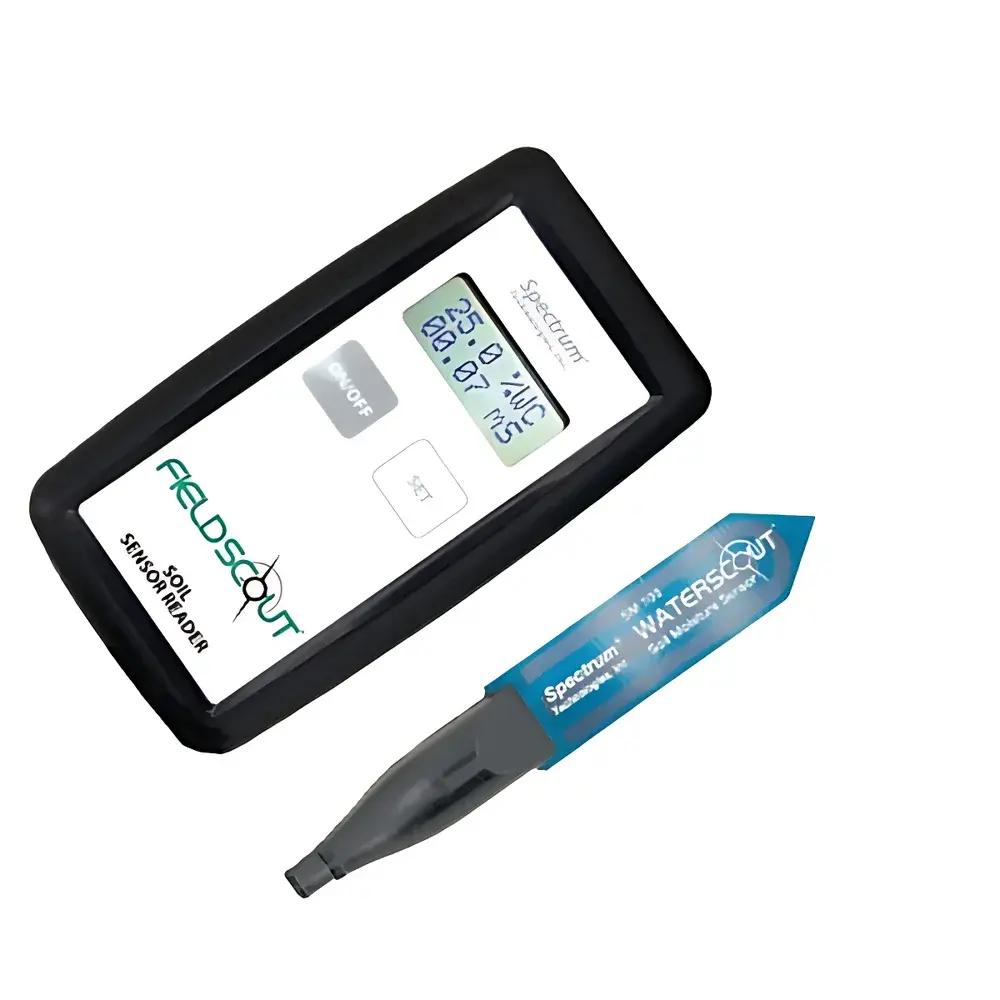
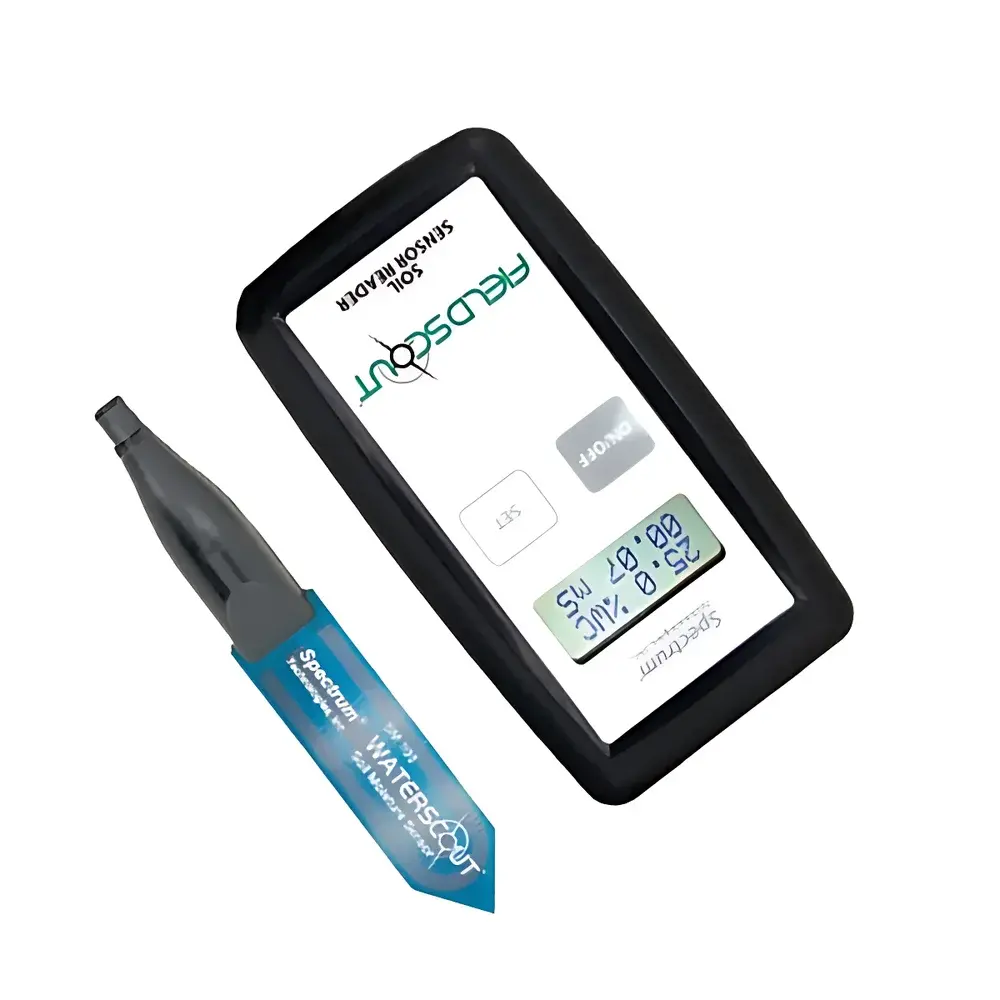
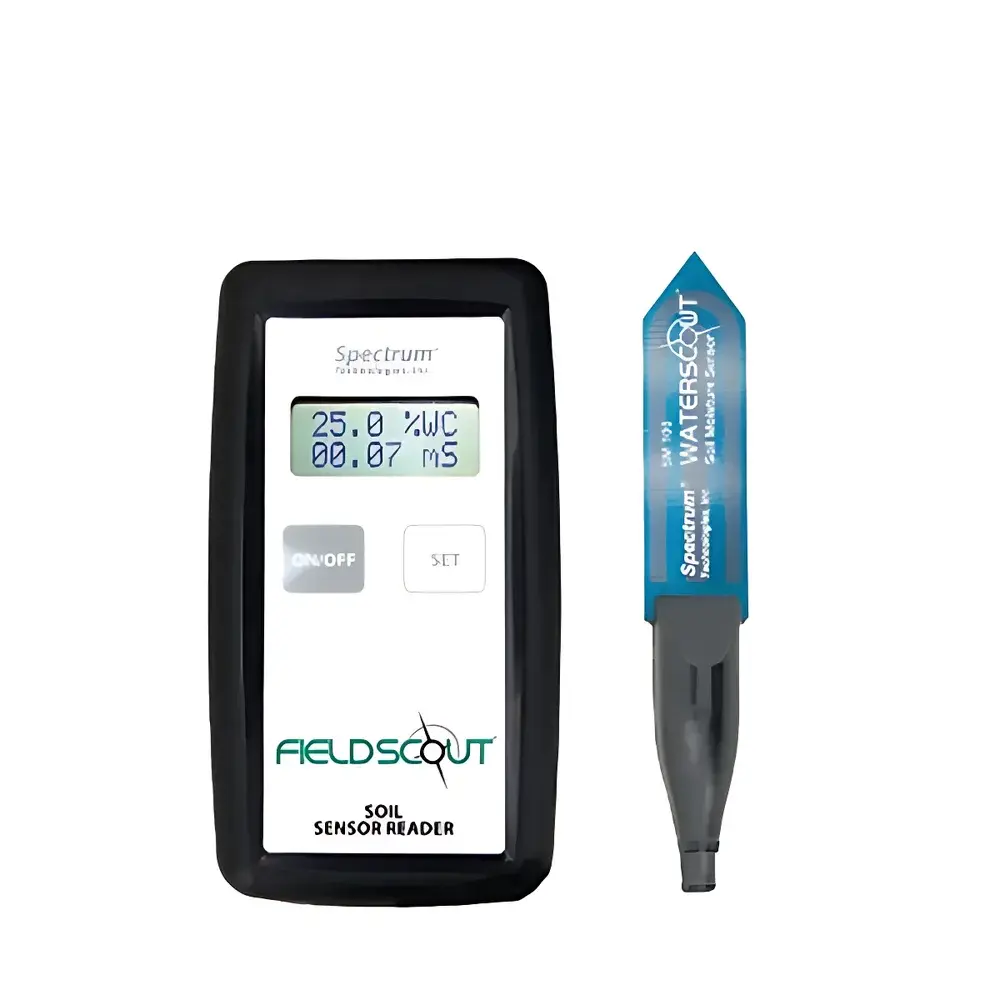
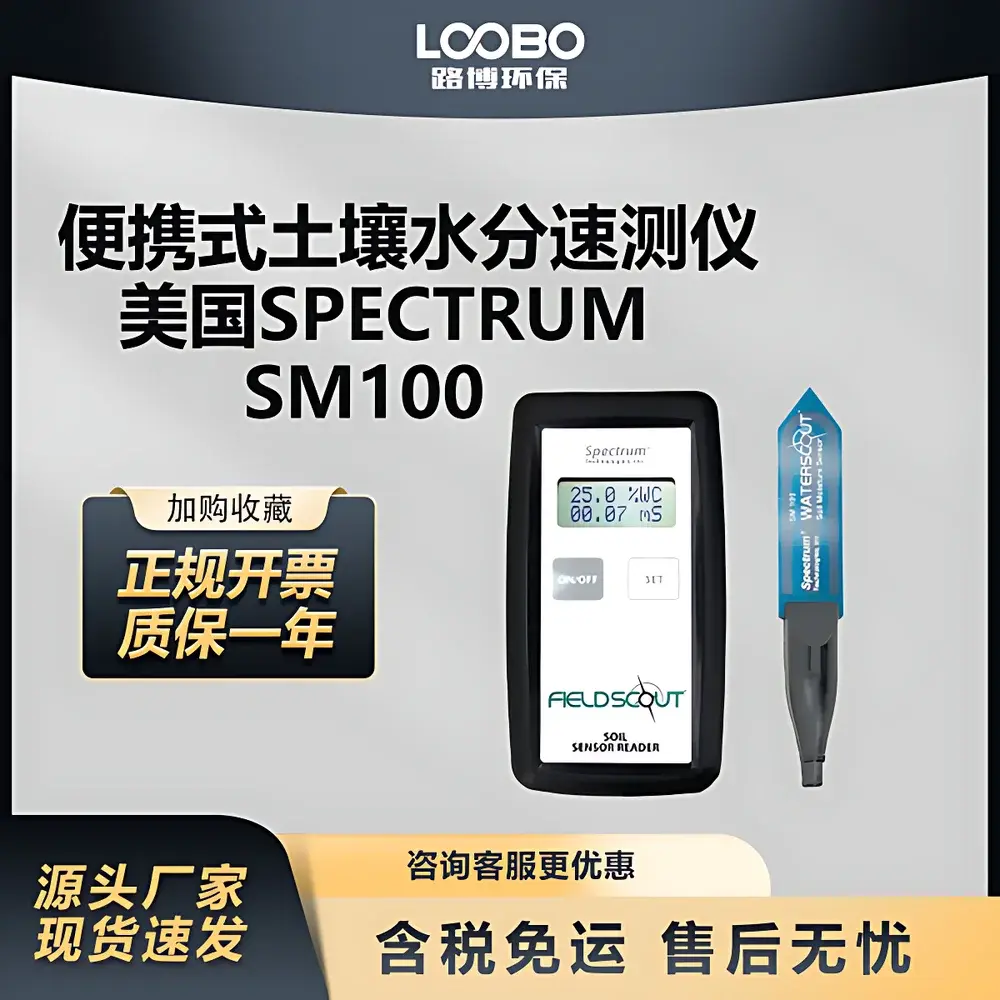
Spectrum SM100 Portable Soil Moisture Sensor
| Brand | Active Spectrum |
|---|---|
| Origin | USA |
| Manufacturer Type | Authorized Distributor |
| Origin Category | Imported |
| Model | SM100 |
| Instrument Type | Portable |
| Detection Channels | 1 or 4 (configurable) |
| Measured Parameter | Volumetric Water Content (VWC) |
| Maximum Sample Mass Capacity | 1 kg |
| Operating Voltage | 3–5 V DC @ 6–10 mA |
| Output Signal | Analog voltage (0.5–1.5 V at 3 V excitation |
| Oscillation Frequency | 70–80 MHz |
| Resolution | 0.1% VWC |
| Accuracy | ±1–3% VWC (for soil EC < 8 mS/cm) |
| Sensing Volume | 6 cm × 2 cm × 0.3 cm |
| Standard Cable Length | 1.8 m (optional: 6 m |
| Handheld Meter Operating Temperature | −40 °C to +50 °C |
| Data Storage | ≥6 months continuous logging |
| Measurement Time | ≤1 s per reading |
| Interface | 2.5 mm stereo jack (3-conductor) |
| Data Transfer | USB cable |
| Enclosure Rating | IPX4 (splash-resistant) |
Overview
The Spectrum SM100 Portable Soil Moisture Sensor is an engineered field instrument designed for rapid, non-destructive quantification of volumetric water content (VWC) in mineral and organic soils. It operates on the principle of frequency-domain reflectometry (FDR), utilizing a stable 70–80 MHz electromagnetic oscillator to measure the dielectric permittivity of soil—directly correlated to its water content. Unlike time-domain reflectometry (TDR) systems requiring high-speed sampling electronics, the SM100’s FDR architecture delivers consistent performance with low power consumption (6–10 mA at 3–5 V DC), making it ideal for long-term unattended monitoring or handheld survey applications across agricultural, ecological, hydrological, and environmental research domains. Its compact sensor head (6 cm × 2 cm × 0.3 cm active sensing zone) enables minimal soil disturbance during insertion, while the calibrated analog voltage output ensures compatibility with third-party data loggers, SCADA systems, and custom acquisition hardware adhering to standard 2.5 mm stereo interface protocols.
Key Features
- Field-deployable handheld meter with integrated data logging—stores ≥6 months of timestamped VWC readings internally
- Configurable channel support: single-sensor operation or multiplexed 4-channel deployment via optional expansion module
- High-resolution measurement capability: 0.1% VWC resolution across full range (0% to saturation)
- Robust thermal performance: operational from −40 °C to +50 °C, validated for year-round use in temperate, arid, and subarctic climates
- Splash-resistant (IPX4) enclosure rated for outdoor exposure during rain or dew accumulation
- Low-power FDR electronics minimize battery drain—enables >12 months of intermittent field use on standard AA cells (meter-dependent)
- Standardized 2.5 mm stereo jack interface (3-conductor) ensures interoperability with Campbell Scientific, Onset HOBO, Decagon (now METER Group), and other industry-standard loggers
- Cable options include 1.8 m (standard), 6 m (common extension), and custom lengths up to 15 m without signal degradation under recommended shielding practices
Sample Compatibility & Compliance
The SM100 is validated for direct insertion into undisturbed mineral soils, sandy loams, clay loams, peat-based substrates, and potting media. Accuracy specifications (±1–3% VWC) assume bulk electrical conductivity (EC) remains below 8 mS/cm—a threshold commonly observed in non-saline agricultural and natural soils. For high-EC environments (e.g., coastal marshes, irrigated arid-zone fields), empirical calibration using gravimetric reference samples is recommended per ASTM D4959 and ISO 11274 guidelines. The sensor conforms to CE marking requirements for electromagnetic compatibility (EMC Directive 2014/30/EU) and RoHS 2011/65/EU material restrictions. While not certified for explosion-proof or intrinsically safe operation, its low-voltage design (<5 V DC) meets IEC 60079-11 safety thresholds for non-hazardous area instrumentation.
Software & Data Management
Data retrieval occurs via USB connection to Windows/macOS/Linux systems using vendor-provided Spectrum Connect software (v3.2+), which supports batch export in CSV, Excel (.xlsx), and HDF5 formats. All logged entries include UTC timestamps, sensor ID, channel index, VWC value, temperature-compensated raw voltage, and diagnostic flags (e.g., low-battery warning, open-circuit detection). Audit-trail functionality records user-initiated calibration events and firmware updates—supporting GLP-compliant workflows where traceability is required. The system does not implement FDA 21 CFR Part 11 electronic signature controls; however, exported datasets retain immutable metadata suitable for inclusion in validated analytical reports under ISO/IEC 17025-accredited laboratories.
Applications
- Irrigation scheduling and precision agriculture decision support
- Soil moisture network deployment for watershed-scale hydrological modeling
- Ecological studies of plant-water relations and root-zone dynamics
- Landfill cover monitoring and leachate migration assessment
- Green infrastructure performance evaluation (bioswales, rain gardens)
- Calibration validation for satellite-based soil moisture products (e.g., SMAP, Sentinel-1)
- Long-term climate change impact studies on soil desiccation and recharge patterns
FAQ
What is the recommended calibration protocol for the SM100?
Gravimetric calibration is advised prior to first use and annually thereafter—or after sensor exposure to extreme salinity or mechanical damage. Follow ASTM D4959 procedures using oven-dried mass loss at 105 °C.
Can the SM100 be used in frozen soil?
No. Dielectric measurement ceases to correlate linearly with liquid-phase VWC below 0 °C. The sensor will report stable but non-physiological values in frozen matrices.
Is the 2.5 mm interface compatible with SDI-12 or RS-485 systems?
No. The SM100 outputs analog voltage only. Integration with digital bus protocols requires external analog-to-digital conversion (e.g., CR1000X with AM16/32B multiplexer).
Does cable length affect measurement accuracy?
Within 15 m and using shielded twisted-pair cabling, no statistically significant drift has been observed in controlled laboratory testing (n = 42, p > 0.05, ANOVA).
How often should the sensor be cleaned?
After each use in clay-rich or organic soils, gently wipe the prongs with isopropyl alcohol and a lint-free cloth to prevent dielectric film buildup that may bias readings.







