
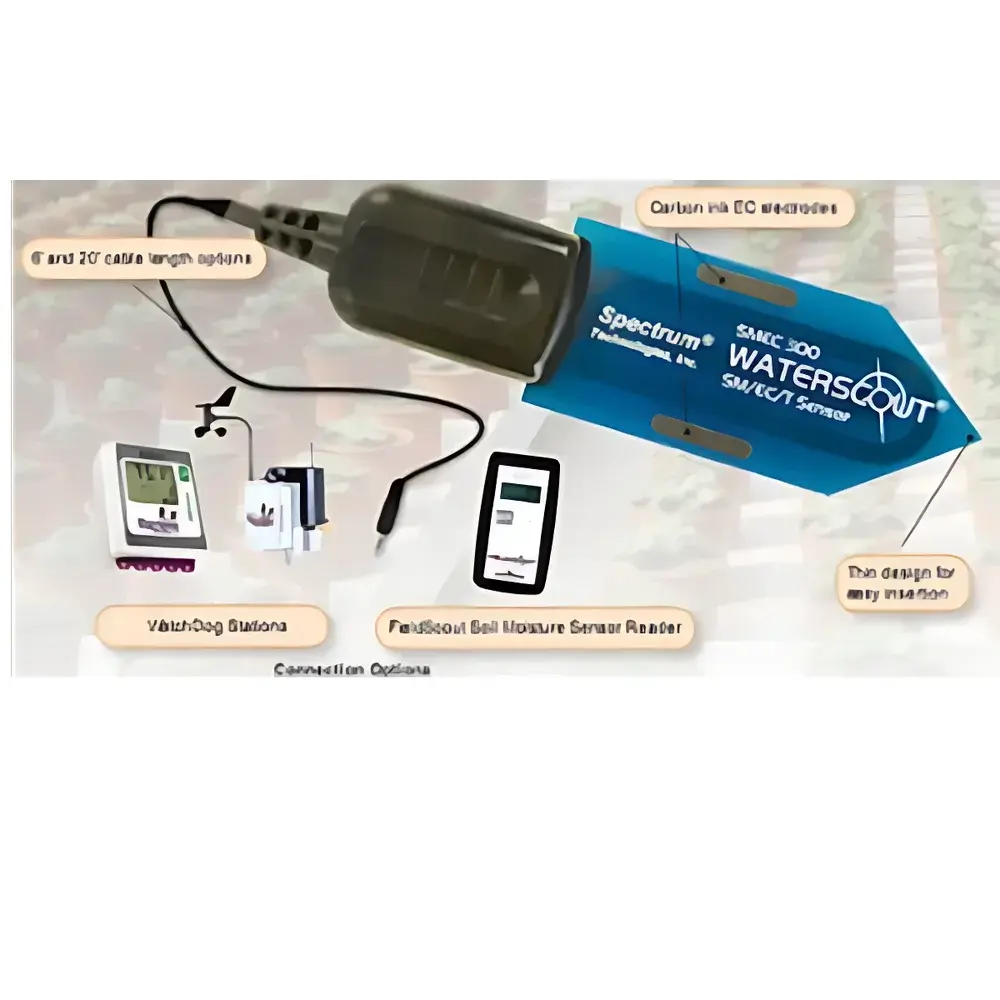
Spectrum SMEC300 Soil Moisture, Electrical Conductivity & Temperature Sensor
| Brand | Spectrum |
|---|---|
| Origin | USA |
| Manufacturer Type | Authorized Distributor |
| Origin Category | Imported |
| Model | SMEC300 |
| Price | Upon Request |
| Volumetric Water Content Range | 0–Saturation (vol%) |
| EC Range | 0–10 mS/cm |
| Temperature Range | 0.5–80°C |
| VWC Resolution | 0.1% |
| EC Resolution | 0.01 mS/cm |
| Temp Resolution | 0.1°C |
| VWC Accuracy | ±3% |
| EC Accuracy | ±2% |
| Temp Accuracy | ±0.8°C |
| Cable Lengths | 1.8 m and 6.1 m (extendable up to 15 m) |
| Power | 3 V @ 6–10 mA |
| Output | Analog voltage, time-division multiplexed |
| Sensing Volume | 5.72 cm × 1.91 cm |
| Compatible Loggers | WatchDog 1400 (4 sensors, 8064 data points, ~220 days at 30-min interval), WatchDog 2400 (4 sensors, 8800 data points, ~183 days at 30-min interval) |
| Display | LCD real-time readout |
| Power Source | 4 × AA batteries |
| Battery Life | Up to 12 months |
Overview
The Spectrum SMEC300 is a field-deployable, three-parameter soil sensor engineered for simultaneous, in-situ measurement of volumetric water content (VWC), bulk electrical conductivity (EC), and soil temperature. It operates on the principle of frequency-domain reflectometry (FDR) for moisture quantification and uses a robust graphite electrode array for contact-based EC measurement—enabling direct correlation between ion mobility and salinity without requiring soil extraction or lab calibration. Temperature is measured via an integrated thermistor embedded within the sensing head, ensuring thermal equilibrium with the surrounding matrix. Designed for long-term unattended monitoring, the SMEC300 delivers stable, reproducible readings across diverse soil textures—from sandy loam to clay—and supports critical agronomic decisions related to irrigation scheduling, fertigation management, and salinity risk assessment. Its compact geometry and low-power analog output make it compatible with widely deployed environmental data loggers used in research-grade agricultural trials, greenhouse operations, turfgrass management, and ecological restoration projects.
Key Features
- Triple-parameter integration: Simultaneous acquisition of VWC, EC, and temperature from a single probe—reducing spatial variability and installation complexity.
- Graphite electrode design: Provides high surface-area contact for reliable EC measurements across variable soil moisture conditions, minimizing polarization effects common in stainless-steel electrodes.
- FDR-based moisture sensing: Utilizes 70 MHz oscillation frequency to minimize dielectric dispersion errors in high-clay or organic-rich soils.
- Low-power analog output: Delivers time-division multiplexed voltage signals (0–2.5 V) compatible with standard 12-bit ADC inputs on WatchDog-series and other third-party data loggers.
- Modular cable system: Standard 1.8 m and 6.1 m shielded cables; extendable to 15 m using certified low-capacitance extension kits to preserve signal integrity.
- Ruggedized ceramic housing: IP68-rated sensor body withstands repeated insertion, freeze-thaw cycles, and mechanical abrasion in field conditions.
Sample Compatibility & Compliance
The SMEC300 is validated for use in mineral soils, potting media, hydroponic substrates, and turf root zones. It does not require soil-specific calibration but benefits from site-specific empirical correction when deployed in soils with >30% organic matter or high iron oxide content. The sensor conforms to ASTM D5084–22 (Standard Test Methods for Measurement of Hydraulic Conductivity of Saturated Porous Materials) for indirect validation of moisture dynamics, and its EC measurement protocol aligns with ISO 11265:2020 (Soil quality — Determination of electrical conductivity). While not FDA- or GLP-certified (as it is not intended for regulated pharmaceutical or clinical applications), its data traceability—when paired with WatchDog loggers featuring timestamped storage and non-volatile memory—supports QA/QC documentation in USDA NRCS, EPA Region 10, and FAO-aligned soil health monitoring programs.
Software & Data Management
Data acquisition is fully supported by Spectrum’s proprietary FieldScout® software (v4.2+) and the legacy WatchDog® Desktop application. Both platforms enable configuration of sampling intervals (1, 10, 15, 30, 60, or 120 minutes), automatic unit conversion (e.g., dS/m ↔ mS/cm), and export to CSV, Excel, or GIS-ready formats. When interfaced with WatchDog 1400 or 2400 data loggers, the SMEC300 benefits from built-in audit trail functionality: each stored record includes sensor ID, UTC timestamp, battery voltage, and CRC checksum. Raw analog outputs are linearly scalable per factory calibration coefficients (supplied with each unit), enabling integration into custom SCADA or IoT edge systems via analog-to-digital gateways compliant with Modbus RTU or LoRaWAN protocols.
Applications
- Irrigation optimization in precision agriculture—correlating VWC decline with EC rise to identify leaching requirements.
- Salinity mapping in coastal farmland and reclaimed arid-zone soils under long-term drip irrigation.
- Root-zone monitoring in containerized horticulture and vertical farming systems where substrate EC directly impacts nutrient availability.
- Long-term soil health assessment in LTER (Long-Term Ecological Research) sites tracking climate-driven shifts in soil water retention and solute transport.
- Calibration reference for proximal sensing platforms (e.g., drone-mounted multispectral or ground-penetrating radar systems).
FAQ
Can the SMEC300 be used in frozen soil?
No. Ice formation disrupts FDR signal propagation and renders VWC and EC measurements invalid. The sensor is rated for operation only above 0.5°C.
Does it require soil-specific calibration?
Factory calibration covers typical mineral soils (sand to clay). For peat, compost, or biochar-amended media, users should perform a two-point gravimetric validation and apply slope/offset correction in post-processing.
Is the probe suitable for permanent burial?
Yes—its ceramic body and graphite electrodes resist corrosion and biofouling. However, periodic visual inspection every 6–12 months is recommended to assess physical integrity in high-root-density or abrasive environments.
How does cable length affect measurement accuracy?
Signal attenuation becomes significant beyond 15 m. If longer distances are required, users must install a local signal conditioner or switch to digital-output alternatives such as SDI-12–enabled variants.
Can multiple SMEC300 sensors share one logger channel?
No. Each sensor requires a dedicated analog input channel due to its time-division multiplexed output architecture. WatchDog 1400/2400 support up to four SMEC300 units simultaneously, one per channel.







