
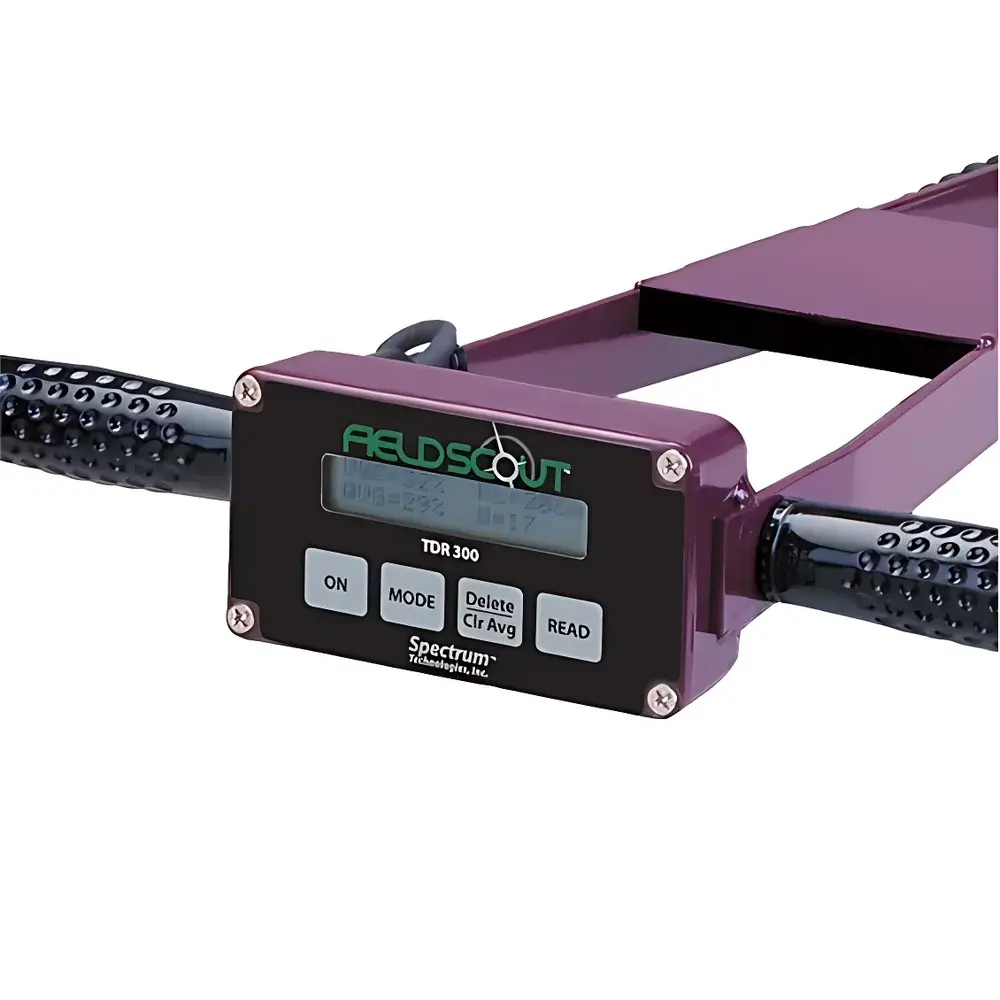
SPECTRUM TDR300 Time-Domain Reflectometry Soil Moisture Meter
| Origin | USA |
|---|---|
| Manufacturer Type | Authorized Distributor |
| Origin Category | Imported |
| Model | TDR300 |
| Instrument Type | Volumetric Water Content & Relative Water Content Meter |
| Price Range | USD 1,400 – 2,800 (FOB) |
| Measurement Principle | TDR (Time-Domain Reflectometry) |
| Accuracy | ±3.0% VWC (for EC < 2 dS/m and clay content < 30%) |
| Resolution | 1.0% VWC |
| Data Storage Capacity | 2,700 readings (1,250 with GPS synchronization) |
| Battery | 4 × AAA alkaline (typical operational life: 12 months) |
| Weight | 1.36 kg |
| Display | Backlit LCD with on-device data logging |
| Communication Interface | RS-232 serial port |
| Probe Options | 3.8 cm, 7.5 cm, 12 cm, and 20 cm lengths (0.5 cm diameter, 3.3 cm electrode spacing) |
| Operating Modes | Volumetric Water Content (VWC) and Relative Water Content (RWC) for irrigation scheduling |
Overview
The SPECTRUM TDR300 is a field-deployable, handheld time-domain reflectometry (TDR) soil moisture meter engineered for high-reproducibility measurement of volumetric water content (VWC) in mineral and organic soils. Unlike capacitance-based sensors, the TDR300 employs electromagnetic pulse propagation along parallel stainless-steel rods to determine dielectric permittivity—directly correlated to soil water content via established calibration models (e.g., Topp equation). Its robust architecture ensures stable performance across variable salinity (EC < 2 dS/m) and texture conditions (clay content ≤30%), making it suitable for long-term monitoring in agricultural fields, rangelands, turfgrass systems (including golf courses), greenhouses, and controlled-environment laboratories. Designed for integration into precision irrigation workflows, the TDR300 delivers real-time, in-situ VWC data without requiring soil extraction or laboratory analysis.
Key Features
- True TDR technology with built-in signal generator and oscilloscope-style waveform analysis—eliminates reliance on empirical capacitance correlations
- Dual measurement modes: Volumetric Water Content (m³/m³, % vol.) and Relative Water Content (RWC) scaled to field capacity and wilting point for irrigation decision support
- Onboard backlit LCD display with intuitive menu navigation and real-time graphical feedback
- Integrated data logger storing up to 2,700 timestamped readings (reduced to 1,250 when synchronized with external GPS)
- RS-232 serial interface for direct connection to PCs or data loggers; compatible with standard terminal emulation software (e.g., PuTTY, Tera Term)
- Modular probe system with four standardized lengths (3.8 cm, 7.5 cm, 12 cm, 20 cm) enabling depth-resolved profiling without recalibration
- Compact, rugged housing (10.5 × 7.0 × 1.8 cm) with IP65-rated enclosure for dust and water resistance during field use
Sample Compatibility & Compliance
The TDR300 is validated for use in mineral soils, sandy loams, silts, and peats with bulk electrical conductivity below 2 dS/m and clay fractions under 30%. It complies with ASTM D5778–22 (“Standard Test Method for Determining Soil Moisture Content Using Time Domain Reflectometry”) and supports GLP-aligned field documentation protocols. While not FDA-regulated, its data integrity features—including sequential reading IDs, internal clock stamping, and non-volatile memory—facilitate audit-ready recordkeeping for USDA NRCS, EPA Region-specific monitoring programs, and ISO 17025-accredited environmental labs conducting soil hydrological characterization.
Software & Data Management
Data export occurs via ASCII-formatted text files through the RS-232 interface, supporting direct import into Excel, R, Python (pandas), or GIS platforms (ArcGIS, QGIS). When paired with third-party GPS receivers (NMEA 0183 compliant), georeferenced VWC datasets can be generated for spatial interpolation (kriging, inverse distance weighting) and irrigation zone mapping. The device does not require proprietary software; however, SPECTRUM provides open CSV schema documentation and sample Python scripts for batch processing and QA/QC filtering (e.g., outlier detection based on reflected signal amplitude thresholds).
Applications
- Precision irrigation scheduling in row crops, orchards, and vineyards using RWC thresholds relative to crop-specific management allowed depletion (MAD)
- Soil moisture monitoring for drought early-warning systems in rangeland and pasture management
- Calibration and validation of remote-sensing soil moisture products (e.g., SMAP, Sentinel-1 SAR)
- Long-term hydrological studies involving infiltration, evapotranspiration partitioning, and vadose zone modeling
- Greenhouse substrate monitoring for horticultural crop optimization and nutrient solution delivery control
- Educational use in university soil physics and environmental science curricula
FAQ
What soil properties affect TDR300 accuracy?
Accuracy is optimized for soils with EC < 2 dS/m and clay content < 30%. High-salinity or heavy-clay soils may require site-specific calibration using gravimetric sampling.
Can the TDR300 measure frozen or saline soils?
No—frozen water lacks dielectric contrast; saline soils above 2 dS/m distort pulse reflection timing and reduce signal-to-noise ratio.
Is the device compatible with modern GPS units?
Yes—via optional NMEA 0183-compatible GPS/DGPS interface cable; user-supplied GPS must output GGA and RMC sentences.
How is probe insertion depth selected?
Probe length corresponds to target sampling depth: 3.8 cm for surface mulch or seedbeds; 20 cm for root-zone assessment in deep-rooted perennials.
Does the TDR300 meet regulatory requirements for certified environmental reporting?
While not certified under ISO/IEC 17025, its adherence to ASTM D5778–22 and traceable measurement principles supports defensible data submission to state and federal natural resource agencies.







