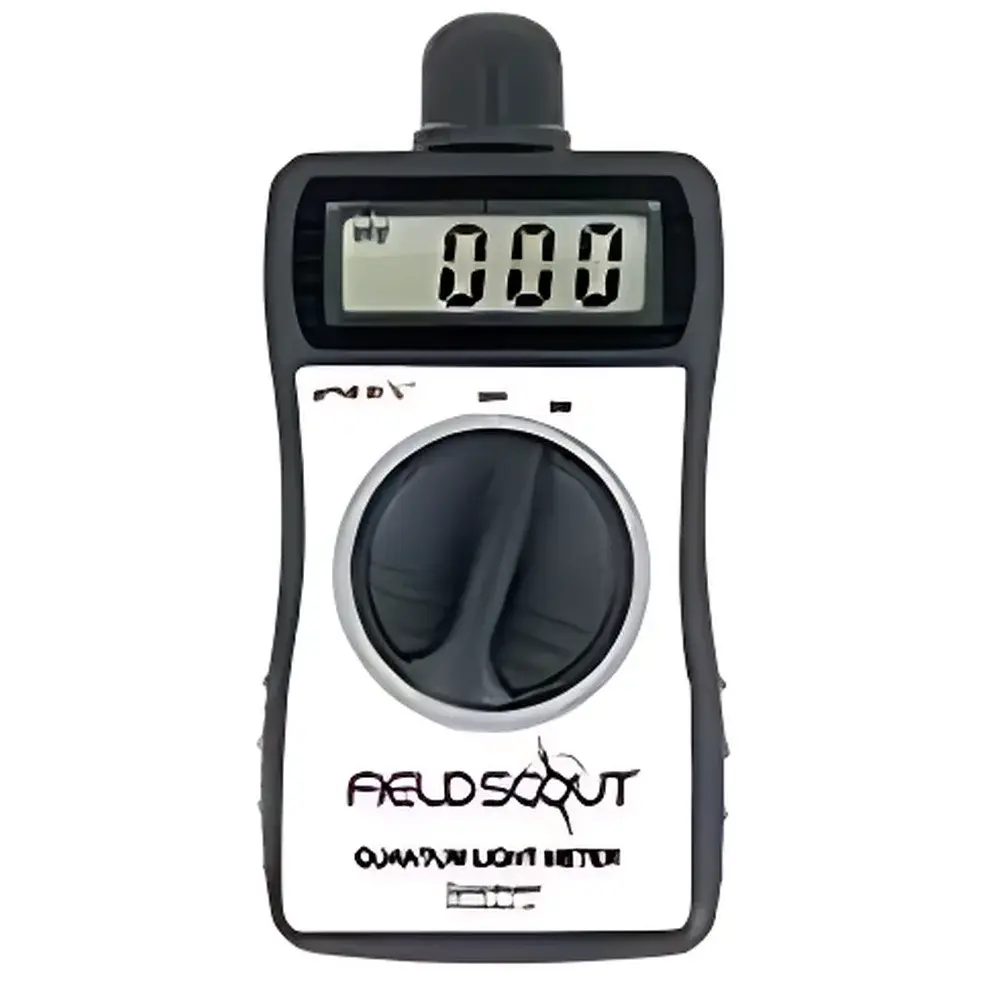
Spectrum Technologies 3415F Quantum Light Meter
| Brand | Spectrum Technologies |
|---|---|
| Origin | USA |
| Model | 3415F |
| Measurement Range | 0–1999 μmol·m⁻²·s⁻¹ |
| Spectral Response | 400–700 nm (PAR) |
| Accuracy | ±5% |
| Display Unit | μmol·m⁻²·s⁻¹ |
| Power Supply | 9V alkaline battery |
Overview
The Spectrum Technologies 3415F Quantum Light Meter is a field-deployable, hand-held instrument engineered for the precise quantification of Photosynthetically Active Radiation (PAR) in the 400–700 nm spectral band. Based on silicon photodiode technology with cosine-corrected optical input and spectrally tuned interference filters, the 3415F delivers traceable irradiance measurements expressed as photosynthetic photon flux density (PPFD) in micromoles per square meter per second (μmol·m⁻²·s⁻¹). Its design adheres to the foundational metrological principles defined in ASTM E2912–22 (“Standard Practice for Determining Photosynthetic Photon Flux Density”) and aligns with ISO 17166:2022 (CIE S 026/E:2018) recommendations for plant lighting measurement. The device is calibrated against NIST-traceable standards and validated under controlled spectral irradiance conditions to ensure inter-laboratory reproducibility—critical for longitudinal ecological monitoring and controlled-environment agriculture (CEA) validation.
Key Features
- Optimized spectral response: Narrowband filtering ensures minimal out-of-band sensitivity (<2% deviation at 380 nm and 720 nm), minimizing errors from near-UV or NIR contamination common in broad-spectrum light sources such as LEDs and high-pressure sodium lamps.
- Cosine-corrected diffuser: Precision-machined acrylic diffuser provides <±3% angular response error up to 80° zenith angle, satisfying IEC 62471 requirements for directional uniformity in field measurements.
- Real-time digital readout: High-contrast LCD displays instantaneous PPFD values with 1-second update rate; no averaging or smoothing applied—enabling detection of rapid light transients during cloud cover or dynamic shading events.
- Rugged field architecture: IP54-rated enclosure resists dust ingress and incidental water splashing; operating temperature range: –10 °C to +50 °C, suitable for unshaded outdoor deployment across multiple growing seasons.
- Battery-operated autonomy: Powered by a single 9V alkaline battery (included), supporting >200 hours of continuous operation; low-battery indicator alerts users prior to measurement drift onset.
Sample Compatibility & Compliance
The 3415F is compatible with all common PAR-emitting sources encountered in agricultural and ecological settings—including natural sunlight, horticultural LEDs, fluorescent tubes, metal halide, and ceramic metal halide fixtures. It does not require source-specific calibration factors due to its spectrally flat quantum responsivity across the defined PAR band. The instrument conforms to GLP-aligned documentation practices: each unit ships with a factory calibration certificate indicating date, reference standard (NIST SRM 2255), and uncertainty budget (k=2). While not FDA 21 CFR Part 11 compliant (as it lacks audit trail or electronic signature functionality), raw data export is supported via optional RS-232 interface (Model 3415F-RS), enabling integration into validated LIMS or environmental data acquisition systems compliant with ISO/IEC 17025.
Software & Data Management
The 3415F operates as a standalone meter but supports external data logging through the optional Spectrum Technologies Logger Pro software (v4.2+). When connected via RS-232 adapter, users can configure time-stamped sampling intervals (1 s to 60 min), define measurement sessions, and export CSV-formatted datasets containing timestamp, PPFD value, and ambient temperature (if paired with optional thermistor probe). All exported files include metadata headers compliant with FAIR data principles (Findable, Accessible, Interoperable, Reusable), facilitating integration with R, Python (pandas), or MATLAB workflows used in crop modeling (e.g., Farquhar-von Caemmerer-Berry biochemical model inputs) or ecosystem carbon flux analysis.
Applications
- Greenhouse light mapping: Quantify spatial PPFD distribution to optimize supplemental lighting placement and identify shading anomalies caused by structural elements or crop canopy development.
- Controlled-environment agriculture (CEA) validation: Verify manufacturer-specified PPFD output of LED grow lights under operational conditions, supporting DOE GATEWAY program reporting requirements.
- Ecological field studies: Monitor diurnal and seasonal PAR dynamics in forest understories, grasslands, and wetland margins to parameterize net primary productivity (NPP) models.
- Plant physiology experiments: Correlate real-time PPFD exposure with gas exchange (e.g., LI-6400XT), chlorophyll fluorescence (e.g., PAM-2500), or leaf-level photosynthetic acclimation indices.
- Agricultural extension & advisory services: Provide growers with objective light intensity benchmarks for crop-specific DLI (Daily Light Integral) targets—e.g., 17–25 mol·m⁻²·d⁻¹ for tomato fruiting, 12–15 mol·m⁻²·d⁻¹ for lettuce production.
FAQ
Is the 3415F calibrated to NIST-traceable standards?
Yes—each unit undergoes individual calibration using a NIST-traceable 1000 W quartz-tungsten-halogen standard lamp and spectroradiometric verification across the 400–700 nm band.
Can the 3415F measure underwater PAR?
No—the cosine corrector is optimized for air interface; immersion alters angular response and spectral transmission. For aquatic applications, use the dedicated underwater quantum sensor (e.g., QSL-2100 series).
Does the 3415F support data logging without external hardware?
No internal memory is provided; continuous logging requires the optional RS-232 interface and Logger Pro software.
What is the recommended recalibration interval?
Annual recalibration is advised for research-grade applications; biennial recalibration suffices for routine agronomic monitoring where absolute accuracy tolerance exceeds ±10%.
How does the 3415F differ from broadband pyranometers?
Unlike thermopile-based pyranometers that measure total solar irradiance (W·m⁻²), the 3415F measures photon count within the biologically relevant 400–700 nm band—essential for photosynthesis modeling where photon energy (not wattage) drives electron transport.
Related Products