
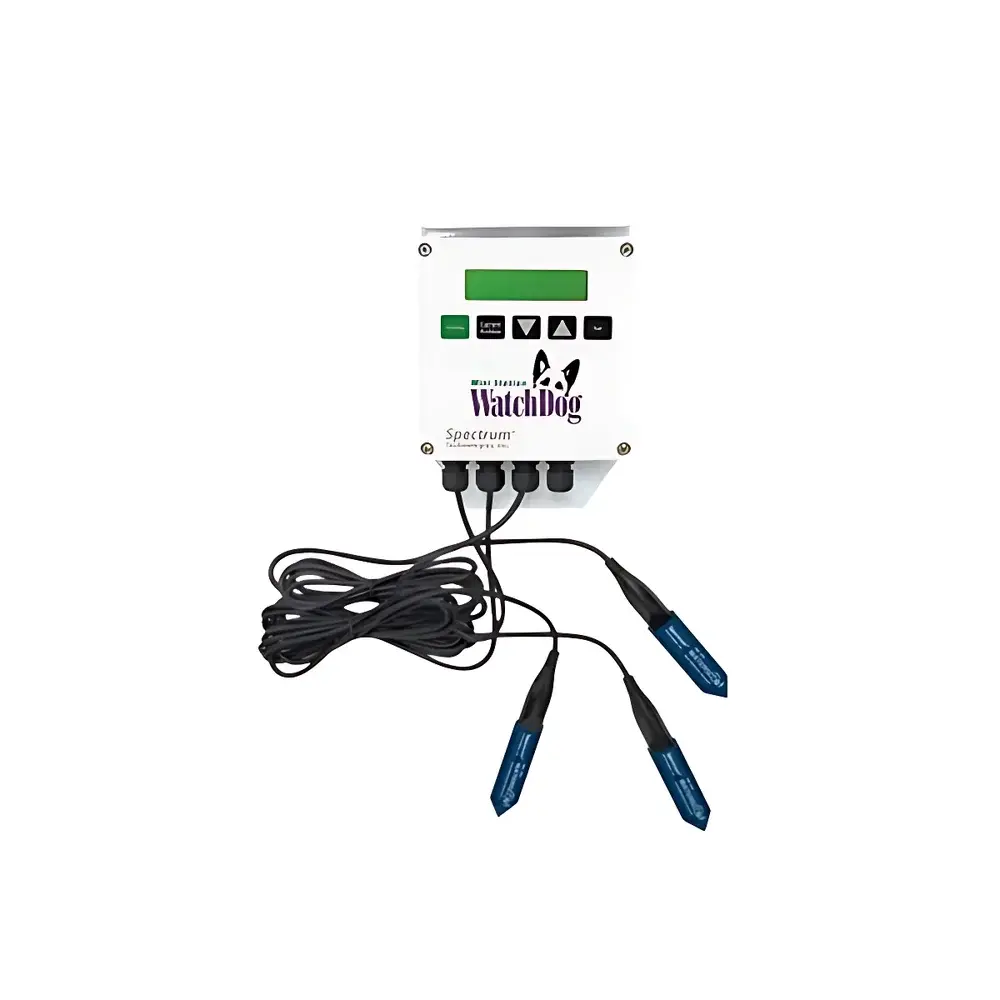
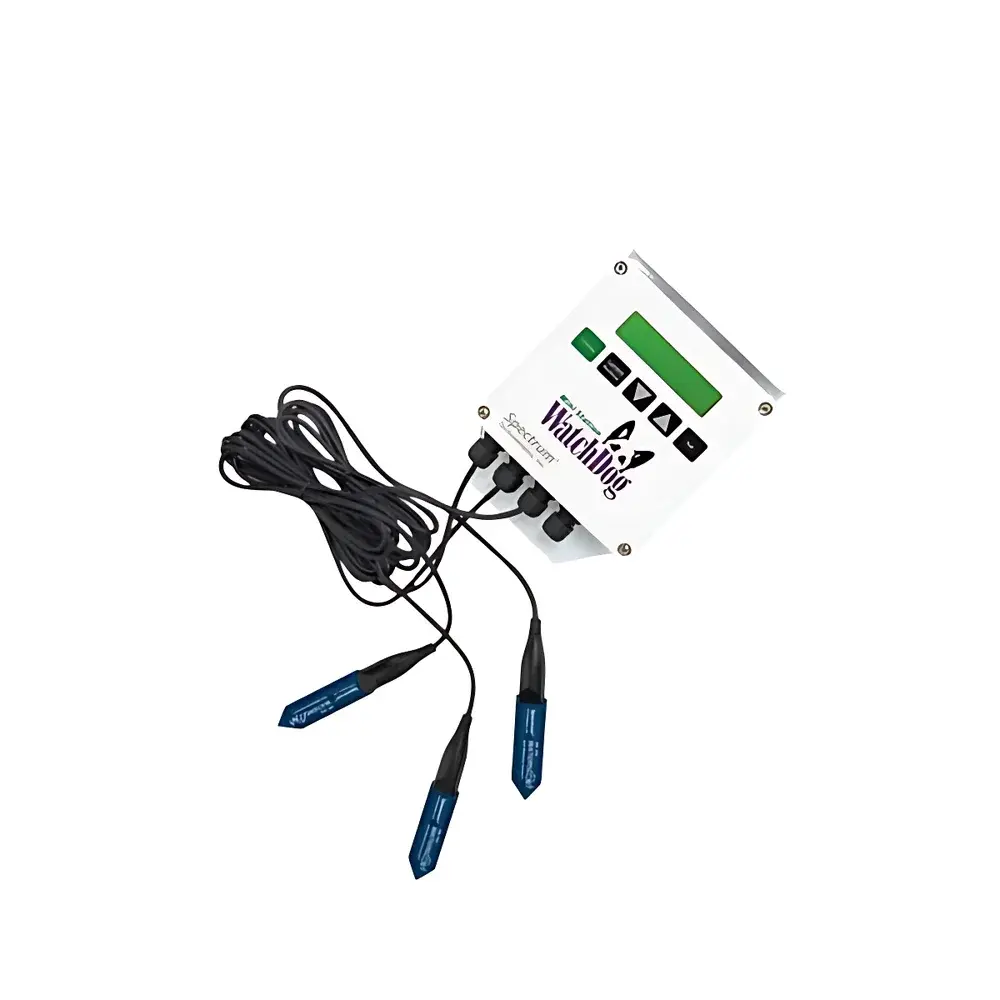
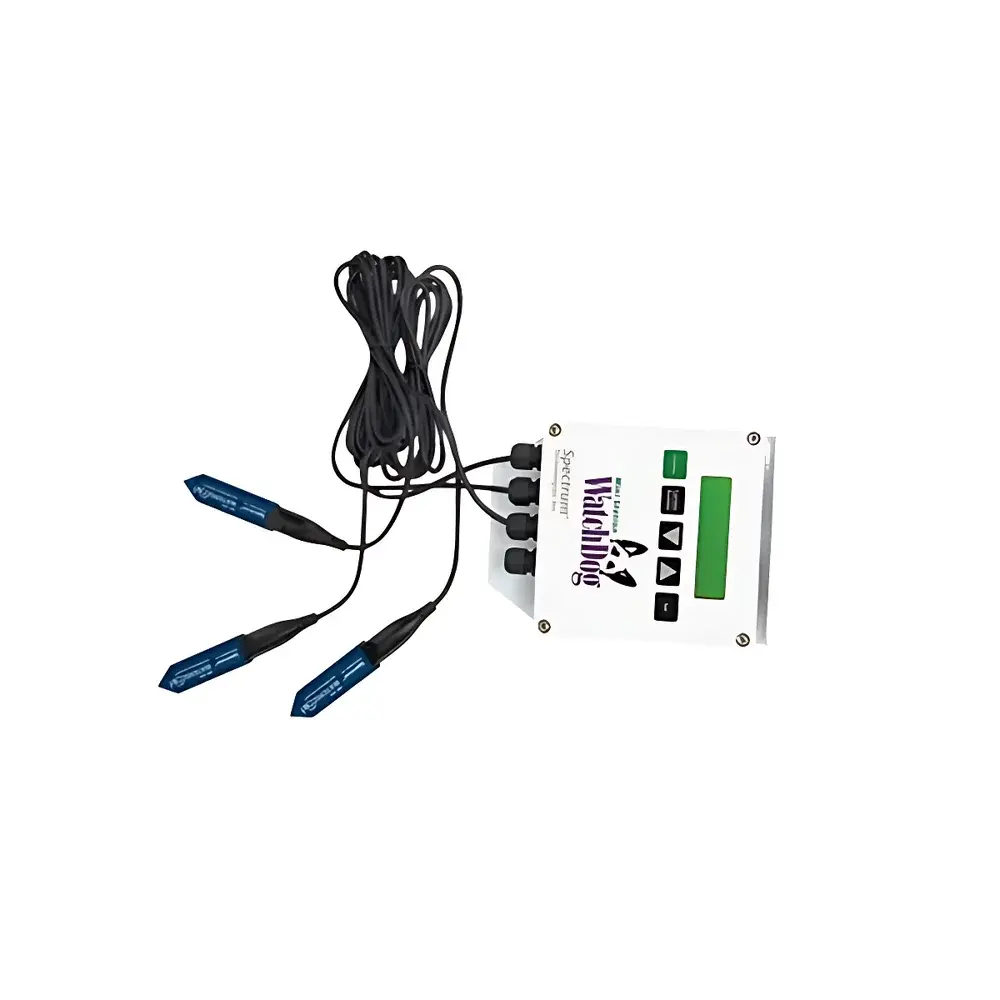
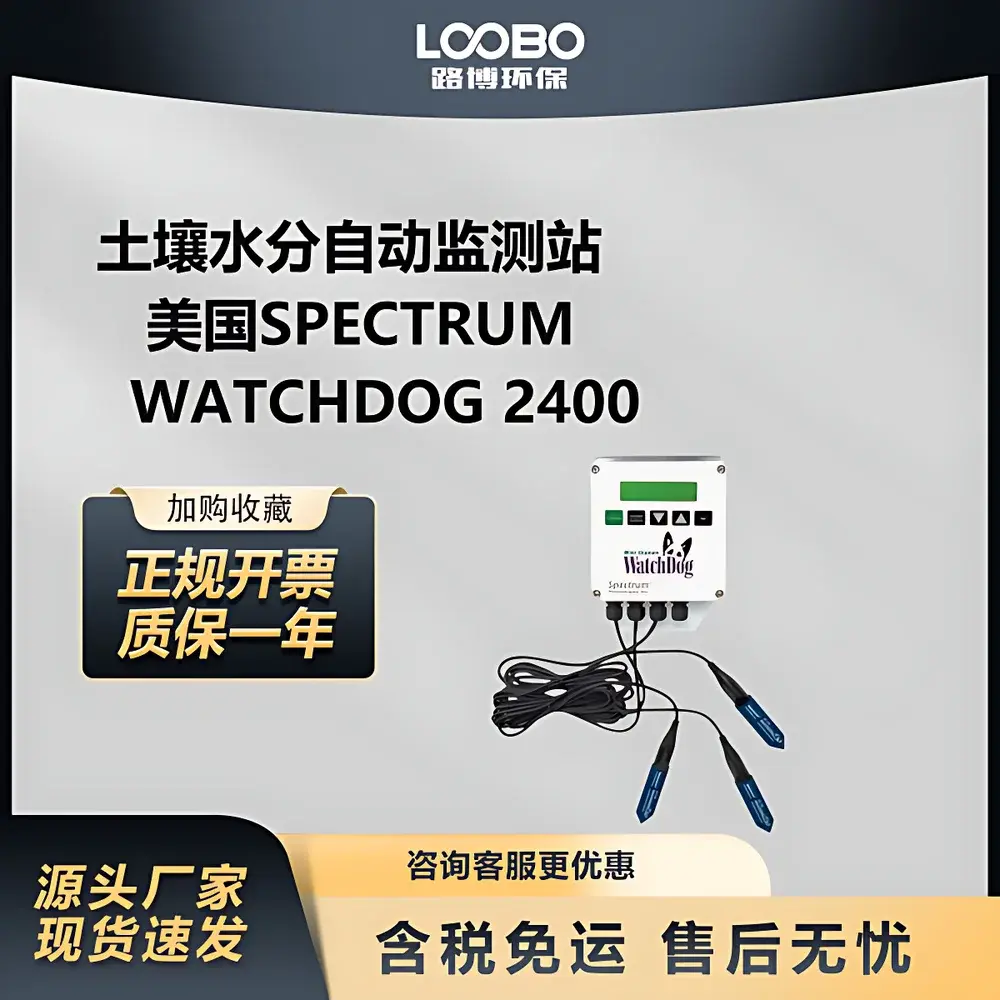
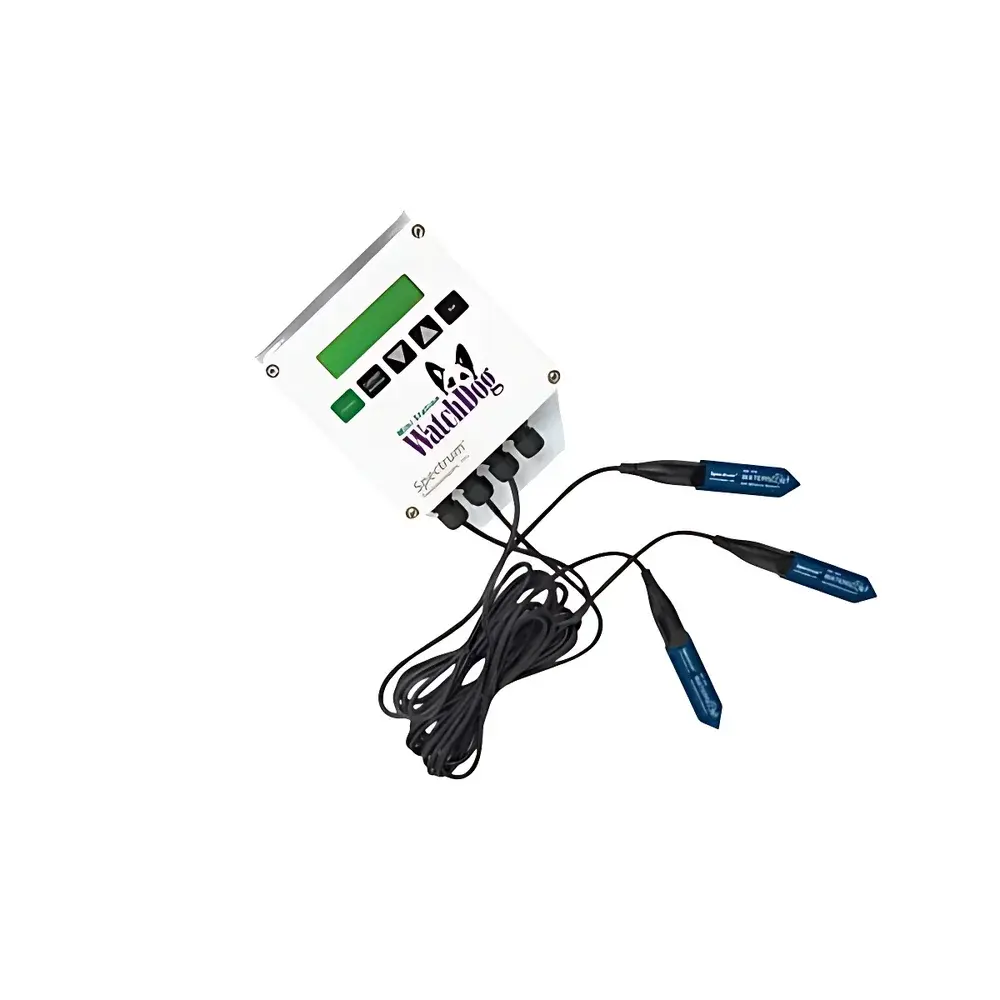
SPECTRUM WATCHDOG 2400 Soil Moisture and Environmental Monitoring Station
| Brand | Active Spectrum |
|---|---|
| Origin | USA |
| Model | WATCHDOG 2400 |
| IP Rating | IP66 |
| Power Supply | 4×AA batteries (alkaline: up to 10 months |
| lithium | up to 12 months) |
| Data Storage | Non-volatile memory with auto-failover protection |
| Display | Integrated LCD for real-time and daily min/max values |
| Sensor Capacity | Up to 4 internal soil moisture/temperature probes + up to 9 external sensors |
| Communication | RS-232 serial port |
| Compliance | CE, FCC Class B, RoHS |
Overview
The SPECTRUM WATCHDOG 2400 Soil Moisture and Environmental Monitoring Station is a field-deployable, battery-powered data logging system engineered for long-term, unattended monitoring of soil water content and complementary environmental parameters. Based on time-domain reflectometry (TDR) or capacitance-based soil moisture sensing (depending on probe configuration), the system delivers repeatable volumetric water content (VWC) measurements across multiple soil profiles—up to four discrete locations simultaneously. Its ruggedized design incorporates an IP66-rated enclosure and weather-resistant connectors, enabling reliable operation in exposed outdoor environments ranging from agricultural fields and research watersheds to ecological restoration sites and municipal green infrastructure projects. Unlike cloud-dependent IoT platforms, the WATCHDOG 2400 operates autonomously with local data storage and direct LCD readout, minimizing dependency on external infrastructure while maintaining traceability and audit readiness.
Key Features
- Integrated LCD display for real-time viewing of current readings, plus daily maximum and minimum values—no PC required for basic status verification.
- Non-volatile memory with automatic failover protection ensures data integrity during power interruption or battery replacement.
- Modular sensor architecture: supports up to four internal soil moisture and temperature probes (e.g., 10HS, EC-5, or TEROS 12-compatible analog outputs) and up to nine additional external sensors via analog voltage, pulse-count, or SDI-12 interfaces.
- Field-configurable sampling intervals (1 minute to 24 hours) and programmable alarm thresholds for rapid response to critical moisture thresholds.
- RS-232 serial communication port enables direct connection to PCs, modems, or SCADA systems for scheduled data retrieval and firmware updates.
- Low-power electronics optimized for extended battery life: alkaline AA cells sustain operation for up to 10 months; lithium AA cells extend runtime to 12 months under typical logging intervals (e.g., 15-minute sampling).
Sample Compatibility & Compliance
The WATCHDOG 2400 is compatible with industry-standard soil moisture sensors calibrated for mineral, organic, and saline soils—supporting VWC measurement ranges from 0–100% with typical accuracy of ±3% VWC (dependent on probe selection and soil-specific calibration). Temperature compensation is applied automatically using integrated thermistors. The system complies with FCC Part 15 Class B and CE directives for electromagnetic compatibility and safety. While not certified for hazardous locations, its IP66 ingress protection meets IEC 60529 requirements for dust-tight and water-jet resistance—making it suitable for permanent installation in USDA NRCS, EPA Region IV, or FAO-recommended monitoring networks. Data logs are timestamped and stored in ASCII-delimited format, facilitating import into USDA-ARS Hydrus, R, Python (pandas), or commercial GIS platforms.
Software & Data Management
Data retrieval and configuration are performed using Spectrum’s proprietary WatchDog Software (Windows-compatible), which supports batch download, graphical trend visualization, statistical summary generation (mean, std dev, min/max), and export to CSV, Excel, or XML. The software enforces user-defined metadata tagging (site ID, probe depth, soil texture class) and maintains full change history for instrument settings. Although the device does not implement FDA 21 CFR Part 11 electronic signature controls, its deterministic logging behavior, non-erasable memory buffer, and sequential record numbering support GLP-aligned field data collection workflows when paired with documented SOPs and manual audit trails.
Applications
- Irrigation scheduling and deficit irrigation management in row crops, orchards, and vineyards.
- Soil hydrology studies including infiltration rate estimation, evapotranspiration modeling, and vadose zone flux analysis.
- Wetland restoration monitoring and groundwater recharge assessment.
- Educational deployment in university soil physics and environmental science laboratories.
- Municipal stormwater BMP performance evaluation (e.g., bioswales, rain gardens, permeable pavements).
- Long-term climate observatory networks requiring low-maintenance, solar-adjacent sensor nodes.
FAQ
Can the WATCHDOG 2400 operate without a computer after initial setup?
Yes—the unit runs fully autonomously once configured. All logging, storage, and display functions are self-contained.
What types of external sensors are supported?
Analog voltage (0–5 V), pulse-output (e.g., tipping bucket rain gauges), and SDI-12 digital sensors—including air temperature, relative humidity, solar radiation, wind speed/direction, barometric pressure, and leaf wetness sensors.
Is calibration traceable to NIST standards?
Sensor calibration is performed by individual probe manufacturers (e.g., Decagon/METER Group, Campbell Scientific). The WATCHDOG 2400 itself serves as a data acquisition platform and does not perform primary calibration; users must apply site-specific calibrations per ASTM D5859 and ISO 11274 guidelines.
Does the system support remote telemetry?
Not natively—but the RS-232 port allows integration with third-party cellular or LoRaWAN modems for off-site data transmission, subject to user-configured polling protocols.
How is data security handled during transfer?
Data files are plain-text ASCII with no encryption. Secure transfer requires external measures such as encrypted VPN tunnels or password-protected FTP/SFTP servers managed at the host system level.
Related Products







