
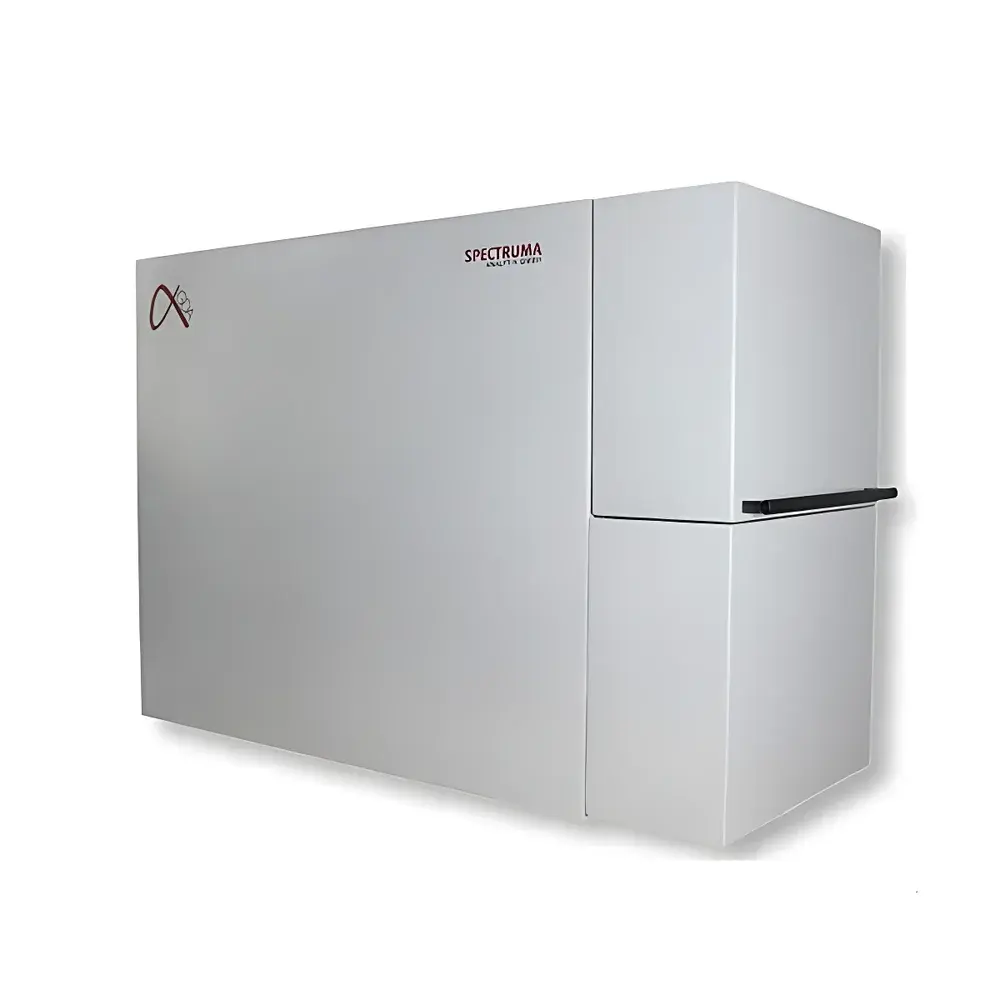
SPECTRUMA GDA Alpha High-Resolution Glow Discharge Optical Emission Spectrometer
| Brand | SPECTRUMA |
|---|---|
| Origin | Germany |
| Manufacturer Type | Authorized Distributor |
| Origin Category | Imported |
| Model | GDA Alpha |
| Pricing | Upon Request |
Overview
The SPECTRUMA GDA Alpha is a high-resolution glow discharge optical emission spectrometer (GD-OES) engineered for quantitative depth profiling and bulk elemental analysis of conductive and semi-conductive solid materials. It operates on the principle of radiofrequency (RF) or direct-current (DC) glow discharge plasma sputtering, where a low-pressure argon plasma bombards the sample surface, atomizing and exciting elements in situ. Emitted photons are dispersed by a Paschen-Runge optical system and detected by a state-of-the-art back-thinned CCD detector, enabling simultaneous acquisition across the full spectral range from 120 nm to 800 nm. This architecture delivers true multi-element capability—including light elements such as H, C, N, and O—with detection limits in the sub-ppm range and depth resolution at the nanometer scale. Designed for metrology-grade reproducibility and long-term stability, the GDA Alpha meets the stringent requirements of industrial QA/QC laboratories, R&D centers, and accredited testing facilities operating under ISO/IEC 17025, ASTM E3061, and ISO 14707 frameworks.
Key Features
- High-resolution CCD detection system with automatic gain control, delivering wide dynamic range (>10⁶), low noise, and full-spectrum acquisition without mechanical scanning
- Paschen-Runge optical design with 400 mm focal length, holographically ruled grating (2400 lines/mm), and spectral resolution <20 pm (FWHM)
- Thermally stabilized optical chamber with active temperature control (±0.1 °C), ensuring drift-free performance over extended measurement sequences
- Modular DC glow discharge source: adjustable voltage up to 1500 V, current up to 250 mA, and interchangeable anodes (1–8 mm diameter) for optimized sputtering across diverse matrices
- Integrated vacuum system with single-stage oil-sealed rotary vane pump (<50 dB noise), stainless-steel vacuum chamber, and built-in safety valve to prevent backstreaming during power interruption
- Direct sample cooling capability enables stable analysis of thin films (down to 50 µm) and heat-sensitive layers without external chillers
- Optimized argon flow management—dynamically regulated for both ultra-low detection limits (e.g., for N in steel) and high depth resolution (≤1 nm/step)
- Automated cleaning cycle for electrode and optical windows, minimizing downtime and maintaining calibration integrity between runs
Sample Compatibility & Compliance
The GDA Alpha accepts flat, solid, electrically conductive samples with thicknesses ranging from 50 µm to 45 mm. Non-conductive coatings may be analyzed using RF mode with appropriate grounding strategies. The instrument supports analysis of metals, alloys, carbides, nitrides, PVD/CVD coatings, electroplated layers, and diffusion-treated surfaces. All measurements comply with traceability requirements for GLP and GMP environments: WinG DOES software includes audit trail functionality, electronic signatures (21 CFR Part 11 compliant when configured with validated IT infrastructure), and secure method/version control. Calibration protocols follow certified reference materials traceable to NIST and BAM standards; oxygen and nitrogen quantification is validated per ISO 14707 for metallic matrices.
Software & Data Management
WinG DOES is a Windows-based platform (Windows 10/11 compatible) designed for intuitive yet rigorous spectral data handling. Its modular interface supports role-based access control, method templating, and hierarchical user permissions. Key capabilities include: automated QDP (Quantitative Depth Profile) calibration using matrix-matched standards; iterative background correction algorithms; real-time spectral deconvolution for overlapping lines (e.g., Fe I 238.204 nm / C I 238.205 nm); customizable reporting templates exportable to PDF, CSV, XML, and SPC formats; post-acquisition reprocessing with variable smoothing, normalization, and layer boundary definition. Data archives are structured in ACID-compliant SQLite databases with SHA-256 checksum validation for integrity assurance.
Applications
- Heat treatment verification: quantifying carburized, nitrided, or carbonitrided case depths with sub-micron accuracy and stoichiometric ratio determination (e.g., Fe₃C vs. Fe₄N phases via C/N depth correlation)
- Coating characterization: measuring thickness, composition gradients, interdiffusion zones, and interface contamination in Zn, Cr, TiN, DLC, and Al-Si coatings
- Hardmetal and cemented carbide analysis: resolving W, Co, C, and trace B/Ta distributions across binder and grain phases
- Bulk compositional certification: rapid (<60 s) full-element survey (H–U) for alloy grade verification in aerospace nickel superalloys and automotive steels
- Photovoltaic and battery materials: profiling dopant distribution (e.g., P/B in Si wafers) and SEI layer chemistry in Li-ion electrode cross-sections
- Failure analysis: identifying subsurface oxidation, hydrogen embrittlement markers, or intergranular segregation in fracture surfaces
FAQ
What light elements can the GDA Alpha quantify with certified accuracy?
O, N, C, H, and F are routinely measured using vacuum UV optics and optimized discharge parameters; detection limits are ≤0.1 ppm for O in Fe-based matrices and ≤5 ppm for H in Ti alloys.
Is the instrument capable of analyzing non-metallic or insulating samples?
Yes—via RF glow discharge mode with external grounding and optional RF impedance matching network; suitable for ceramics, oxides, and polymer-coated metals.
How does the GDA Alpha ensure long-term calibration stability?
Through continuous internal wavelength reference tracking (Hg/Ne lamp), daily automated intensity normalization, and thermal stabilization of both optical path and plasma source.
Can depth profiles be exported for third-party modeling tools?
Yes—depth-resolved concentration data is exportable in standardized ASCII format with metadata headers compatible with Thermo-Calc, DICTRA, and MATLAB-based diffusion simulation workflows.
What maintenance intervals are recommended for routine operation?
Vacuum pump oil replacement every 6 months; CCD window cleaning every 200 hours of operation; anode replacement based on sputter yield (typically 500–1000 h for Cu anodes in steel analysis).
Related Products





