
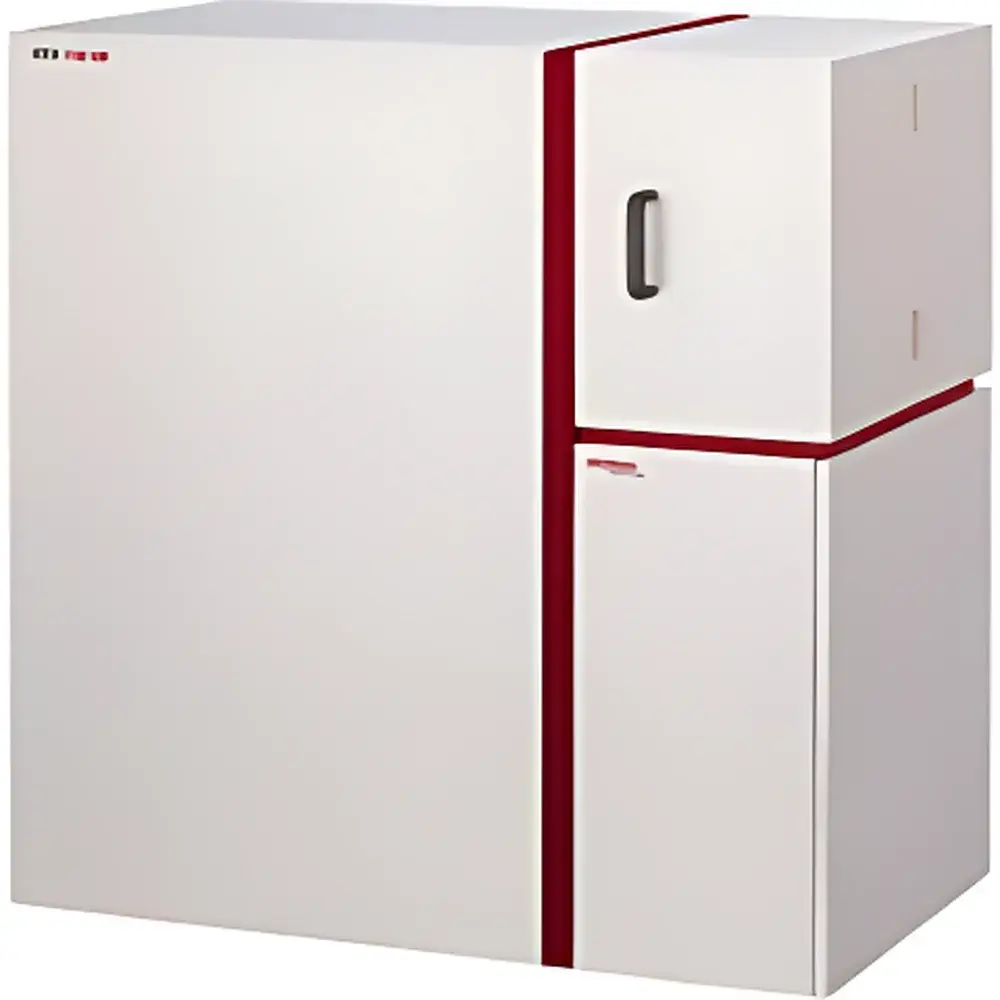
SPECTRUMA GDA150 HR High-Resolution Glow Discharge Optical Emission Spectrometer
| Brand | SPECTRUMA |
|---|---|
| Origin | Germany |
| Model | GDA150 HR |
| Detector Type | Thermally Stabilized CCD |
| Light Element Capability | C, N, H (O optional) |
| Sample Type | Conductive solids only |
| Application Scope | Depth profiling, surface diffusion analysis, coating & plating evaluation, hard coating characterization |
Overview
The SPECTRUMA GDA150 HR is a high-resolution glow discharge optical emission spectrometer (GD-OES) engineered for quantitative depth-resolved elemental analysis of conductive solid materials. Based on the principle of radiofrequency (RF) or direct current (DC) glow discharge plasma sputtering coupled with simultaneous polychromatic detection via a thermally stabilized charge-coupled device (CCD) spectrometer, the GDA150 HR enables rapid, reproducible, and matrix-independent quantification across depth scales from nanometers to hundreds of micrometers. Its robust RF/DC dual-mode excitation source ensures stable plasma generation on a wide range of conductive substrates—including steels, aluminum alloys, titanium, copper, and refractory metals—without requiring conductive coatings. Designed for industrial QA/QC laboratories and R&D facilities, the instrument delivers analytical performance approaching that of the flagship GDA 650 HR platform while maintaining a compact footprint and simplified operational workflow.
Key Features
- Thermally stabilized high-resolution CCD detector with optimized grating configuration for enhanced spectral resolution and signal-to-noise ratio in the 130–800 nm range
- Dual-mode RF/DC glow discharge source enabling flexible excitation for both insulating-coated conductors and pure metals
- Integrated temperature-controlled sample chamber ensuring long-term thermal stability during extended depth profiling sequences
- Automated argon gas flow regulation and pressure control system compliant with ISO 14707 and ASTM E2627 standards for GD-OES operation
- Pre-aligned optical path with sealed vacuum monochromator housing, minimizing maintenance intervals and calibration drift
- Modular electrode design supporting flat, curved, and irregularly shaped samples up to Ø100 mm and 50 mm height
Sample Compatibility & Compliance
The GDA150 HR is validated for direct analysis of electrically conductive bulk solids and coated systems where the substrate remains conductive beneath surface layers. It supports quantitative depth profiling of metallic matrices, diffusion zones (e.g., carburized or nitrided case depths), PVD/CVD hard coatings (TiN, CrN, DLC), electroplated layers (Ni, Zn, Sn), and conversion coatings (phosphate, chromate). Light element detection—including carbon, nitrogen, hydrogen (and optionally oxygen)—is achieved using vacuum-optimized optics and dedicated spectral lines (e.g., C I 165.7 nm, N I 174.3 nm, H I 656.3 nm), with detection limits in the low ppm range under optimized conditions. The system complies with ISO/IEC 17025 requirements for testing laboratories and supports audit-ready documentation aligned with GLP and GMP frameworks. Full traceability of measurement parameters—including sputter time, voltage, current, pressure, and integration time—is maintained per analysis sequence.
Software & Data Management
Operation is managed through SPECTRUMA’s proprietary GD-Analyzer software, a Windows-based application supporting method development, real-time spectral monitoring, and automated depth calibration using certified reference materials (CRMs) traceable to NIST and BAM standards. The software provides full-spectrum evaluation capability, enabling post-acquisition reprocessing of raw intensity data without re-measurement. All analytical sessions generate timestamped, user-attributed reports with embedded metadata required for FDA 21 CFR Part 11 compliance—including electronic signatures, audit trails, and immutable record storage. Data export formats include CSV, XML, and ASTM E1359-compliant .gdos files for integration into LIMS and enterprise QA databases.
Applications
- Quantitative depth profiling of diffusion-treated surfaces (e.g., carburizing, nitriding, boriding) in aerospace and automotive components
- Characterization of multilayer functional coatings in cutting tools, biomedical implants, and microelectronics packaging
- In-process verification of plating thickness uniformity and interfacial composition in galvanic production lines
- Failure analysis of delamination, interdiffusion, or oxidation at coating-substrate interfaces
- Research-grade investigation of light-element segregation behavior in advanced high-strength steels and Ni-based superalloys
- Calibration transfer studies between GD-OES and complementary techniques such as SIMS and XPS
FAQ
Can the GDA150 HR analyze non-conductive samples directly?
No. The instrument requires electrical conductivity for stable glow discharge plasma formation. Non-conductive samples must be embedded in a conductive matrix or coated with a thin conductive layer (e.g., carbon) prior to analysis.
What is the typical depth resolution achievable with this system?
Depth resolution depends on material sputter rate and instrumental parameters; for steel, it typically ranges from 2–5 nm per data point in the near-surface region, improving to ~10–20 nm deeper into the bulk.
Is oxygen analysis supported as standard?
Oxygen quantification is available as an optional upgrade, requiring additional vacuum-path optimization and spectral line validation using O I 130.2 nm or 130.5 nm under high-purity argon purge conditions.
How does the GDA150 HR ensure measurement reproducibility across shifts?
Through hardware-level thermal stabilization, automated plasma ignition routines, and software-enforced method locking with operator-level access controls—all documented in the system’s electronic audit trail.
Does the system support ASTM E2627-compliant reporting?
Yes. The GD-Analyzer software includes preconfigured report templates aligned with ASTM E2627 Annex A1 for GD-OES depth profile reporting, including uncertainty estimation and CRM traceability statements.
Related Products





