
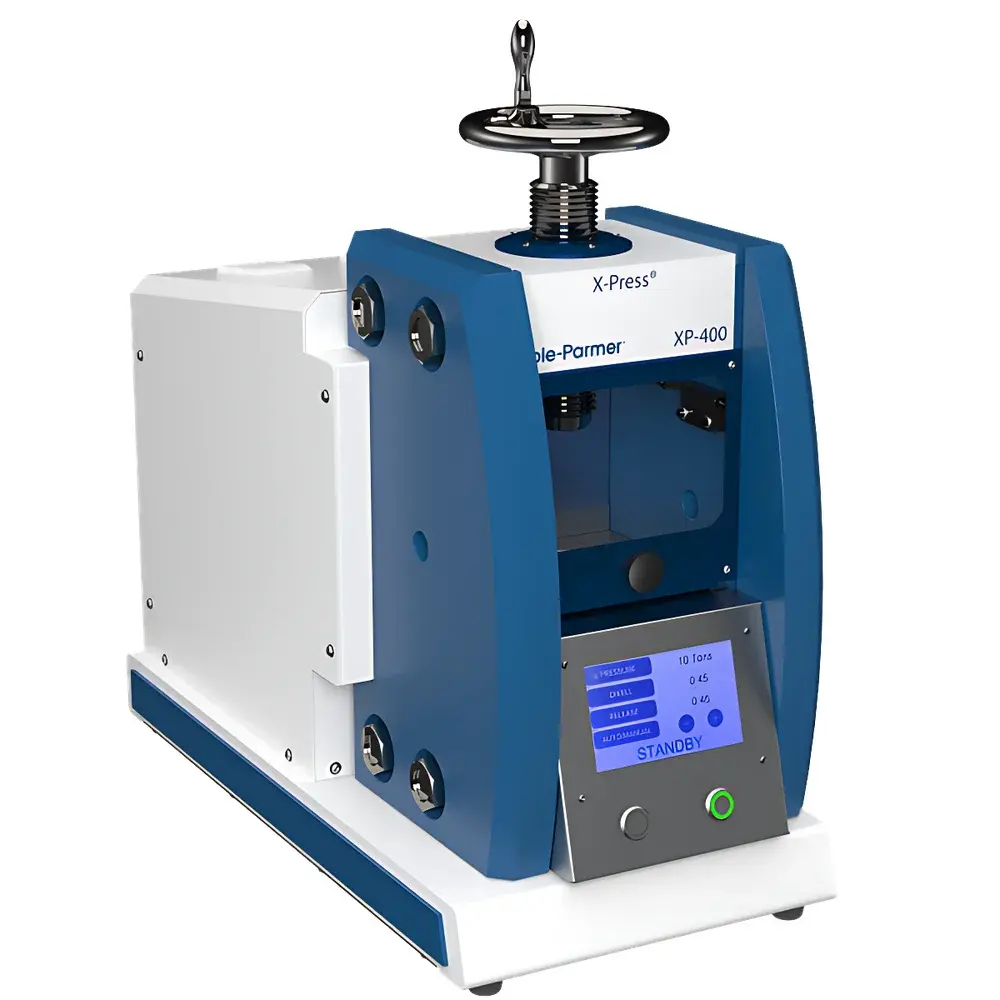
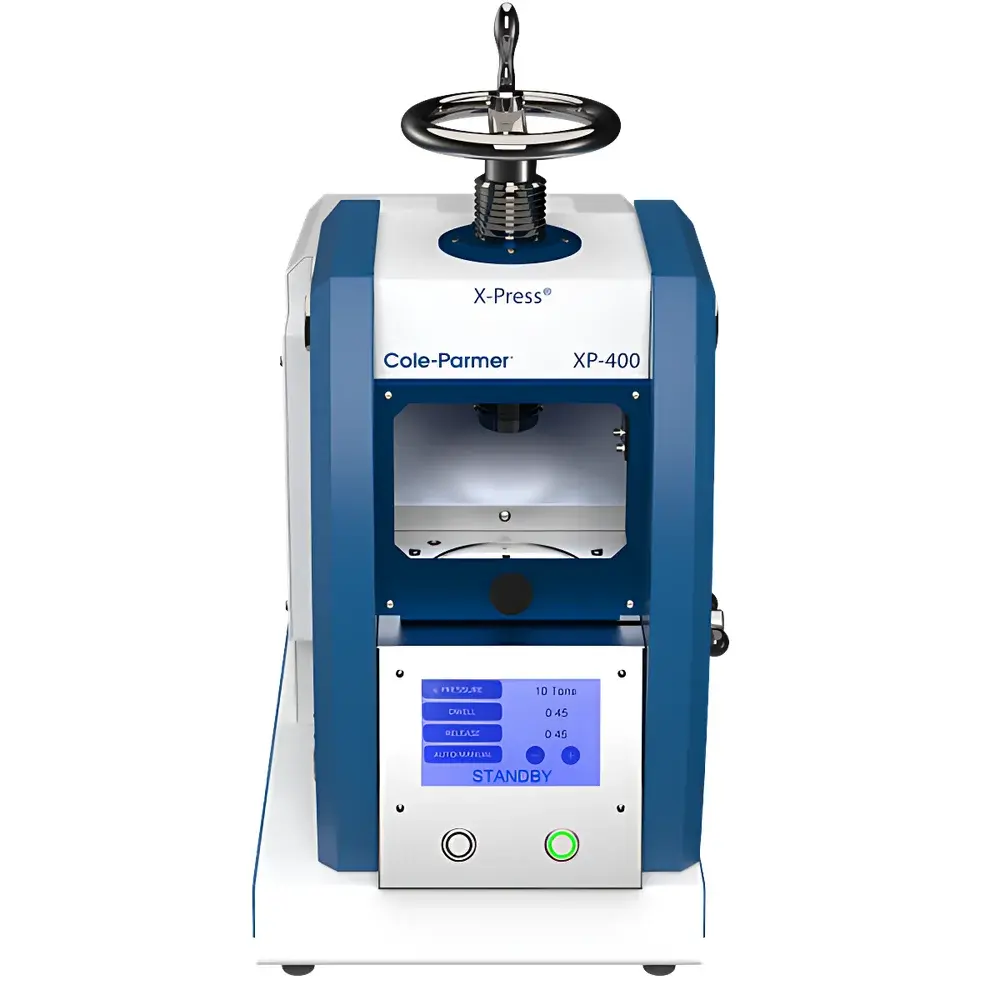
SPEX SamplePrep XP-400 (formerly Model 3636) XRF/FTIR Automated and Manual Hydraulic Pellet Press
| Brand | SPEX SamplePrep |
|---|---|
| Origin | USA |
| Model | XP-400 (formerly 3636) |
| Type | Fully Automated Hydraulic Pellet Press |
| Application | Analytical Pellet Preparation for XRF and FTIR |
| Cycle Time | ≤60 s per pellet |
| Max Platen Width | 80 mm |
| Adjustable Stroke Range | 50–150 mm |
| Nominal Clamping Force | 40 tons (357 kN) |
| Operation Mode | Vertical (Top-Bottom) |
Overview
The SPEX SamplePrep XP-400 (formerly Model 3636) is a high-precision, dual-mode hydraulic pellet press engineered specifically for reproducible sample preparation in wavelength-dispersive and energy-dispersive X-ray fluorescence (WDXRF/EDXRF) spectroscopy and Fourier-transform infrared (FTIR) analysis. Utilizing a closed-loop servo-hydraulic actuation system with real-time pressure feedback, the XP-400 delivers consistent, programmable compaction forces—up to 40 tons (357 kN)—with exceptional stability during hold phases. Its design adheres to fundamental principles of uniaxial cold compaction, where controlled stress application minimizes particle rearrangement and interstitial void formation, yielding pellets with uniform density distribution, minimal cracking, and optimal surface flatness. This mechanical integrity directly translates into improved spectral signal-to-noise ratio, reduced matrix effects, and enhanced quantitative accuracy—critical for compliance-driven laboratories operating under ISO/IEC 17025, ASTM E1361 (for XRF), or USP (for pharmaceutical IR tablet validation).
Key Features
- One-touch automated operation: Pre-programmed or user-defined protocols execute full compression cycles—including force ramping, dwell time, and decompression—in ≤60 seconds per pellet.
- High-resolution pressure control: Digital hydraulic regulation maintains setpoint deviation within ±0.5% of full scale during holding, ensuring inter-batch repeatability (RSD <1.2% for density across 20 replicates).
- Modular platen architecture: 80 mm diameter upper/lower platens accommodate interchangeable die sets; stroke adjustment (50–150 mm) enables precise control over final pellet thickness and green density.
- Industrial-grade HMI interface: 7-inch color LCD touchscreen with intuitive icon-based navigation, multi-language support, and audit-trail-capable parameter logging (aligned with FDA 21 CFR Part 11 requirements when paired with validated software).
- Integrated safety architecture: Dual-channel mechanical interlocks, automatic pump shutoff upon lid opening, and pressure-relief valves compliant with ANSI B11.1 and CE Machinery Directive 2006/42/EC.
- Lightweight yet rigid frame: Anodized aluminum housing and precision-machined steel load train deliver structural rigidity without excessive mass—facilitating benchtop integration in space-constrained analytical labs.
Sample Compatibility & Compliance
The XP-400 supports a broad spectrum of inorganic and organic powdered matrices requiring homogeneous pelletization prior to spectroscopic analysis. Validated applications include geological samples (silicates, clays, ores), metallurgical powders (ferrous/non-ferrous alloys, catalysts), construction materials (cements, slags, ceramics), polymers, pharmaceutical excipients, and environmental particulates. Compatible die geometries span 10 mm to 40 mm diameters, with optional stainless steel, borosilicate glass, polyethylene, and aluminum cups conforming to ASTM D7348 (for XRF cup specifications) and ISO 18588 (for IR pellet geometry tolerances). All standard dies meet dimensional specifications required by major XRF manufacturers—including Bruker, Thermo Fisher Scientific, Malvern Panalytical, Rigaku, Shimadzu, and SPECTRO—as well as FTIR systems from PerkinElmer, Agilent, and Nicolet.
Software & Data Management
The embedded firmware includes 12 factory-default methods optimized for common XRF/FTIR workflows (e.g., “Boron Carbide Binder – 30-ton @ 30 s”, “KBr IR Pellet – 12-ton @ 15 s”). Users may create, name, version, and password-protect custom methods via the touchscreen interface. Each run logs timestamp, operator ID, method name, applied force profile (ramp rate, peak force, dwell duration), and final platen displacement—exportable as CSV files for LIMS integration. When operated with SPEX’s optional LabLink Pro software (Windows-based), the XP-400 supports remote monitoring, electronic signature capture, and automated report generation aligned with GLP/GMP documentation standards.
Applications
- XRF quantitative analysis of major/minor elements in cement, fly ash, and slag using fused bead or pressed-powder methodologies per ISO 29581-2 and ASTM C114.
- FTIR identification of functional groups in polymer blends, active pharmaceutical ingredients (APIs), and counterfeit detection—where pellet homogeneity directly impacts band intensity linearity.
- Geochemical exploration: Preparation of trace-element reference materials for calibration curves in portable XRF field analysis.
- Quality control of catalyst formulations: Ensuring consistent binder dispersion and pore structure across production batches.
- Environmental monitoring: Pelletization of airborne particulate matter (PM10/PM2.5 filters) for heavy metal speciation via synchrotron-based micro-XRF.
FAQ
What is the maximum recommended operating pressure for routine XRF pellet preparation?
For most oxide-based geological and industrial samples, 25–35 tons (222–312 kN) provides optimal density without die deformation; 40-ton capacity serves specialized high-Z matrix applications.
Can the XP-400 be used with KBr or CsI for FTIR transmission measurements?
Yes—its precise force control and low-vibration pressing minimize hygroscopic salt fracture; recommended protocol: 10–15 tons with 20–30 s dwell under inert atmosphere.
Is third-party calibration certification available?
SPEX offers NIST-traceable hydraulic force calibration services with ISO/IEC 17025-accredited certificates, including uncertainty budgets and annual recalibration reminders.
Does the XP-400 support variable-speed ram movement?
No—it employs fixed-ramp-rate hydraulic actuation optimized for reproducibility; however, dwell time, peak force, and total cycle duration are fully programmable.
How often does preventive maintenance require intervention?
Under typical lab use (≤200 cycles/week), hydraulic oil and filter replacement is recommended every 24 months; no scheduled lubrication of load train components is required due to sealed bearing design.



