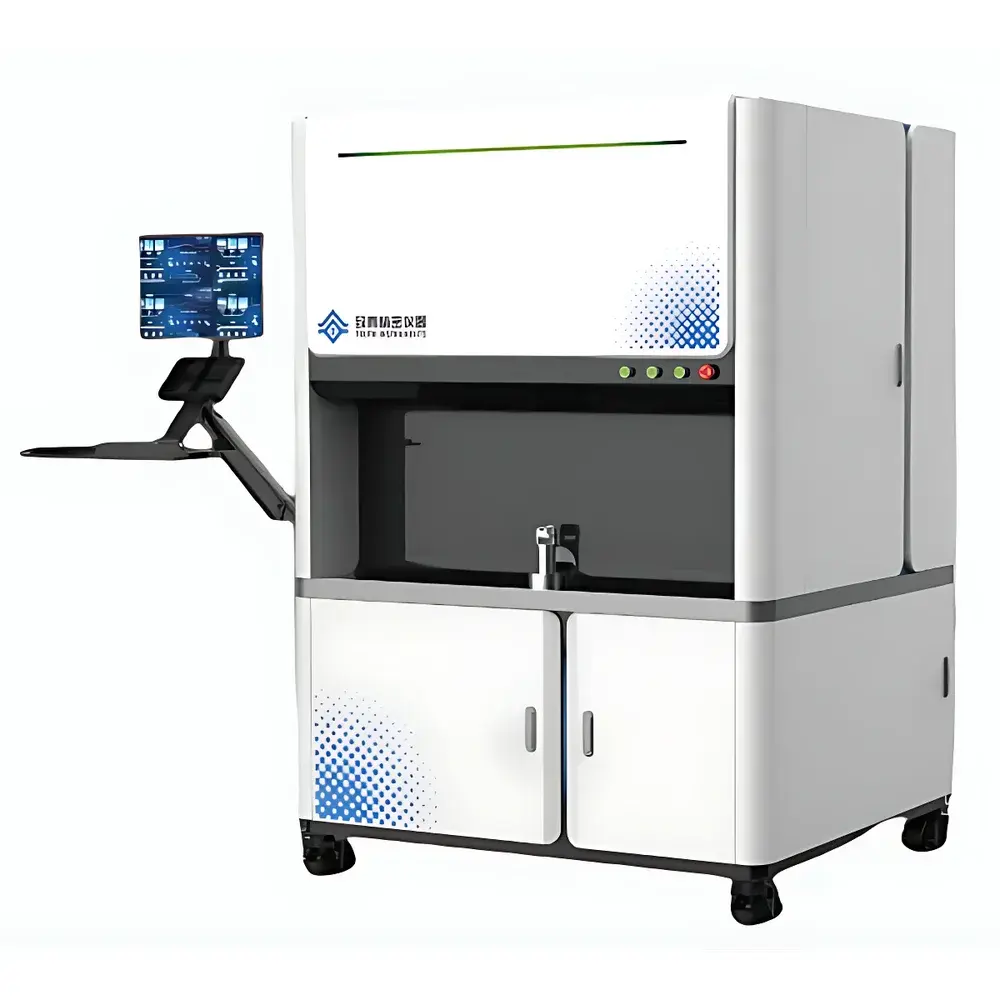
Spin Chip Reliability Tester MCT 500 by Truth Instruments
| Brand | Truth Instruments Company Limited |
|---|---|
| Origin | Shandong, China |
| Manufacturer Type | Authorized Distributor |
| Country of Origin | China |
| Model | MCT 500 |
| Pricing | Available Upon Request |
Overview
The Spin Chip Reliability Tester MCT 500 is a purpose-built semiconductor test platform engineered for accelerated reliability assessment of spintronic integrated circuits—particularly magnetic tunnel junctions (MTJs), spin-transfer torque magnetic random-access memory (STT-MRAM) cells, and other magnetoresistive devices. It operates on the principle of controlled environmental stress testing combined with real-time electrical and magnetic property monitoring. Unlike conventional parametric testers, the MCT 500 integrates synchronized thermal conditioning, vector magnetic field application (in-plane and out-of-plane), and low-noise electrical characterization to evaluate device degradation mechanisms—including thermal activation of magnetic domain switching, interfacial diffusion under bias-temperature stress (BTS), and time-dependent dielectric breakdown (TDDB) in MgO-based barriers. Designed for use in R&D labs, process development centers, and high-reliability qualification facilities, the system supports JEDEC JESD22-A108 (High Temperature Operating Life), JESD22-A110 (Extended Temperature Life), and ISO/IEC 17025-compliant test workflows.
Key Features
- Tri-temperature magnetic testing architecture: precise temperature control at −40 °C, 25 °C, and +125 °C (±0.3 °C stability) using Peltier-based thermal stages with active heat-sink management
- Vector magnetic field generation: dual-axis electromagnet system delivering programmable fields up to ±300 mT in-plane and ±150 mT perpendicular to the sample plane, with field homogeneity better than ±1.5% over 10 mm × 10 mm area
- Non-magnetic probe station: ultra-low magnetic permeability (<1.002 μr) aluminum-bronze frame with vacuum-compatible ceramic chuck, enabling background field suppression below 10 nT during sensitive MR ratio measurements
- Integrated source-measure unit (SMU): four-quadrant, sub-femtoamp resolution current sourcing and nanovolt-level voltage measurement synchronized with magnetic field ramping and thermal cycling
- Automated wafer-level test sequencing: compatible with standard 100–200 mm wafers via manual load or optional robotic handler interface (SEMI E47 compliant)
- Modular hardware design: open I/O architecture supporting third-party instrumentation (e.g., lock-in amplifiers, pulse generators) via IEEE-488, USB-TMC, and PXIe expansion slots
Sample Compatibility & Compliance
The MCT 500 accommodates bare die, packaged ICs (QFN, WLCSP, BGA), and full wafers up to 200 mm diameter. Test fixtures support both DC and pulsed current injection (10 ns–100 μs width, 1 A max), enabling endurance testing per JEDEC JESD22-A117 (Write Endurance). All magnetic field calibration procedures adhere to ASTM A977/A977M (Standard Test Method for Magnetic Properties of Permanent Magnet Materials Using a Permeameter). The system meets electromagnetic compatibility requirements per CISPR 11 Class B and is designed for operation in ISO Class 5 cleanroom environments. Full audit trail logging—including operator ID, environmental setpoints, test sequence version, and raw data timestamps—ensures alignment with GLP and GMP documentation standards.
Software & Data Management
The proprietary SpinTest Suite v3.2 provides deterministic test scripting (Python-based API), real-time waveform visualization, and statistical failure analysis (Weibull, Arrhenius, Eyring modeling). Raw data is stored in HDF5 format with embedded metadata per NI CDF conventions. Export options include CSV, MATLAB .mat, and industry-standard STDF (Semiconductor Test Data Format) for integration with factory MES systems. Software validation packages are available for FDA 21 CFR Part 11 compliance, including electronic signature enforcement, role-based access control, and immutable audit logs with SHA-256 hashing of all critical configuration changes.
Applications
- Accelerated life testing of STT-MRAM arrays under combined thermal-magnetic stress
- Switching threshold mapping across temperature and field vectors for MTJ process optimization
- Retention time characterization under zero-field and biased-field conditions
- Interfacial quality assessment via resistance drift slope analysis during high-temperature storage (HTSL)
- Qualification of anti-ferromagnetic pinning layer stability in synthetic antiferromagnet (SAF) stacks
- Correlation of magnetic hysteresis loop distortion with electromigration-induced defects observed via TEM cross-section
FAQ
What types of spintronic devices can be tested on the MCT 500?
The system supports MTJs, spin valves, domain-wall racetrack memory cells, and emerging skyrmion-based logic elements—provided they operate within the specified current, voltage, and field ranges.
Does the MCT 500 support automated test pattern generation (ATPG)?
No; it is not a functional tester. It performs parametric reliability stress testing—not digital pattern-based fault detection. Integration with external ATPG tools requires custom script orchestration via the Python API.
Is calibration traceable to national metrology institutes?
Yes. Magnetic field sensors are calibrated annually against NIST-traceable Hall probes; temperature modules are verified using PT100 reference standards accredited to ISO/IEC 17025.
Can the system perform real-time magnetic imaging during electrical stressing?
No. It does not include on-board magneto-optical or Lorentz microscopy. However, its synchronization outputs enable external time-resolved imaging systems (e.g., MOKE, XMCD) to trigger acquisition aligned with field/current pulses.
What safety certifications does the MCT 500 hold?
It complies with IEC 61010-1 (Safety Requirements for Electrical Equipment for Measurement, Control, and Laboratory Use) and carries CE marking for EMC and Low Voltage Directive conformity.