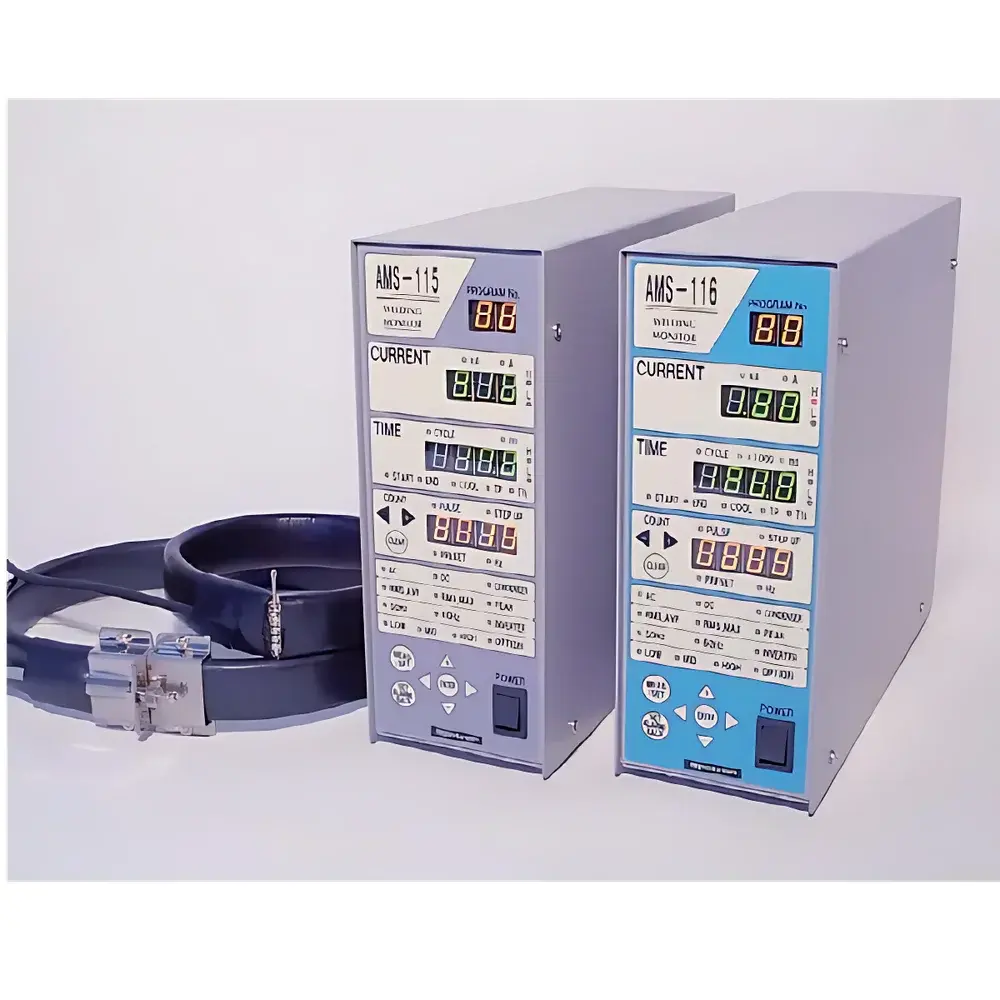
SPOTRON AMS-115/AMS-116 Resistance Weld Monitoring System
| Brand | TAMASAKI (Kyoto) |
|---|---|
| Origin | Japan |
| Model | AMS-115 |
| Measurement Principle | Digital Current/Voltage/Time Synchronization |
| Measurement Range | 50 A – 999 kA (selectable) |
| Time Resolution | 1 ms |
| Max Monitoring Duration | 9,000 cycles (180 s for AMS-116) |
| Sampling Frequency | Up to 600 Hz |
| Input Channels | Primary current, secondary voltage, electrode displacement (optional), trigger signal |
| Output Interfaces | RS-232C (standard), digital I/O (optional) |
| Configuration Memory | 32 programmable welding condition sets |
| Compliance | Designed for ISO 14001 & JIS B 8711-compliant resistance welding process validation |
Overview
The SPOTRON AMS-115 and AMS-116 are dedicated digital resistance welding monitoring systems engineered for real-time, synchronized acquisition and analysis of primary current, secondary voltage, and time-based waveform parameters during spot and seam welding operations. Unlike conventional pressure gauges or analog meters, these units implement high-speed digitization (up to 600 Hz sampling) and cycle-synchronized triggering to capture transient electrical and thermal dynamics intrinsic to resistance welding—principally governed by Joule heating (Q = I²Rt) and interfacial contact resistance evolution. The AMS-115 serves as a universal monitor for spot welding applications with scalable current measurement (50 A–999 kA) and 32 configurable condition sets, while the AMS-116 extends functionality specifically for seam welding, supporting extended monitoring durations up to 9,000 cycles (180 seconds) with enhanced data continuity and cycle-indexed storage. Both models are developed by TAMASAKI (Kyoto, Japan) and manufactured under stringent Japanese industrial quality standards.
Key Features
- High-fidelity synchronized sampling: Simultaneous acquisition of primary current and secondary voltage at up to 600 Hz, enabling precise calculation of instantaneous power, effective resistance, and thermal accumulation per weld cycle.
- Wide dynamic range: Programmable current measurement from 50 A minimum to 999 kA maximum—suitable for micro-welding of fine wires and high-current automotive body-in-white applications.
- Dual-platform architecture: AMS-115 optimized for discrete spot weld verification; AMS-116 includes seam-weld-specific firmware with cycle counter indexing, long-duration buffer memory, and continuous waveform stitching across multi-cycle sequences.
- Configurable condition management: Up to 32 independent welding parameter sets—including threshold limits for current deviation, voltage drop, and time-out windows—enabling automated pass/fail evaluation per EN ISO 14324 and AWS D8.9 guidelines.
- Standard RS-232C interface with ASCII protocol support: Enables direct integration into factory MES systems, statistical process control (SPC) dashboards, and electronic batch record (EBR) archives compliant with FDA 21 CFR Part 11 requirements.
- Expandable I/O capability: Optional digital input/output modules support external PLC handshaking, safety interlock feedback, and external sensor synchronization (e.g., electrode force or displacement transducers).
Sample Compatibility & Compliance
The AMS-115/AMS-116 systems are designed for integration with AC, DC, and MFDC (mid-frequency direct current) resistance welders operating within standard industrial voltage and current safety boundaries (IEC 60204-1). They do not directly measure mechanical pressure but derive weld quality indicators from electrophysical signatures correlated to nugget formation, expulsion risk, and interfacial contamination. Units comply with JIS B 8711 (Resistance Welding – Monitoring Equipment Requirements), meet EMC immunity per IEC 61000-6-2, and support audit-ready data logging aligned with ISO 9001:2015 clause 8.5.2 (Identification and traceability) and ISO/IEC 17025:2017 clause 7.7 (Ensuring validity of results). No calibration certificate is included ex-factory; users must perform initial verification per ASTM E2505 or equivalent traceable procedure using certified shunt resistors and oscilloscope reference.
Software & Data Management
Data export occurs via ASCII-formatted text files through RS-232C, containing timestamped cycle headers, sampled values at user-defined intervals, and calculated metrics (e.g., integrated I²t, average voltage collapse rate, peak resistance). The native file structure supports direct import into MATLAB, Python pandas, or Minitab for advanced SPC modeling—including X-bar/R charting, Cp/Cpk estimation, and multivariate outlier detection. Optional PC software (sold separately) provides real-time waveform visualization, comparative overlay of nominal vs. actual traces, and automated report generation meeting GLP/GMP documentation requirements. All stored data retains immutable cycle indexing and firmware version stamping to satisfy revision control and data integrity mandates.
Applications
- Automotive Tier-1 suppliers performing AIAG CQI-15 validated resistance welding processes on steel/aluminum BIW components.
- Medical device manufacturers requiring documented weld consistency for stainless-steel battery contacts and hermetic enclosure seams.
- Aerospace subcontractors verifying weld integrity in titanium alloy fasteners where microstructure-sensitive thermal input must remain within ±3% of qualified parameters.
- Electronics assembly lines monitoring fine-pitch copper-nickel tab welding in lithium-ion battery module production.
- Research laboratories conducting DOE studies on electrode wear impact, surface oxide effects, or multi-material stack weldability.
FAQ
Does the AMS-115/116 measure electrode force or pressure directly?
No—it monitors electrical parameters only. Force measurement requires integration with external load cells or piezoresistive transducers via optional analog input modules.
Can the system detect weld expulsion or shunting in real time?
Yes—via rapid voltage collapse detection (<5 ms response) and abnormal I²t integral deviation exceeding user-defined thresholds, both configurable per weld schedule.
Is firmware upgrade supported in-field?
Yes—via RS-232C using TAMASAKI-provided binary loader tools and version-controlled release notes compliant with IEC 62304 Class B software lifecycle requirements.
What is the maximum cable length supported for RS-232C communication?
Up to 15 meters without repeater; longer runs require RS-422/485 conversion with isolated transceivers to maintain noise immunity in industrial environments.
Are calibration certificates available with NIST traceability?
TAMASAKI offers optional third-party calibration services through JCSS-accredited labs in Japan; certificates include uncertainty budgets per ISO/IEC 17025 Annex A.3.