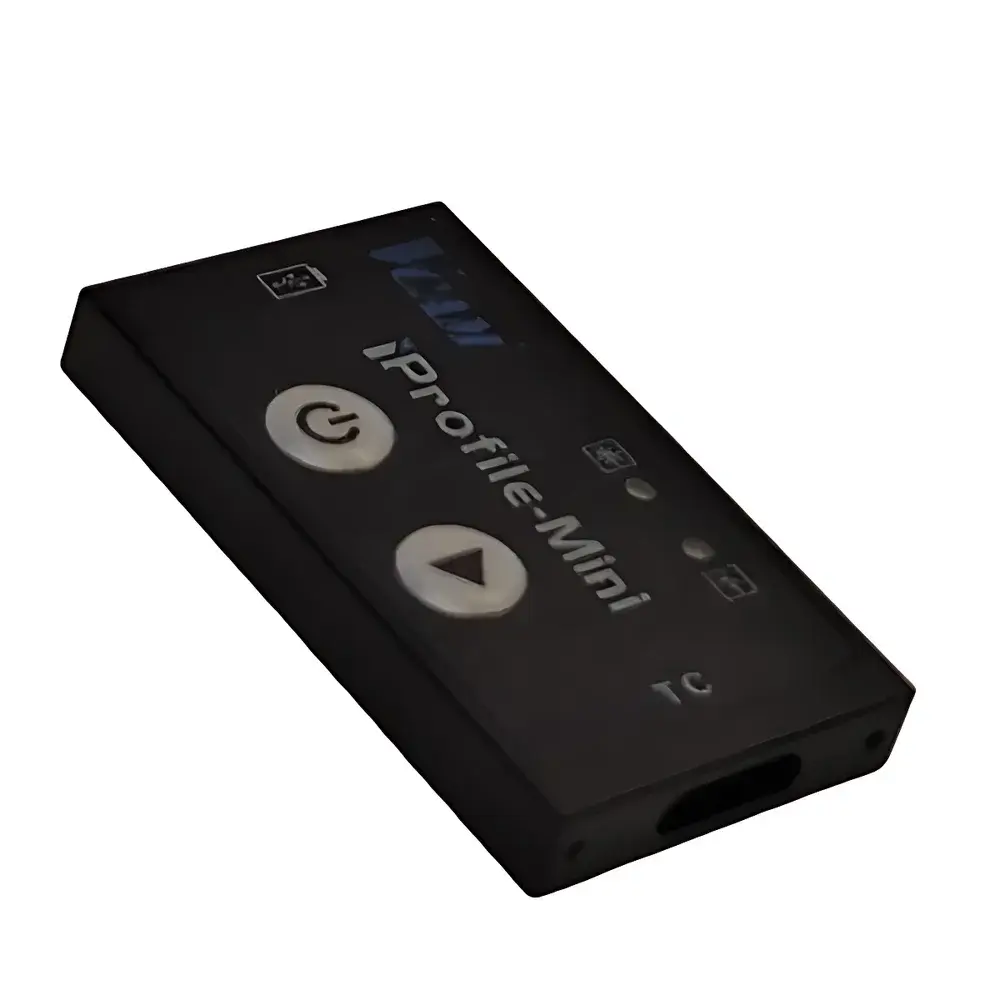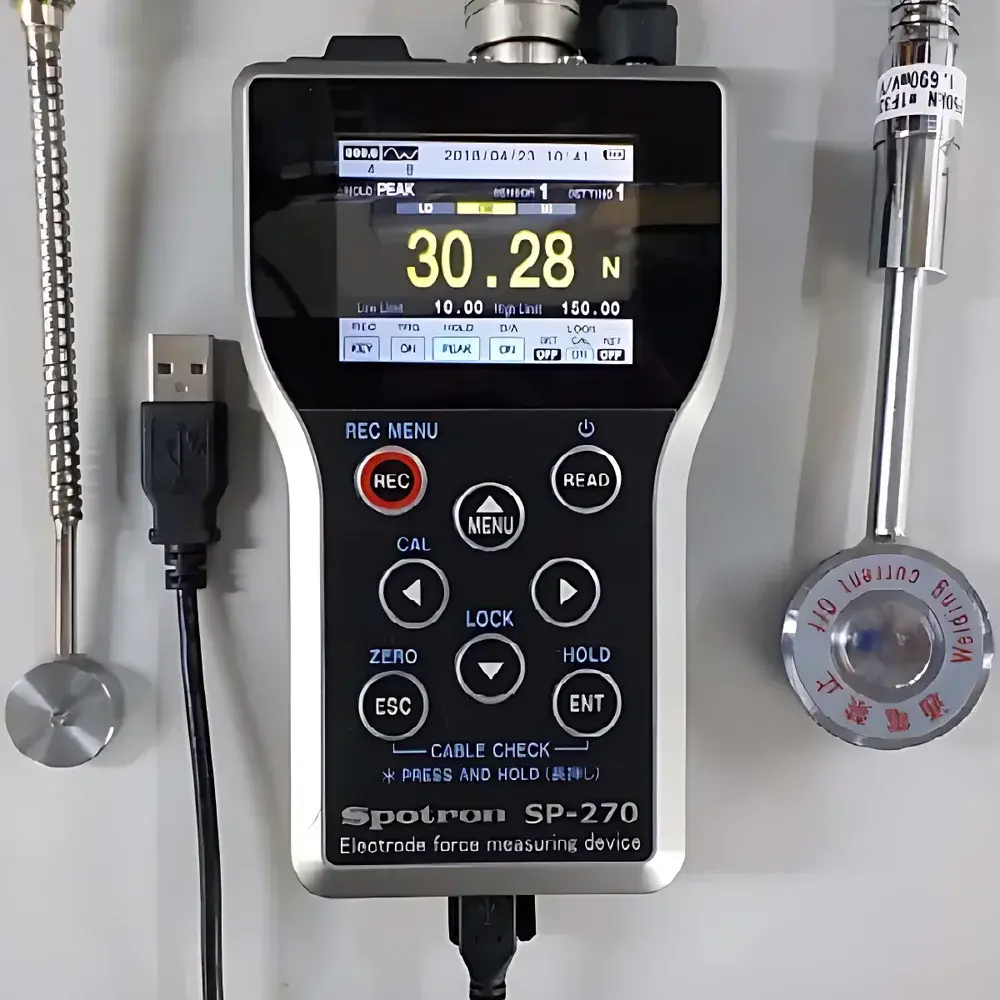
SPOTRON SP-270-F200N Digital Electrode Force Meter for Resistance Spot Welding
| Brand | TAMASAKI (Kyoto) |
|---|---|
| Origin | Japan |
| Model | SP-270-F200N |
| Measurement Principle | Strain-gauge-based force transduction |
| Measurement Range | 20–200 N (F200N variant) |
| Accuracy | ±1% F.S. |
| Overload Capacity | 120% of rated load |
| Output | DC ±2 V F.S. |
| Display | 4-inch TFT color LCD (Japanese/English selectable) |
| Data Sampling | Up to 1 kHz (1 ms interval) via USB |
| Power Supply | Rechargeable battery or USB bus power |
| Auto-power-off | Configurable timeout |
| Operating Temperature | 5–40 °C |
| Sensor Interchangeable | Yes (F200N, F1000N, F10kN, F30kN, F50kN variants) |
| Dimensions (H×W×D) | 140 × 85 × 35 mm |
| Weight (unit + sensor) | 600 g |
| Compliance | Designed for industrial welding process validation per JIS Z 3140 and ISO 14324 Annex B |
Overview
The SPOTRON SP-270-F270-F200N is a purpose-engineered digital electrode force meter developed specifically for real-time monitoring and quantitative verification of electrode contact force in resistance spot welding (RSW) applications. As one of the three critical process parameters—alongside welding current and time—electrode force directly governs weld nugget formation, interfacial contact resistance, heat generation distribution, and ultimately joint integrity. Unlike general-purpose pressure gauges or analog load cells, the SP-270-F200N employs a calibrated strain-gauge transducer integrated into a compact, field-deployable housing optimized for integration into robotic welding cells, manual weld fixtures, and R&D test benches. Its measurement architecture is not based on liquid column or Bourdon tube principles—as misstated in some legacy documentation—but on high-stability, temperature-compensated semiconductor strain sensing, enabling repeatable static and dynamic force acquisition under industrial thermal and mechanical stress conditions.
Key Features
- 4-inch full-color TFT LCD with dual-language interface (English/Japanese), supporting both numeric and real-time graphical waveform display of force vs. time.
- High-speed data capture at 1 kHz sampling rate, delivering timestamped force values every 1 millisecond for transient event analysis (e.g., electrode approach, dwell, squeeze, hold, and retraction phases).
- Configurable upper/lower limit indicators with visual alert zones (color-coded bars and on-screen status flags) to support immediate pass/fail assessment against pre-defined process windows.
- Dual power architecture: operation via internal rechargeable battery or direct USB bus power—enabling uninterrupted use during long-duration production audits or lab characterization tests.
- Modular sensor design: interchangeable transducers (F200N, F1000N, F10kN, F30kN, F50kN) allow precise range matching to electrode geometry, material stack-up, and weld schedule requirements without instrument replacement.
- USB 2.0 interface compliant with standard CDC/ACM class drivers; no proprietary dongles or driver installation required on Windows/macOS/Linux hosts.
- Auto-power-off with user-defined timeout (1–60 min) conserves battery life during intermittent deployment scenarios.
Sample Compatibility & Compliance
The SP-270-F200N is designed for direct mounting between welding electrodes or integration into pneumatic/hydraulic actuation feedback loops. Its F200N sensor variant (20–200 N range, 9.5 mm × 20 mm × 198 mm cylindrical form factor) is optimized for low-force micro-welding of thin foils, battery tab joining, and electronic component assembly. Higher-range sensors (F10kN–F50kN) accommodate automotive body-in-white and structural sheet metal applications. The system meets electromagnetic compatibility (EMC) requirements per IEC 61326-1 for industrial environments and supports traceable calibration per ISO/IEC 17025-accredited procedures. While not FDA-regulated, its data output structure—including time-stamped raw values, metadata headers, and export formats (.csv, .txt)—supports alignment with GLP/GMP documentation workflows where force validation is part of critical process parameter (CPP) control strategies.
Software & Data Management
The included PC software (Windows-compatible, no subscription) enables real-time streaming visualization, post-process waveform annotation, statistical summary (min/max/mean/stdev), and export of synchronized datasets with millisecond precision. All acquired data retain embedded timestamps, sensor ID, and calibration coefficients—ensuring audit readiness. Export files include header information compliant with ASTM E2917 (Standard Practice for Validation of Qualitative and Quantitative Software) and are structured to integrate with LIMS or MES platforms via simple parsing. No cloud dependency or mandatory firmware updates; version-controlled firmware binaries are provided for offline installation and validation in regulated environments.
Applications
- Verification of electrode force consistency across multi-shift production runs in Tier-1 automotive battery cell manufacturing.
- Root cause analysis of expulsion, indentation, or weak nuggets by correlating force profiles with current/voltage waveforms from synchronized oscilloscope capture.
- Development and qualification of new RSW schedules for aluminum alloys and coated steels, where optimal force window is narrow and thermally sensitive.
- Preventive maintenance diagnostics: detecting progressive degradation in pneumatic cylinder seals or servo actuator responsiveness through longitudinal force profile trending.
- Educational laboratories requiring hands-on instruction in weld parameter interdependence and closed-loop process control fundamentals.
FAQ
Is the SP-270-F200N suitable for continuous in-line production monitoring?
Yes—it supports continuous 1 kHz streaming over USB with zero data loss under sustained operation, and its auto-power-off can be disabled for uninterrupted logging.
Can multiple SP-270 units be synchronized for multi-electrode systems?
No native hardware synchronization exists; however, external trigger input (via optional analog/digital I/O module) allows time-aligned start commands across units when used with a master timing source.
Does the unit provide NIST-traceable calibration certificates?
Each unit ships with a factory calibration report referencing TAMASAKI’s ISO/IEC 17025-accredited standards laboratory; full NIST-traceable certification is available as an optional service.
What is the maximum cable length supported between sensor and main unit?
Standard cable is 1.0 m; optional 3 m and 10 m shielded cables are available for F10kN/F30kN/F50kN variants—maintaining signal integrity and noise immunity per MIL-STD-461G Class A limits.
Is the software compatible with Python or LabVIEW for custom automation?
Yes—the USB interface exposes a simple ASCII command protocol (e.g., “READ?”, “CAL?”, “START”) documented in the technical manual, enabling integration with third-party scripting environments without SDK dependencies.