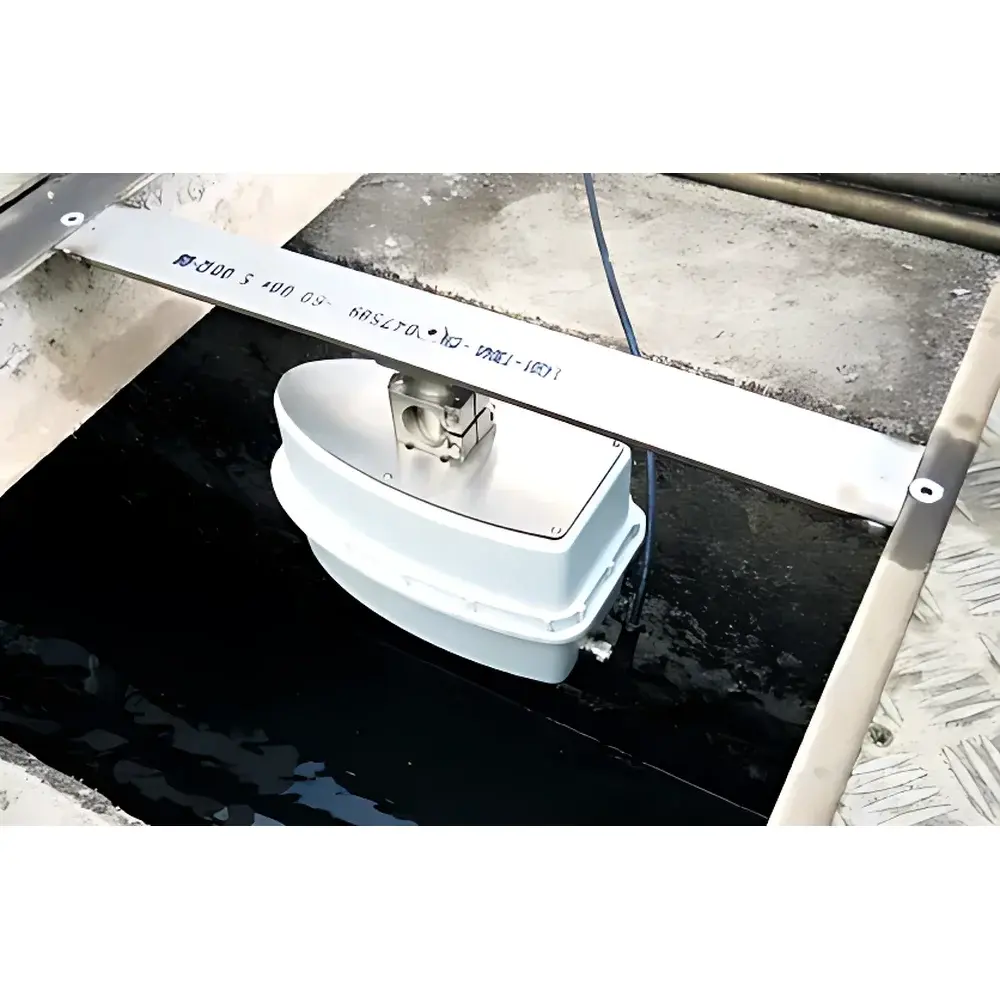
SQ-R Non-Contact Radar Flow Meter
| Origin | Austria |
|---|---|
| Manufacturer Type | Authorized Distributor |
| Origin Category | Imported |
| Model | SQ-R |
| Pricing | Available Upon Request |
Overview
The SQ-R Non-Contact Radar Flow Meter is an engineered solution for continuous, real-time open-channel flow monitoring in municipal and industrial wastewater infrastructure. Designed specifically for challenging environments—including sewer networks, stormwater overflows, treatment plant influent/effluent channels, and process water recirculation loops—the SQ-R employs dual-band radar technology to simultaneously acquire surface velocity (via 24 GHz Doppler radar) and water level (via 80 GHz FMCW radar). This co-located, non-intrusive measurement principle eliminates the need for flumes, weirs, or submerged sensors, thereby avoiding hydraulic disturbances, sediment accumulation, and maintenance downtime associated with contact-based systems. Its compact form factor (272 × 153 × 186 mm), lightweight construction (1.55 kg), and versatile mounting options—including ceiling suspension in manholes, bridge-mounted cantilever brackets, or sidewall fixtures—enable rapid deployment without civil works or channel dewatering. The device operates under full submersion-rated conditions (IP68) and is certified for long-term exposure to aggressive chemical and biological agents common in wastewater.
Key Features
- True non-contact operation: Both level and velocity measured from above the water surface—no wetted parts, no mechanical wear, zero routine calibration required
- Dual-frequency radar architecture: 80 GHz W-band for high-resolution level measurement (≤2 mm resolution, 0.05–8 m range) and 24 GHz K-band Doppler radar for robust surface velocity detection (0.08–16 m/s, ±0.01 m/s + 1% FS accuracy)
- Integrated hydraulics engine: Onboard computational model applies Manning’s equation, ISO 4359 standards, and user-configurable channel geometry to derive volumetric flow (L/min to m³/h) in real time
- Adaptive signal processing: Automatic vertical angle compensation (±1° accuracy, 0.1° resolution) and near-field blanking (0.05 m) ensure stable performance across variable installation heights and turbulent surfaces
- Comprehensive electrical protection: Built-in overvoltage suppression, reverse polarity protection, and surge immunity compliant with IEC 61000-4-5 (lightning protection up to 4 kV)
- Self-diagnostic capability: Real-time validation of radar beam alignment, signal-to-noise ratio, and hydraulic model consistency—flagging installation errors or environmental interference before data corruption occurs
Sample Compatibility & Compliance
The SQ-R is validated for use in heterogeneous, high-turbidity, and solids-laden flows typical of combined sewers, grit-laden effluents, and industrial process streams. It maintains >95% data availability under suspended solids concentrations exceeding 10,000 mg/L and surface foam coverage up to 30%. The housing is constructed from UV-stabilized, corrosion-resistant PPS+GF polymer with stainless steel fasteners, meeting EN 60529 (IP68), EN 60068-2-30 (damp heat cycling), and EN 14114 (wastewater instrumentation) requirements. While not a medical or pharmaceutical device, its analog/digital outputs support integration into SCADA systems operating under IEC 62443-3-3 security frameworks and comply with EU RoHS and REACH directives.
Software & Data Management
Configuration, commissioning, and diagnostics are performed via SQ-Commander—a Windows-based engineering tool supporting firmware updates, hydraulic parameter mapping (e.g., roughness coefficient, channel slope, cross-section profile), and sensor alignment verification. All operational parameters—including measurement interval (8 s to 5 h), averaging duration (5–240 s), and output scaling—are stored in non-volatile memory with tamper-evident logging. Digital interfaces (RS-485/Modbus RTU, SDI-12) transmit timestamped, CRC-protected frames containing flow rate, velocity, level, and diagnostic quality flags. Analog outputs (two isolated 4–20 mA channels) are independently assignable to any primary variable and traceable per NIST-traceable calibration records. Audit trails, configuration history, and alarm events meet GLP-aligned documentation practices for regulatory reporting.
Applications
- Municipal wastewater: Inflow monitoring at lift stations, CSO event quantification, and compliance reporting under EPA NPDES permits
- Treatment plants: Primary clarifier influent balancing, secondary clarifier effluent verification, and sludge return flow control
- Industrial pretreatment: Batch discharge metering for textile, food & beverage, and electroplating facilities subject to local POTW limits
- Green infrastructure: Real-time flow routing in bioswales, infiltration trenches, and retention basins for adaptive stormwater management
- Research & validation: Reference-grade field validation of ultrasonic Doppler profilers and pressure transducer arrays
FAQ
Does the SQ-R require periodic recalibration?
No—its radar-based measurement principle is inherently drift-free; only initial geometric setup and hydraulic parameter input require field verification.
Can it operate reliably in heavily aerated or foamy flows?
Yes—80 GHz radar penetrates light foam layers; Doppler velocity remains valid as long as surface motion is detectable, supported by adaptive SNR thresholding.
Is Modbus TCP supported, or only Modbus RTU over RS-485?
Only Modbus RTU over RS-485 is natively implemented; TCP/IP bridging requires external protocol gateways compatible with Modbus ASCII framing.
What is the minimum required distance between sensor and water surface?
0.05 m for level measurement and 0.05 m for velocity measurement—both enabled simultaneously with automatic near-field blanking.
How is temperature compensation handled across the full operating range (−35 °C to +60 °C)?
Internal thermistor readings feed real-time corrections to radar propagation models and analog output linearity algorithms, validated per IEC 60770-1 Class 1 specifications.