
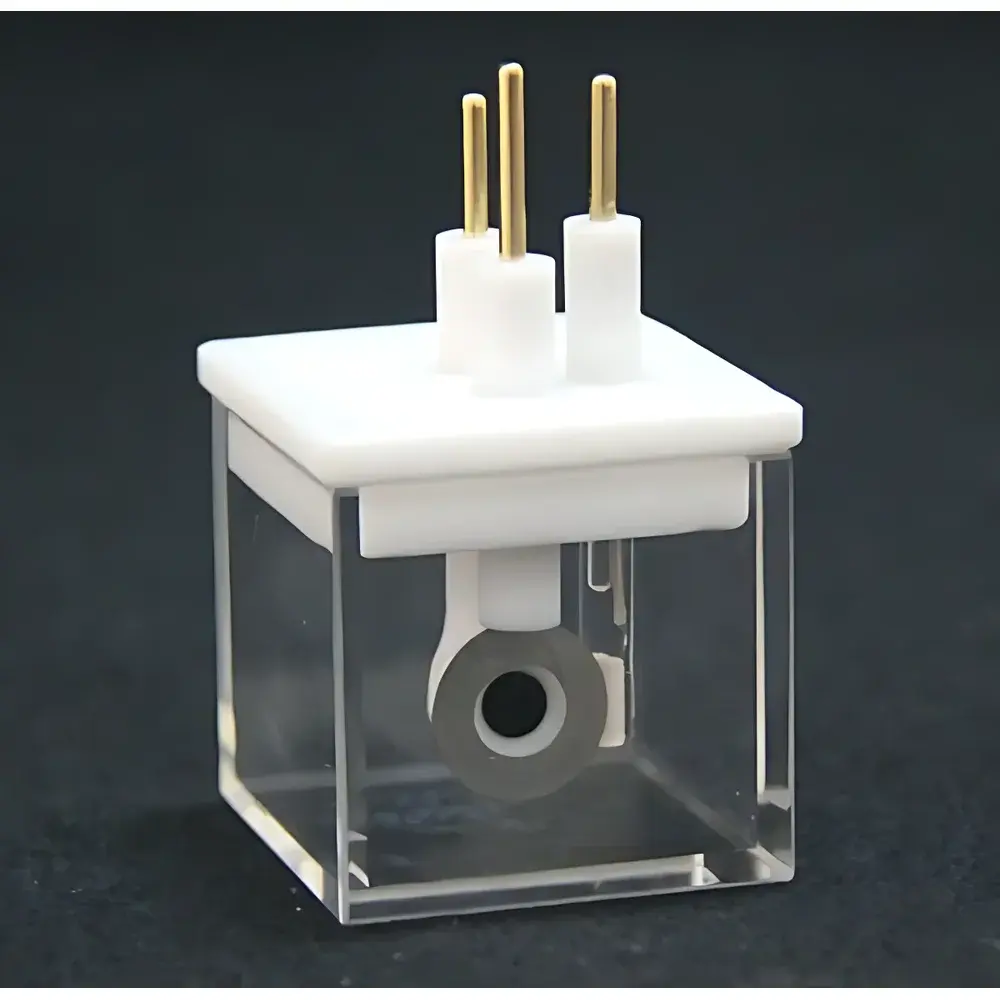
Square Photoelectrochemical Cell
| Brand | MC Merry Change |
|---|---|
| Origin | Beijing, China |
| Manufacturer Type | General Distributor |
| Origin Category | Domestic |
| Model | PECK125 |
| Price Range | USD 420 – 1,410 (est.) |
| Component Category | Other |
Overview
The MC Merry Change PECK125 Square Photoelectrochemical Cell is a precision-engineered optical cell designed for fundamental and applied research in photoelectrochemistry, semiconductor electrochemistry, and interfacial charge-transfer kinetics. Constructed entirely around a rigid square geometry with four optically transparent quartz walls, the cell enables symmetrical side-illumination under controlled electrochemical conditions. Its core measurement principle relies on the simultaneous application of potentiostatic/galvanostatic control and quantifiable photon flux delivery to an immersed working electrode—enabling direct correlation between incident light intensity, spectral distribution, and resulting photocurrent or photovoltage response. Unlike sealed or pressurized reactor systems, the PECK125 operates as an open, ambient-pressure cell optimized for rapid setup, electrode exchange, and real-time optical access—making it especially suitable for transient absorption spectroscopy coupling, in situ Raman monitoring, and time-resolved photocurrent measurements in academic and industrial R&D laboratories.
Key Features
- Square geometry with four identical fused-silica (GGS2 quartz) optical windows (50 mm² each), ensuring uniform lateral illumination and minimal optical distortion across UV–vis–NIR range (185–2,500 nm)
- PTFE top cap providing chemical inertness, low outgassing, and mechanical stability during electrode insertion and cable routing
- Single-compartment design eliminating membrane-induced resistance or diffusion layer complications—ideal for studying intrinsic photoelectrode kinetics without mass-transport artifacts
- No integrated stirring, heating, or pressure containment; intentionally configured for simplicity, reproducibility, and compatibility with external accessories (e.g., thermoregulated baths, gas manifolds, or optical choppers)
- Pre-drilled ports and standardized electrode feedthroughs support conventional three-electrode configuration (working, counter, reference) with minimal electrical shielding interference
- Compatible with standard electrochemical workstations (e.g., BioLogic SP-300, Gamry Interface 5000E) and modular optical benches (e.g., Newport Oriel systems, Thorlabs cage assemblies)
Sample Compatibility & Compliance
The PECK125 accommodates liquid electrolyte volumes from 30 mL to 80 mL—sufficient for stable baseline current acquisition while minimizing capacitive charging artifacts. Electrode substrates up to 15 mm × 15 mm can be mounted flush against any quartz wall, enabling precise alignment with incident beam paths. The GGS2 quartz body meets ASTM F796-22 specifications for optical-grade fused silica used in analytical instrumentation. Though not certified to ISO/IEC 17025 or GLP standards as a standalone system, its material traceability (quartz lot number, PTFE grade certification) supports audit-ready documentation when integrated into validated lab workflows. No built-in gas/liquid sampling ports; users must implement external septa or custom manifolds per experimental protocol.
Software & Data Management
As a passive electro-optical interface—not an active instrument—the PECK125 requires no embedded firmware or proprietary software. All data acquisition is managed through host electrochemical software (e.g., EC-Lab, Framework, or NOVA) and optical control platforms (e.g., OceanInsight OceanView, Thorlabs Kinesis). When used in regulated environments (e.g., university core facilities operating under FDA 21 CFR Part 11-compliant SOPs), the cell’s static design facilitates full traceability: batch-specific material certificates, calibration logs for coupled light sources and potentiostats, and timestamped experiment metadata are retained externally. No onboard memory, network interface, or audit-trail generation is provided—consistent with ISO/IEC 17025 Clause 6.4.7 requirements for non-automated measurement components.
Applications
- Photoelectrocatalytic water splitting and CO₂ reduction studies on metal oxide, chalcogenide, or perovskite photoanodes/cathodes
- Transient photocurrent decay analysis to extract carrier lifetime and surface recombination velocity
- In situ UV-Vis absorption spectroelectrochemistry of redox-active films and quantum dot monolayers
- Light-intensity-dependent J–V characterization under AM1.5G or monochromatic illumination
- Electrochemical impedance spectroscopy (EIS) under modulated illumination to resolve capacitive vs. faradaic contributions
- Validation of theoretical models (e.g., Gerischer-Marcus formalism) for electron transfer at semiconductor/electrolyte interfaces
FAQ
Is the PECK125 compatible with corrosive electrolytes such as HF-based etchants or molten salts?
Yes—GGS2 quartz exhibits exceptional resistance to hydrofluoric acid (up to 5% v/v, short-term exposure) and most non-oxidizing molten salt mixtures below 400 °C. PTFE cap integrity should be verified separately for extended high-temperature use.
Can I mount a rotating disk electrode (RDE) inside this cell?
No—the absence of shaft feedthroughs and internal motor mounting provisions precludes RDE integration. It is intended for static or externally agitated configurations only.
Does the cell include electrical feedthroughs or wiring harnesses?
No—feedthroughs are user-supplied. Standard configurations use coaxial SMA or banana-jack adapters sealed via compression ferrules; recommended maximum voltage rating: ±15 V DC.
What spectral range is supported by the GGS2 quartz windows?
185 nm (deep UV) to 2,500 nm (short-wave IR), with transmission >85% across 200–2,200 nm when polished to λ/10 surface flatness.
Is there documentation available for GMP/GLP-compliant installation qualification (IQ)?
Yes—MC Merry Change provides material declarations, dimensional drawings (ISO 1101 geometric tolerancing), and cleaning validation protocols upon request for IQ/OQ execution in regulated labs.




