
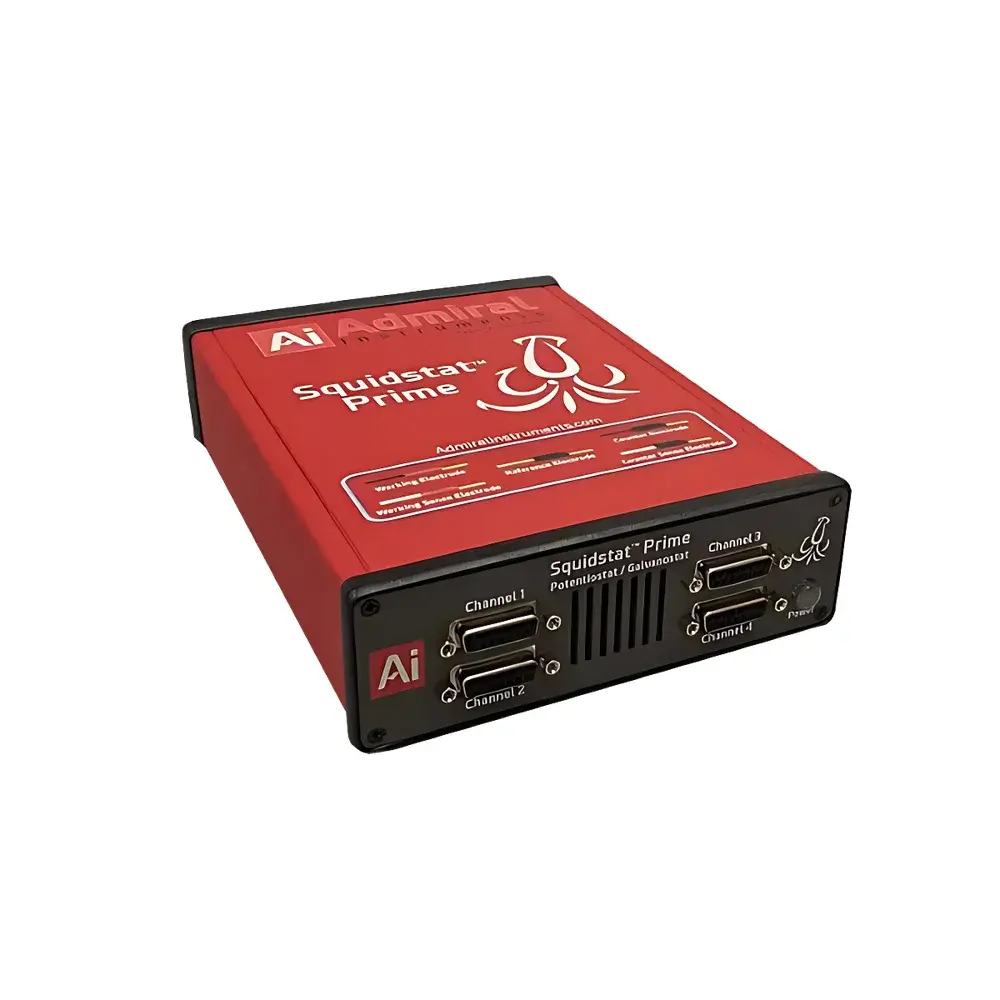
Squidstat Prime Electrochemical Workstation
| Brand | Admiral Instruments |
|---|---|
| Origin | USA |
| Model | Squidstat Prime |
| Instrument Type | Multi-Channel Potentiostat/Galvanostat |
| Number of Channels | 4 Independent Channels |
| Voltage Range per Channel | ±10 V |
| Current Range per Channel | ±250 mA |
| Current Resolution | 750 fA (0.003% of range) |
| Voltage Resolution | 33 µV |
| Input Impedance | 10 TΩ |
| ADC Resolution | 16-bit |
| Maximum Sampling Rate | 40,000 samples/s |
| Onboard Memory | 16 GB |
| Electrode Configurations Supported | 2-, 3-, 4-, and 5-electrode cells |
| Cable Length | 90 cm |
| Operating Modes | Potentiostatic, Galvanostatic, Zero Resistance Ammeter (ZRA) |
| Grounding Options | Grounded or Floating |
| Electrochemical Techniques Supported | CV, LSV, OCP, Tafel, Potentiodynamic Polarization, CA, CC, CP, CR, DPV, NPV, SWV, Staircase Voltammetry, GITT, PITT, CC-CV Cycling, dQ/dV Analysis, Coulombic Efficiency Calculation, State-of-Charge (SOC) Tracking, Energy Efficiency Metrics, Charge/Discharge Time & Capacity Statistics |
| EIS Frequency Range | 10 µHz to 1 MHz (typical) |
| Current Accuracy | ±0.1% of full scale, down to 10 nA |
| Potential Accuracy | ±0.1% of full scale, within ±1 mV |
| Maximum Impedance Measurement | 5 GΩ (typical) |
Overview
The Squidstat Prime Electrochemical Workstation is a high-performance, four-channel potentiostat/galvanostat engineered for rigorous electrochemical research and industrial quality control. Built on a modular, low-noise analog architecture with 16-bit ADC resolution and real-time digital signal processing, it implements classical three-electrode electrochemistry—potentiostatic, galvanostatic, and zero-resistance ammeter (ZRA) modes—with precise control over potential and current stimuli. Its core design adheres to fundamental electrochemical measurement principles: accurate application of controlled potentials across the working–reference electrode pair while measuring resulting current at the working electrode, or vice versa under galvanostatic conditions. The system supports impedance spectroscopy (EIS) from 10 µHz to 1 MHz, enabling kinetic and interfacial characterization of batteries, fuel cells, corrosion systems, biosensors, and electrodeposited materials. With a 10 TΩ input impedance and sub-picoampere current resolution (750 fA), it delivers high-fidelity data acquisition even for ultra-low-current processes such as passivation layer studies or enzymatic redox reactions.
Key Features
- Four fully independent, synchronized channels—each capable of simultaneous, autonomous experiment execution without cross-talk or shared resource contention
- Wide dynamic current range: 25 nA to 250 mA across eight auto-ranging decades, supporting both microelectrode and high-power battery testing
- Precision voltage control: ±10 V compliance range with 33 µV resolution and ±1 mV absolute accuracy across the full scale
- High-speed data acquisition: up to 40,000 samples per second per channel, enabling transient analysis of fast electron-transfer kinetics
- Onboard 16 GB non-volatile memory—data logged directly to internal storage during experiments, eliminating host PC dependency and ensuring continuity during network interruptions
- Flexible grounding architecture: selectable grounded or floating operation to accommodate isolated cell configurations (e.g., bipolar stacks, reference electrode shielding)
- Universal electrode connectivity: native support for 2-, 3-, 4-, and 5-electrode setups, including dual-working-electrode and rotating ring-disk electrode (RRDE) configurations
- Low-noise analog front-end with active guarding and shielded cabling (90 cm standard length), minimizing capacitive coupling and environmental interference
Sample Compatibility & Compliance
The Squidstat Prime is compatible with aqueous, non-aqueous, molten salt, and solid-state electrochemical cells—including coin cells, Swagelok-type reactors, flow cells, and custom-designed electrochemical microfluidic platforms. Its hardware and firmware are designed to meet essential requirements for regulated environments: data integrity is preserved through timestamped, immutable binary logging; audit trails can be enabled in software for GLP/GMP-aligned workflows; and all experimental parameters—including method definitions, instrument settings, and raw time-series data—are stored in open-format files (.csv, .txt, .mpt) compliant with ASTM E2917-22 (Standard Practice for Electrochemical Impedance Spectroscopy Data Analysis) and ISO 12944-6 (Corrosion protection of steel structures). While not FDA-certified as a medical device, its data handling architecture supports validation protocols required under 21 CFR Part 11 when deployed in pharmaceutical electroanalysis or battery safety qualification labs.
Software & Data Management
Controlled via the proprietary “Squidstat Studio” software suite (Windows-based), the workstation provides intuitive method building, real-time visualization, and post-experiment analysis modules. Users construct multi-step sequences combining DC techniques (CV, LSV, GITT, PITT), pulse methods (DPV, SWV), and EIS—all with programmable parameter dependencies (e.g., scan rate ramping, SOC-triggered step changes). All raw data streams are saved in ASCII-compatible formats with embedded metadata (instrument ID, firmware version, calibration timestamps, user annotations). The software includes built-in tools for derivative analysis (dQ/dV), coulombic efficiency tracking, capacity retention modeling, and Nyquist/Bode plot generation with Kramers–Kronig validation. Export options include MATLAB (.mat), Python-compatible HDF5, and Excel-ready tables—facilitating integration into automated QA pipelines or machine learning training workflows.
Applications
- Battery R&D: Cycle life assessment, SEI growth monitoring, Li-ion/Si-anode degradation mapping, solid-state electrolyte interfacial resistance quantification
- Corrosion Science: Polarization resistance (Rp), electrochemical noise analysis (ENA), localized pitting detection in chloride media per ASTM G102
- Electrocatalysis: HER/OER/CO2RR activity screening, Tafel slope derivation, turnover frequency (TOF) estimation from CA/CC data
- Biosensor Development: Amperometric enzyme kinetics, DNA hybridization detection, redox polymer film characterization
- Materials Synthesis: Electrodeposition process optimization, conductive polymer growth control, nanomaterial nucleation studies
- Fuel Cell Diagnostics: Membrane hydration state inference via low-frequency EIS, catalyst layer charge transfer resistance mapping
FAQ
Can the Squidstat Prime perform simultaneous EIS on all four channels?
Yes—each channel operates independently and can run EIS concurrently, with user-defined frequency sweeps and perturbation amplitudes.
Is external triggering supported for synchronization with auxiliary equipment?
Yes—TTL-compatible trigger I/O ports enable hardware-level synchronization with potentiostats, load switches, temperature controllers, or optical spectrometers.
Does the system support custom scripting or API access?
Yes—COM-based automation interface (via LabVIEW, Python pywin32, or C#) allows full remote control, method loading, and real-time data streaming.
What calibration procedures are recommended for long-term accuracy?
Admiral Instruments recommends annual factory recalibration traceable to NIST standards; users may perform daily verification using certified reference resistors and voltage sources per ASTM E2659.
How is data security handled during multi-user lab deployment?
User accounts, role-based permissions, and encrypted project folders are enforced in Squidstat Studio; raw data files contain no embedded credentials and may be archived to secure NAS or LIMS environments.
Related Products






