
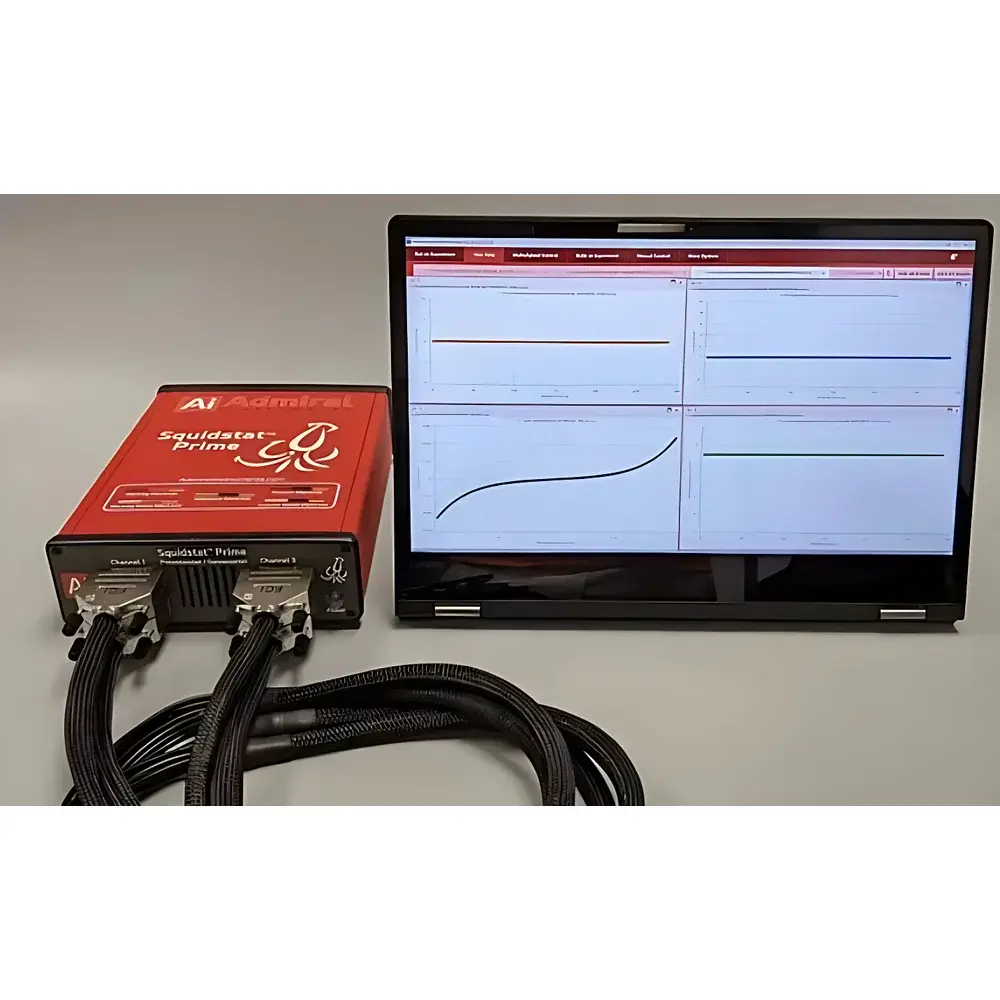
Squidstat Prime Quad-Channel Electrochemical Workstation
| Brand | Admiral |
|---|---|
| Origin | USA |
| Model | Squidstat Prime |
| Instrument Type | Benchtop Multi-Channel Electrochemical Workstation |
| Number of Channels | 4 Independent Channels |
| Current Range per Channel | ±250 mA |
| Current Resolution | 750 fA (0.003% of range) |
| Current Accuracy | 0.1% of full scale, down to 10 nA |
| Potential Range | ±10 V |
| Potential Accuracy | ±1 mV (0.1% of range) |
| Potentiostatic/Galvanostatic/ZRA Modes | Yes |
| Input Impedance | 10 TΩ |
| ADC Resolution | 16-bit |
| Sampling Rate | 40 kS/s |
| Onboard Memory | 16 GB |
| Electrode Configurations Supported | 2-, 3-, 4-, and 5-electrode |
| Standard Cable Length | 90 cm |
| AC Impedance Frequency Range | 10 µHz – 1 MHz (typical, dependent on cell configuration) |
| Compliance | ASTM G5, G59, G102 |
Overview
The Squidstat Prime Quad-Channel Electrochemical Workstation is a high-fidelity, benchtop-grade potentiostat/galvanostat system engineered for precision DC and transient electrochemical measurements in research laboratories, quality control environments, and battery development facilities. Based on a true four-channel architecture—where each channel operates independently with full hardware-level isolation—the system enables parallel, synchronized, or staggered experiments across multiple working electrodes without cross-talk or shared resource contention. Its core measurement principle relies on digitally controlled analog feedback loops with low-noise current-to-voltage conversion, high-stability reference voltage sources, and real-time digital signal processing to ensure sub-millivolt potential control and femtoampere-level current resolution. Designed for reproducibility in demanding applications such as battery cycling, corrosion kinetics, sensor calibration, and electrodeposition studies, the Squidstat Prime meets the functional requirements of ASTM G59 (potentiodynamic polarization), ASTM G102 (electrochemical impedance spectroscopy analysis), and ISO 16773-2 (electrochemical testing of coatings), supporting both fundamental electrochemistry and regulated industrial workflows.
Key Features
- Four fully independent electrochemical channels, each with dedicated potentiostat, galvanostat, and zero-resistance ammeter (ZRA) circuitry
- Simultaneous multi-electrode operation with hardware-triggered synchronization and timestamp alignment across channels
- Potential control range of ±10 V with accuracy of ±1 mV (0.1% of range) and resolution of 300 µV
- Current measurement from ±25 nA to ±250 mA across eight auto-ranging decades, with minimum resolution of 750 fA
- 16-bit analog-to-digital conversion at up to 40,000 samples per second per channel, enabling high-temporal-resolution transient capture
- Input impedance exceeding 10 TΩ ensures minimal loading effects during high-impedance measurements (e.g., coated metals, polymer electrolytes)
- Flexible grounding options: switchable between grounded and floating configurations to accommodate isolated cells or differential setups
- Support for 2-, 3-, 4-, and 5-electrode configurations—including dual-reference and counter-reference arrangements—for advanced corrosion and battery testing
- Onboard 16 GB non-volatile memory for autonomous data logging during extended experiments or PC-disconnected operation
Sample Compatibility & Compliance
The Squidstat Prime accommodates a broad spectrum of electrochemical cells—from standard three-electrode aqueous solutions and organic electrolyte coin cells to high-temperature molten salt systems and solid-state battery half-cells. Its wide compliance voltage (±10 V) and high current capability (±250 mA per channel) allow characterization of low-conductivity media and high-power electrode materials. The system supports IEC 62660-1/2-compliant charge/discharge protocols and integrates seamlessly into GLP/GMP-aligned laboratories through audit-trail-enabled software (see Software section). All hardware design adheres to IEC 61010-1 safety standards for laboratory electrical equipment. For corrosion testing, it satisfies ASTM G5 (reference electrode calibration), ASTM G59 (polarization resistance), and ASTM G102 (corrosion rate calculation). In battery R&D, it aligns with USP guidance for electrochemical stability profiling of active pharmaceutical ingredients (APIs) and excipients in redox-active formulations.
Software & Data Management
Control and analysis are performed via the proprietary “Squidstat Studio” software—a Windows-based application compliant with FDA 21 CFR Part 11 requirements when configured with electronic signatures, role-based access control, and immutable audit trails. The software supports method sequencing, conditional branching, and real-time parameter adjustment during ongoing experiments. Raw data are stored in open-format HDF5 files with embedded metadata (timestamp, instrument ID, user, experiment parameters), ensuring long-term archival integrity and third-party interoperability. Built-in analysis modules include Tafel slope extraction, EIS equivalent circuit fitting (using ZView-compatible models), dQ/dV peak identification, Coulombic efficiency tracking, and SOC estimation via incremental capacity analysis. Export options include CSV, MATLAB .mat, and MPT formats. Remote monitoring and scripting via Python API (PySquid) enable integration into automated test benches and LIMS environments.
Applications
- Battery material screening: multi-channel parallel cycling of cathode/anode composites under identical thermal and environmental conditions
- Corrosion science: simultaneous polarization resistance mapping across alloy gradients or coating defect sites
- Electrocatalysis: comparative evaluation of catalyst activity using identical CV scan rates and IR compensation settings across four electrodes
- Sensor development: real-time amperometric detection with statistical validation via N ≥ 4 replicates per condition
- Fuel cell membrane testing: high-impedance EIS measurements on proton exchange membranes with floating-ground configuration
- Electrodeposition process optimization: chronoamperometric nucleation analysis combined with post-deposition SEM correlation
- Academic teaching labs: modular experiment libraries for undergraduate electrochemistry courses, with pre-validated methods and instructor lockout modes
FAQ
Can the Squidstat Prime be expanded beyond four channels?
Yes—up to 32 Squidstat Prime units can be daisy-chained via Ethernet and synchronized via a master PC, enabling scalable configurations of up to 128 independent channels with nanosecond-level inter-channel timing alignment.
Does the system support electrochemical impedance spectroscopy (EIS)?
Yes, each channel performs single-sine or multi-sine EIS from 10 µHz to 1 MHz with programmable amplitude, DC bias, and Kramers–Kronig validation; frequency resolution and stability meet ISO 16773-2 requirements for coating impedance assessment.
Is the firmware upgradable in the field?
Yes—firmware updates are delivered via Squidstat Studio and applied without requiring hardware service; all updates preserve backward compatibility with existing method files and data formats.
What electrode cable options are available beyond the standard 90 cm length?
Custom-length shielded coaxial cables (up to 5 m) and low-capacitance twisted-pair configurations are available for Faraday cage integration or high-frequency EIS applications.
How is data integrity ensured during long-duration experiments?
The onboard 16 GB memory buffers all raw data continuously; in the event of PC disconnect or power interruption, measurements resume automatically upon reconnection with no data loss or time-gap artifacts.
Related Products



