
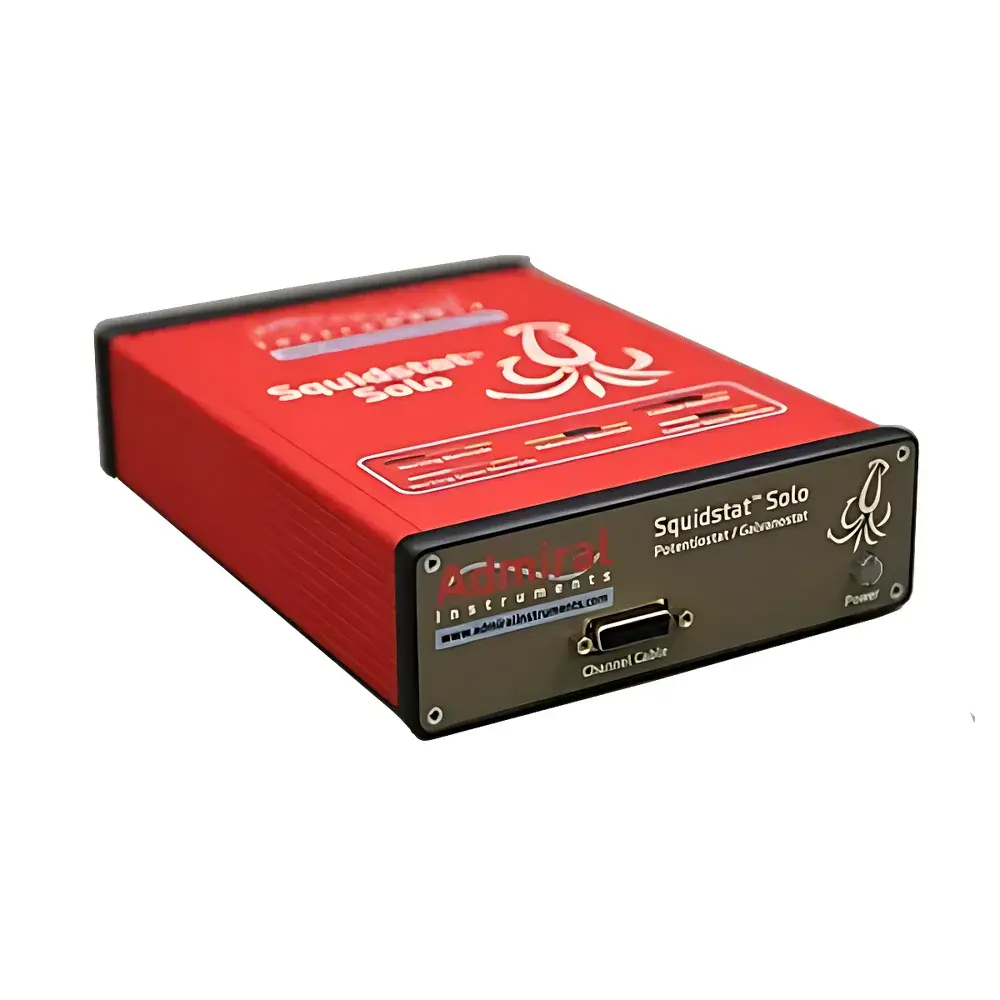
Squidstat Solo Electrochemical Workstation by Admiral
| Brand | Admiral |
|---|---|
| Origin | USA |
| Manufacturer Type | Authorized Distributor |
| Product Category | Imported Instrument |
| Model | Squidstat Solo |
| Instrument Type | Electrochemical Workstation |
| Channel Count | Single-Channel |
| Current Range | ±100 mA |
| Current Accuracy | 0.2% of full scale, down to 20 nA |
| Potentiostatic Range | ±10 V |
| EIS Frequency Range | 10 µHz to 1 MHz |
Overview
The Squidstat Solo Electrochemical Workstation by Admiral is a compact, high-fidelity single-channel potentiostat/galvanostat engineered for precision electrochemical characterization in research laboratories, quality control environments, and battery development facilities. Based on a robust analog front-end architecture with digital signal processing and real-time control firmware, the instrument implements classical three-electrode potentiostatic and galvanostatic techniques alongside advanced impedance spectroscopy using a direct digital synthesis (DDS) frequency generator and synchronous demodulation. Its design emphasizes low-noise current measurement, high-voltage compliance, and stable reference electrode potential control—critical for studying corrosion kinetics, electrode reaction mechanisms, interfacial charge transfer, and solid-state ion transport in Li-ion and next-generation battery materials.
Key Features
- Single-channel architecture with configurable 2-, 3-, 4-, or 5-terminal electrode connections (including ZRA mode)
- True floating ground operation with selectable grounding configuration for isolated cell setups
- 16-bit analog-to-digital converter (ADC) with up to 100 kS/s sampling rate for high-temporal-resolution transient capture
- Eight programmable current ranges (10 nA – 100 mA), delivering a minimum current resolution of 300 fA at the lowest range
- Potentiostatic control range of ±10 V with voltage resolution of 33 µV and accuracy of ±0.1% of setpoint (±1 mV max)
- Input impedance >1013 Ω ensures minimal loading error during high-impedance measurements (e.g., coated metals, polymer electrolytes)
- Onboard 16 GB non-volatile memory enables autonomous long-term data logging without PC dependency
- Modular scalability: multiple Squidstat Solo units can be synchronized via external trigger or USB hub for parallel multi-cell testing
Sample Compatibility & Compliance
The Squidstat Solo supports standard aqueous and non-aqueous electrochemical cells—including rotating disk electrodes (RDE), rotating ring-disk electrodes (RRDE), microelectrodes, and coin/pouch/prismatic battery test fixtures. It complies with fundamental safety and electromagnetic compatibility standards per FCC Part 15 Class B and CE directives. While not pre-certified for regulated GxP environments, its architecture supports GLP/GMP-aligned workflows when paired with validated software configurations: audit-trail-enabled method saving, timestamped raw data export (CSV/Binary), and user-access-controlled parameter locking are fully implemented. The instrument meets key performance benchmarks referenced in ASTM G5, G59, G102, and ISO 17475 for corrosion testing, as well as IEC 62660-1 for lithium-ion cell characterization.
Software & Data Management
Control and analysis are performed via Admiral’s proprietary “Squidstat Studio” software (Windows-based), which provides an intuitive graphical interface for experiment sequencing, real-time visualization, and post-acquisition processing. Users may construct custom method sequences combining DC techniques (CV, LSV, OCP, Tafel, DPV, SWV, NPV) with EIS sweeps or hybrid protocols such as GITT/PITT and CC-CV cycling. All raw datasets include metadata headers (timestamp, instrument ID, calibration status, user ID), supporting traceability requirements. Export formats include CSV, MATLAB (.mat), and generic binary; third-party integration is enabled via COM/ActiveX API and SCPI command set. Software updates are delivered through secure HTTPS channels with SHA-256 signature verification.
Applications
- Battery R&D: Charge/discharge profiling, dQ/dV analysis, state-of-charge (SOC) estimation, Coulombic and energy efficiency quantification
- Corrosion science: Polarization resistance, electrochemical noise analysis (ENA), localized corrosion monitoring under variable pH or chloride exposure
- Electrocatalysis: HER/OER/ORR activity mapping, stability assessment via accelerated stress tests (ASTs)
- Sensors & biosensors: Amperometric detection limits, enzyme kinetics modeling, redox mediator diffusion coefficient determination
- Materials screening: Conductivity mapping of conductive polymers, interfacial capacitance of MOFs/COFs, SEI formation dynamics in solid electrolytes
FAQ
Is the Squidstat Solo compatible with rotating ring-disk electrode (RRDE) configurations?
Yes—the instrument supports dual-potentiostat mode for independent control of ring and disk potentials, enabling collection efficiency calibration and reaction intermediate detection.
Can EIS data be acquired simultaneously with DC polarization?
No—EIS and DC techniques operate in mutually exclusive modes; however, users may embed EIS scans within multi-step protocols before or after DC segments.
What is the minimum measurable current and its corresponding accuracy specification?
At the 10 nA range, the minimum detectable current is 20 nA with ±0.2% full-scale accuracy; resolution is 300 fA, though accuracy degrades below 20 nA due to thermal noise floor limitations.
Does the system support FDA 21 CFR Part 11-compliant electronic signatures?
The base software does not include Part 11 modules; however, enterprise deployment packages with role-based access control, electronic signature workflows, and audit trail generation are available upon request and require site-specific validation documentation.
How is hardware calibration performed?
Calibration is executed via internal reference sources and verified using NIST-traceable external standards; procedures are guided stepwise in the software and generate a dated calibration certificate stored in the instrument’s memory.
Related Products





