
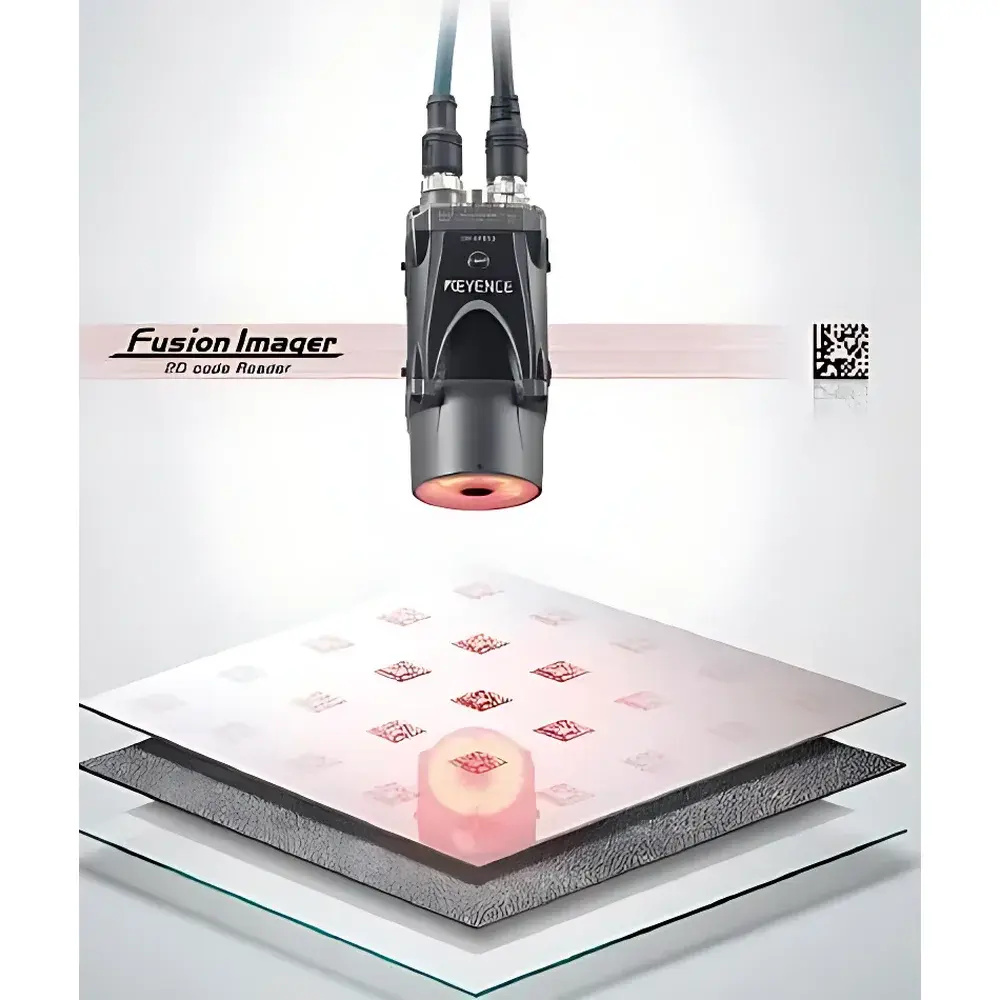
SR-D100 Series Fixed-Mount 2D Barcode Imager
| Brand | KEYENCE |
|---|---|
| Origin | Japan |
| Manufacturer Type | Original Equipment Manufacturer (OEM) |
| Product Origin | Imported |
| Model | SR-D100 Series |
| Pricing | Available Upon Request |
Overview
The KEYENCE SR-D100 Series is a fixed-mount, high-performance 2D barcode imager engineered for industrial automation environments where reliability, speed, and consistent decoding accuracy are critical. Unlike handheld scanners or legacy vision-based readers, the SR-D100 employs a fused optical architecture combining high-resolution CMOS imaging sensors with adaptive illumination control and real-time image processing firmware. It operates on the principle of multi-angle, multi-exposure image acquisition followed by proprietary pattern recognition algorithms optimized for low-contrast, distorted, or physically degraded 2D codes—including Data Matrix, QR Code, Aztec, and PDF417 symbologies. Designed specifically for integration into production lines, packaging systems, and traceability stations, the SR-D100 delivers deterministic read performance under variable lighting, motion blur, and substrate-induced challenges—without requiring operator intervention or manual parameter tuning.
Key Features
- Fusion Imager Architecture: Integrates synchronized LED illumination, dynamic exposure control, and hardware-accelerated decoding to resolve codes on challenging surfaces—including reflective metals, translucent glass, matte plastics, and textured castings.
- Three-Step Calibration Workflow: A guided, menu-driven setup process enables optimal focus, lighting angle, and decoding sensitivity configuration in under 60 seconds—no vision expertise or external software required.
- Robust Industrial Housing: IP65-rated aluminum alloy enclosure with thermal-stable lens mount and shock-dampened internal optics ensures long-term repeatability across ambient temperature fluctuations (−10 °C to +50 °C) and mechanical vibration.
- Zero-Configuration Operation: Auto-detects code type, orientation, and grade; dynamically adjusts ROI (Region of Interest), contrast enhancement, and binarization thresholds without user-defined presets.
- Real-Time Diagnostics & Status Feedback: Integrated LED indicators and digital I/O signals provide immediate visual and electrical confirmation of read success, failure cause (e.g., motion blur, insufficient contrast), and system health.
Sample Compatibility & Compliance
The SR-D100 Series reliably decodes 2D barcodes applied via laser etching, inkjet printing, dot peening, and chemical etching on substrates including anodized aluminum, stainless steel castings, tempered glass, polycarbonate housings, and ceramic components. It meets ISO/IEC 15415 and ISO/IEC 15416 grading standards for symbol quality assessment and supports configurable pass/fail criteria per application. The device complies with CE marking requirements (EMC Directive 2014/30/EU, RoHS Directive 2011/65/EU), and its electrical interface conforms to IEC 61131-2 Type 1/3 digital input/output specifications. For regulated industries, the imager supports deterministic timestamping and audit-ready logging when integrated with PLC-controlled systems operating under GLP or GMP frameworks.
Software & Data Management
No PC-based configuration software is required for basic operation—the SR-D100 features embedded web server access via Ethernet (TCP/IP) for remote monitoring, firmware updates, and log export. Advanced users may leverage KEYENCE’s optional FA Network Manager for centralized deployment, batch parameter synchronization across multiple units, and CSV-formatted decode history export with timestamps, symbology ID, and confidence scores. All communication protocols—including Modbus TCP, EtherNet/IP, and PROFINET—are implemented at firmware level with deterministic cycle times (< 5 ms). Optional support for FDA 21 CFR Part 11–compliant electronic signatures and audit trails is available through validated third-party MES/SCADA integrations.
Applications
- Automotive component traceability on engine blocks, brake calipers, and transmission housings
- Electronics assembly line verification of PCB serial numbers and firmware version codes
- Pharmaceutical secondary packaging validation (carton-level Data Matrix compliance per EU Falsified Medicines Directive)
- Food & beverage can/bottle coding inspection despite condensation, label curl, or surface grease
- Aerospace part pedigree tracking on titanium and Inconel components with laser-marked UID codes
FAQ
Does the SR-D100 require regular recalibration during continuous operation?
No—its thermally compensated optical design and self-diagnostic firmware eliminate drift-related recalibration needs over typical shift cycles. Recalibration is only advised after physical impact or extreme ambient temperature shifts (>15 °C change sustained for >2 hours).
Can it decode damaged or partially obscured 2D codes?
Yes—via multi-frame reconstruction and error-correction-aware decoding logic, the SR-D100 recovers symbols with up to 40% localized damage, smudging, or occlusion, provided minimum module size and contrast thresholds are met.
Is GPIO wiring compatible with standard PLC input cards?
Yes—all digital outputs are opto-isolated, 24 VDC sink/source configurable, and rated for 100 mA continuous load—fully interoperable with Siemens S7, Rockwell ControlLogix, and Mitsubishi FX series PLCs.
What is the maximum working distance for a 10 mm × 10 mm Data Matrix code?
At standard mounting height (150 mm), the SR-D100 achieves reliable reads of 10 mm codes with ≥20% contrast on matte surfaces; extended-range variants (SR-D100-L) support up to 300 mm working distance with appropriate lens selection.
Does it support custom symbology or proprietary 2D formats?
No—it supports only ISO/IEC-standardized 2D symbologies. Custom or encrypted formats must be pre-processed externally prior to presentation to the imager.




