
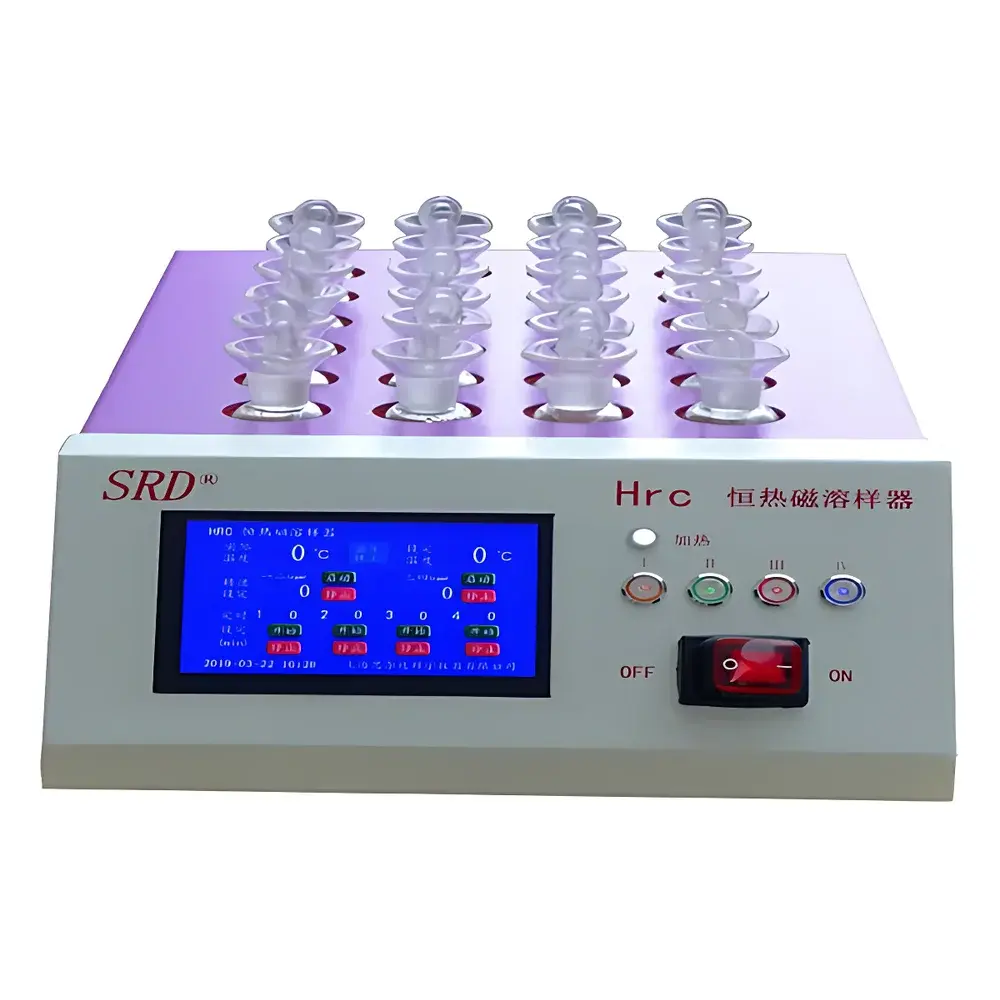
SRD HRC Magnetic Hotplate Stirrer for Rapid Sample Dissolution
| Brand | SRD |
|---|---|
| Origin | Shanghai, China |
| Model | HRC |
| Instrument Type | Constant-Temperature Heating Bath |
| Number of Sample Positions | 24 (arranged in 4 zones × 6 positions) |
| Temperature Range | Ambient to 135 °C |
| Temperature Stability | ±1 °C |
| Vessel Compatibility | Standard Glass Vials with Magnetic Stir Bars |
Overview
The SRD HRC Magnetic Hotplate Stirrer is an engineered solution for controlled, high-throughput sample dissolution in analytical and quality control laboratories. Designed specifically as a dedicated sample preparation module for the NCY-X Automated Viscometry System, the HRC operates on the principle of contactless magnetic stirring driven by a precisely regulated rotating magnetic field generated beneath the heating plate surface. Unlike conventional hotplate stirrers relying on fixed-speed motors and mechanical coupling, the HRC employs electromagnetic field modulation to induce synchronous rotation of standard magnetic stir bars placed inside sample vials—enabling independent, uniform agitation across all 24 positions without physical drive components or moving parts in direct contact with the bath surface. The unit delivers stable thermal conditions from ambient up to 135 °C with ±1 °C stability over time, supporting reproducible dissolution kinetics critical for viscosity measurement pre-conditioning, polymer solubilization, pharmaceutical excipient dispersion, and routine QC sample homogenization.
Key Features
- 24-position modular layout organized into four independently configurable zones (6 positions per zone), each supporting individual temperature and stirring speed settings via intuitive touchscreen interface
- Electromagnetic field-driven stirring eliminates mechanical wear, noise, and cross-contamination risks associated with motor-coupled stirrers
- High-resolution digital temperature control with real-time feedback and auto-tuning PID algorithm ensures consistent thermal profiles across all positions
- Touchscreen HMI supports programmable dissolution protocols—including ramp-hold sequences, multi-stage stirring profiles, and timed shutdown—traceable via internal event log
- Heating plate constructed from corrosion-resistant aluminum alloy with PTFE-coated surface for chemical compatibility and easy cleaning
- No external coolant or circulation system required; optimized for benchtop deployment in ISO/IEC 17025-accredited labs where footprint and utility constraints are prioritized
Sample Compatibility & Compliance
The HRC accommodates standard 10–25 mL glass vials (e.g., ASTM D2196-compliant viscometry tubes) fitted with chemically inert magnetic stir bars (e.g., PTFE-encapsulated NdFeB). It complies with general electrical safety requirements per IEC 61010-1 and meets CE marking criteria for laboratory equipment. While not certified to GLP or GMP out-of-the-box, its parameter logging capability, user-accessible audit trail, and password-protected configuration mode support alignment with FDA 21 CFR Part 11 expectations when integrated into validated workflows. The device is routinely deployed in applications governed by USP , ISO 1628-1 (polymer viscosity), and ASTM D1250 (liquid density/temperature correction) where thermal and hydrodynamic consistency directly impact downstream measurement integrity.
Software & Data Management
The embedded firmware stores up to 100 protocol templates with timestamped execution records. All setpoints (temperature, field rotation frequency, duration), actual measured values, and error flags are logged internally and exportable via USB flash drive in CSV format. No proprietary software installation is required; data files are human-readable and compatible with LIMS integration via standard scripting interfaces (e.g., Python-based LabVIEW or custom REST API middleware). Audit trails include operator ID (if enabled), session start/end times, and deviation alerts triggered when measured temperature exceeds ±1.5 °C of setpoint for >30 seconds—supporting root-cause analysis during method validation or nonconformance investigations.
Applications
- Polymer solution preparation for capillary and rotational viscometry (e.g., PVC, PVA, cellulose derivatives)
- Dissolution of high-molecular-weight standards prior to rheological characterization
- Homogenization of viscous pharmaceutical suspensions and ointment bases under defined thermal history
- Pre-analytical conditioning of lubricant additives and surfactant systems per ASTM D445/D7042
- Controlled solvation of geological core extracts and bituminous materials for asphalt binder testing
- Standardized sample warming for FTIR and UV-Vis quantification where matrix viscosity affects pathlength uniformity
FAQ
Is the HRC compatible with non-magnetic sample containers?
No—the system requires ferromagnetic or rare-earth magnetic stir bars placed inside standard glass or quartz vials. Non-magnetic vessels (e.g., certain polymers or ceramics) will not respond to the rotating field.
Can multiple zones operate at different temperatures simultaneously?
Yes—each of the four zones can be assigned unique temperature and stirring parameters, enabling parallel dissolution of chemically dissimilar samples.
Does the unit support external temperature probe input for vessel-specific monitoring?
No—temperature sensing is performed via built-in PT100 sensor array beneath the plate surface; direct vial-integrated probe input is not supported.
What maintenance is required for long-term field reliability?
Annual calibration verification against NIST-traceable reference thermometer is recommended; no routine lubrication or bearing replacement is needed due to contactless drive architecture.
Is firmware upgrade capability available?
Yes—field-upgradable via USB; release notes and version-controlled binaries are provided upon registration with SRD’s technical support portal.



