
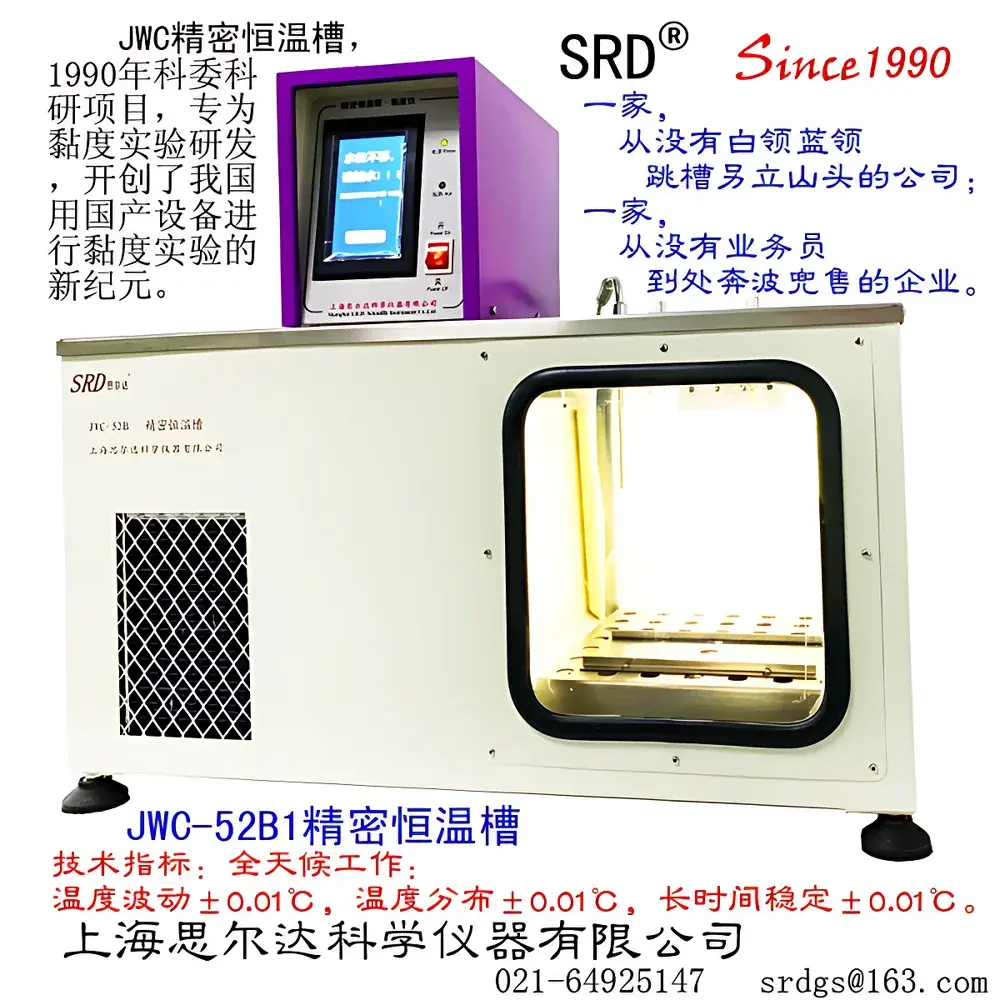
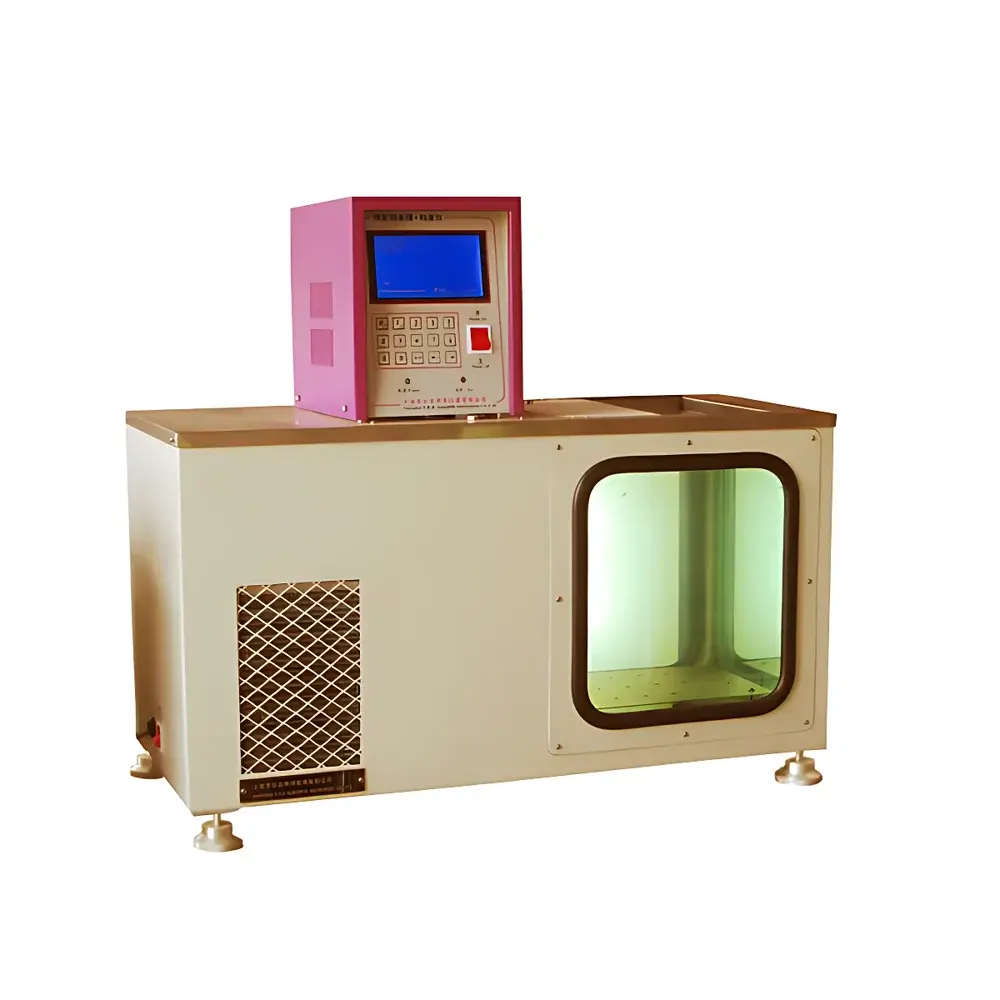
SRD JWC-52B1 Precision Circulating Constant-Temperature Bath
| Brand | SRD |
|---|---|
| Origin | Shanghai, China |
| Model | JWC-52B1 |
| Instrument Type | Circulating Constant-Temperature Bath |
| Circulation Mode | Internal Circulation |
| Temperature Control | Refrigeration & Heating |
| Bath Volume | 30 L |
| Temperature Range | 0–70 °C |
| Temperature Stability | ±0.01 °C |
| Temperature Resolution | 0.01 °C |
| Temperature Uniformity | ±0.01 °C (within ambient ±30 °C) |
| Refrigeration Capacity | 220 kcal/h |
| Heating Power | 1 kW |
| Power Supply | 220 V, 10 A, 50 Hz |
Overview
The SRD JWC-52B1 Precision Circulating Constant-Temperature Bath is an engineered thermal control platform designed for high-fidelity temperature regulation in analytical, materials testing, and quality assurance laboratories. Based on a dual-mode refrigeration–heating architecture—featuring a hermetically sealed compressor-based cooling system and a precision-controlled resistive heating element—the instrument delivers stable, uniform thermal environments across its 30 L working volume. Unlike Peltier-based systems, the JWC-52B1 eliminates dependency on external chilled water supplies and avoids performance degradation at elevated ambient temperatures, ensuring consistent operation from 0 °C to 70 °C regardless of seasonal or facility-specific environmental conditions. Its core function is to maintain setpoint temperature with long-term stability of ±0.01 °C and spatial uniformity of ±0.01 °C (measured across the bath chamber under ambient conditions ±30 °C), meeting the stringent thermal requirements of ASTM D1505 (density of plastics), ISO 11357 (DSC calibration), USP (water conductivity testing), and other temperature-critical protocols requiring GLP-compliant thermal validation.
Key Features
- Dual-mode thermal control system: independent compressor-driven refrigeration (220 kcal/h) and 1 kW resistive heating for rapid, bidirectional temperature response
- High-stability PID algorithm with adaptive tuning, enabling ±0.01 °C temperature stability over extended periods
- Internal circulation design with optimized flow path ensures uniform heat distribution without external pump coupling or tubing complexity
- Stainless steel bath chamber and powder-coated steel housing for chemical resistance and mechanical durability in routine lab use
- Large dual-side observation windows (575 × 675 mm) with rear-mounted diffused white LED backlighting for real-time visual monitoring of submerged samples and reaction vessels
- Integrated digital display showing real-time temperature deviation from setpoint, with 0.01 °C resolution and user-adjustable offset correction (<0.1 °C max error)
- Front-panel LED indicators for active heating, refrigeration, and system fault status; intuitive push-button interface with no software dependency
Sample Compatibility & Compliance
The JWC-52B1 accommodates standard laboratory glassware—including beakers, flasks, viscometers, and dilatometer cells—via its top-mounted adjustable sample rack assembly. Its 30 L usable volume (800 × 725 × 850 mm internal dimensions) supports immersion of multi-component test setups while maintaining thermal homogeneity. The unit complies with IEC 61010-1:2010 safety standards for electrical equipment used in measurement, control, and laboratory applications. Its temperature performance is traceable to NIST-traceable reference thermometers and validated per ISO/IEC 17025 procedures. For regulated environments, the instrument’s deterministic thermal behavior—free from software-mediated control loops—supports audit-ready documentation under FDA 21 CFR Part 11 (when paired with external validated data loggers) and fulfills temperature uniformity prerequisites for ISO 17025-accredited calibration labs.
Software & Data Management
The JWC-52B1 operates as a standalone hardware-controlled system with no embedded firmware or network connectivity. All temperature regulation logic resides in dedicated microelectronic circuitry, eliminating cybersecurity risks and software obsolescence concerns common in connected instruments. For data integrity and regulatory compliance, users may integrate external Class A platinum resistance thermometers (PRTs) and certified data loggers (e.g., Omega OM-DAQPRO-5300 series) to record time-stamped temperature profiles with full audit trail capability. This architecture aligns with GMP/GLP principles emphasizing separation of control and recording functions, and supports retrospective validation of thermal exposure history for critical assays such as polymer crystallinity studies or enzyme activity profiling.
Applications
- Calibration of thermometers, RTDs, and thermocouples against primary standards
- Temperature stabilization for rotational viscometers, density meters, and refractometers
- Controlled-condition aging studies of polymers, elastomers, and composite resins per ASTM D3045
- Thermal conditioning of biological samples prior to spectroscopic or chromatographic analysis
- Supporting differential scanning calorimetry (DSC) cell equilibration and baseline verification
- Providing stable thermal sinks/sources for thermal conductivity and expansion coefficient measurements
FAQ
What is the recommended maintenance schedule for the compressor-based cooling system?
Compressor oil and refrigerant integrity should be verified annually by qualified service personnel; condenser coils require biweekly dust removal using compressed air.
Can the bath operate continuously at 0 °C in a 35 °C ambient environment?
Yes—the compressor system maintains setpoint stability within specification across the full 0–70 °C range, even when ambient temperature exceeds 30 °C.
Is the temperature uniformity specification valid for the entire 30 L volume?
Yes—uniformity of ±0.01 °C is measured at nine standardized locations (per ISO 17025 Annex C) throughout the working volume under steady-state conditions.
Does the unit support external temperature probe input for cascade control?
No—the JWC-52B1 is a self-contained, open-loop controlled bath without analog/digital I/O ports; external feedback requires third-party controller integration.
What materials are in contact with the bath fluid?
The tank liner is 304 stainless steel; all wetted seals are EPDM; no copper, brass, or aluminum components are exposed to the working medium.



