
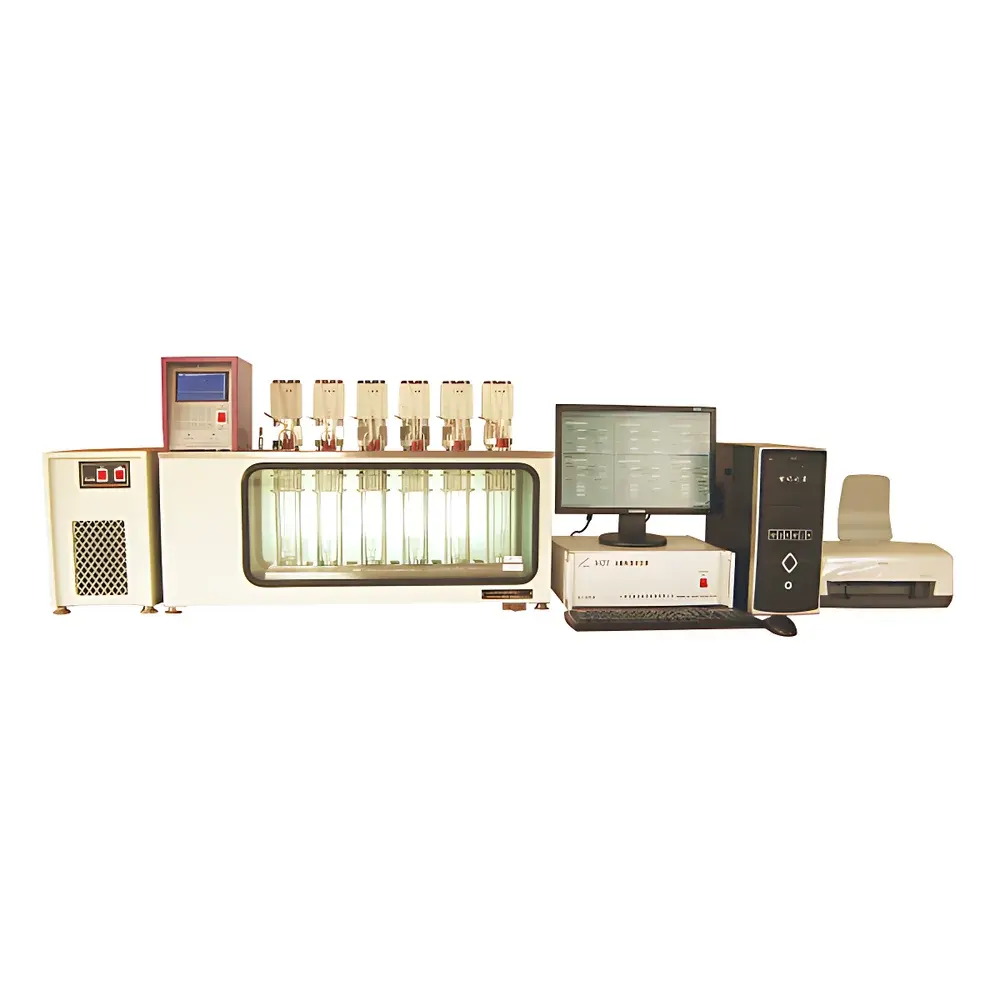
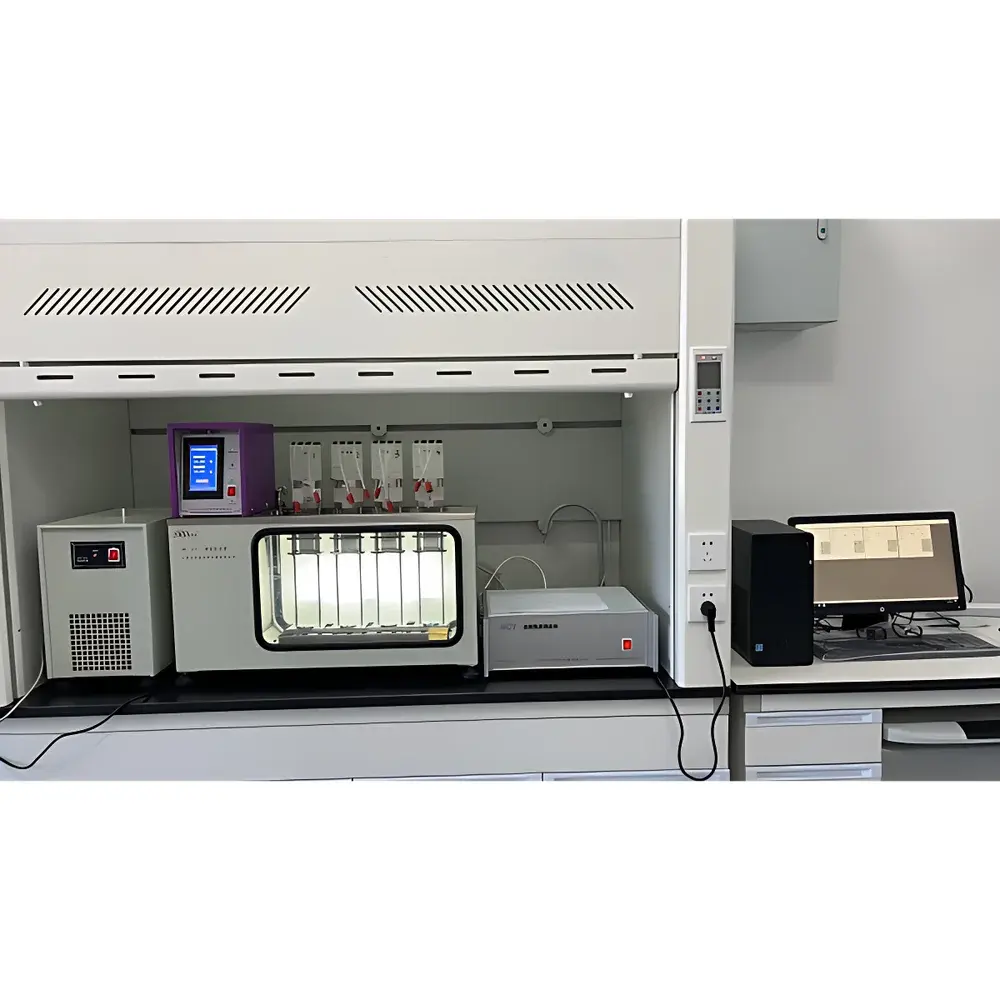
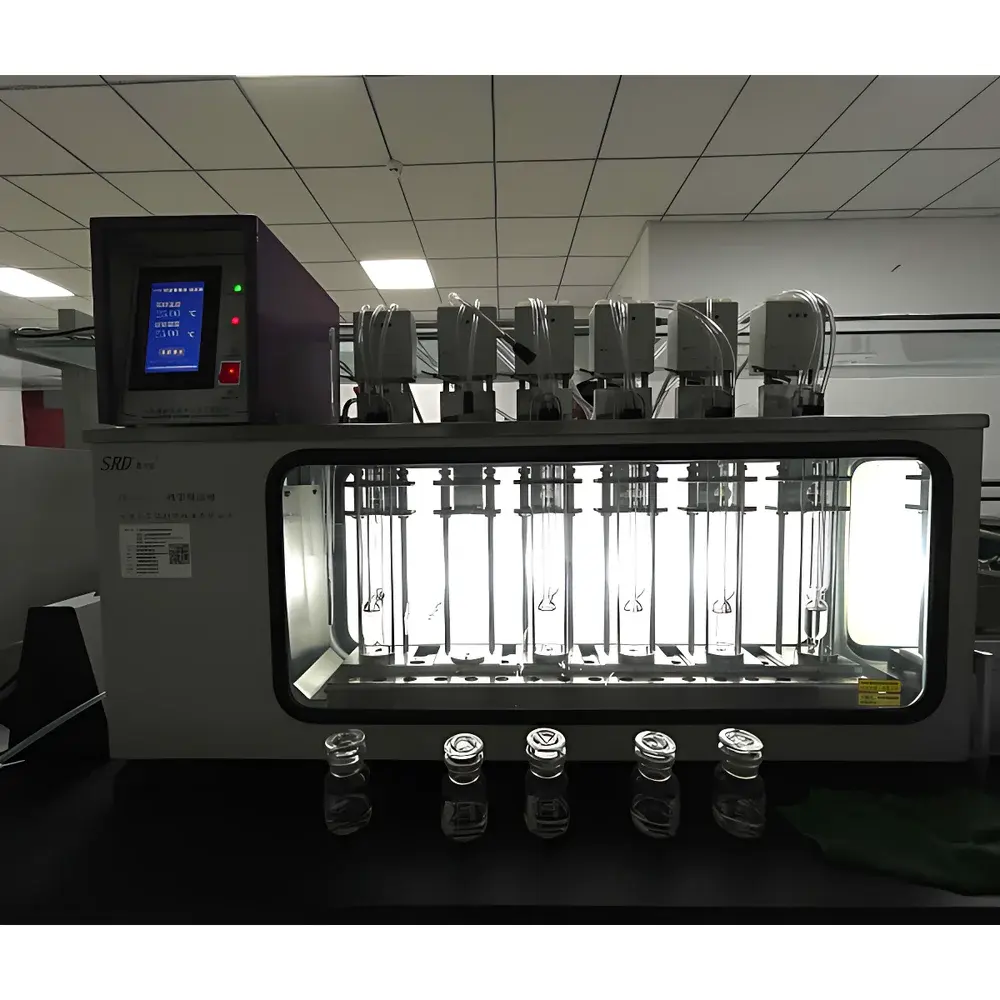
SRD NCY-2 Automated Capillary Viscometer
| Brand | SRD |
|---|---|
| Model | NCY-2 |
| Type | Fixed-Position Automated Capillary Viscometer |
| Viscosity Range (Efflux Time) | 0.01–999.99 s |
| Temperature Range | 5–75 °C |
| Temperature Resolution | 0.01 °C |
| Temperature Accuracy | ±0.01 °C |
| Timing Resolution | 0.01 s |
| Timing Range | 0.01–999.99 s |
| Measured Parameters | Intrinsic Viscosity (0.1–4.0 dL/g), Average Polymerization Degree (100–10,000), Kinematic Viscosity (0.1–300 mm²/s), Dynamic Viscosity (5–800 mPa·s) |
| Heating Power | 1 kW |
| Cooling Capacity | 125/220 kcal/h |
| Power Supply | 220 V AC, 6–10 A |
Overview
The SRD NCY-2 Automated Capillary Viscometer is a precision-engineered instrument designed for standardized intrinsic viscosity, kinematic viscosity, dynamic viscosity, and average polymerization degree determination in synthetic polymer solutions—particularly polyester, nylon, PVC, PVA, acrylic, and viscose rayon. It operates on the principle of capillary flow viscometry, complying with fundamental ISO 1628-1, ASTM D445, and GB/T 1632-2008 methodologies. The system integrates a thermostatically controlled bath with ±0.01 °C temperature stability across all measurement positions, ensuring high reproducibility required for polymer characterization in QC laboratories and R&D settings. Unlike manual Ubbelohde or Ostwald viscometers, the NCY-2 automates aspiration, efflux timing, outlier rejection, and multi-parameter calculation—reducing operator bias and human error while maintaining full traceability per GLP/GMP-aligned data handling protocols.
Key Features
- Fixed-position dual-capillary configuration (NCY-2 model) enabling simultaneous, independent analysis of two polymer solution samples under identical thermal conditions
- High-stability precision thermostatic bath with active heating (1 kW) and dual-stage cooling (125/220 kcal/h), delivering uniform ±0.01 °C temperature distribution across the entire bath volume
- Automated fluid handling system with solenoid-driven aspiration and gravity-fed capillary flow detection via optical sensors
- Sub-millisecond timing resolution (0.01 s) over full 0.01–999.99 s range, synchronized with real-time video-assisted flow monitoring for visual validation
- Preloaded library of 10 standardized calculation formulas—including Huggins, Kraemer, Schulz-Blaschke, and Solomon-Ciuta equations—for intrinsic viscosity derivation under varying concentration regimes
- Self-validating algorithmic workflow: automatic outlier detection (via Grubbs’ test or user-defined deviation thresholds), iterative retesting, and statistical reporting of mean, SD, and CV%
- Integrated Windows-based control software (v3.x, localized interface optional) supporting audit trail logging, electronic signatures, and 21 CFR Part 11–compliant user access tiers
Sample Compatibility & Compliance
The NCY-2 is validated for use with common polymer-solvent systems including sulfuric acid (for cellulose derivatives), phenol/1,1,2,2-tetrachloroethane (for polyesters), formic acid (for nylon), and DMF (for acrylics). All capillary viscometers are calibrated using NIST-traceable standard oils (ISO VG 22 to VG 100). The instrument meets mechanical and electrical safety requirements per IEC 61010-1 and supports laboratory accreditation under ISO/IEC 17025. Its temperature control architecture satisfies ASTM D445 Annex A1 criteria for bath uniformity and stability, while data integrity features align with FDA expectations for regulated environments conducting polymer lot release testing.
Software & Data Management
The embedded Windows application provides full lifecycle data management: from method setup (temperature setpoint, dwell time, number of replicates, formula selection) to raw efflux time capture, automated unit conversion, and report generation. All measurements are timestamped, user-annotated, and stored in an encrypted local SQL database with configurable backup intervals. Audit trails record every parameter change, calibration event, and result export action. Export formats include CSV (for LIMS integration), PDF (with embedded chromatogram-style flow curves), and XML (compatible with ELN platforms). Optional network licensing enables centralized method deployment across multiple NCY-series instruments within a single facility.
Applications
- QC release testing of PET chips and melt-spun fibers per ISO 1628-5 and GB/T 14189
- Determination of molecular weight distribution proxies for nylon 6 and nylon 66 in spinning dope preparation
- Batch-to-batch consistency verification of PVA hydrolysis degree via intrinsic viscosity correlation
- Stability assessment of cellulose xanthate solutions during viscose staple fiber production
- Regulatory submission support for medical-grade polymer formulations requiring USP viscosity compliance
- Research-grade screening of novel biopolymer solutions where shear-thinning effects are negligible at low shear rates typical of capillary flow
FAQ
What standards does the NCY-2 comply with for intrinsic viscosity measurement?
It supports ISO 1628-1 (general principles), ISO 1628-5 (polyesters), ASTM D4603 (PET), and GB/T 1632-2008 (general polymer solutions), with configurable calculation models aligned to each standard’s specified concentration ranges and extrapolation methods.
Can the NCY-2 operate without a PC connection?
No—the instrument requires continuous RS232 communication with the host computer for real-time control, sensor feedback, and data processing; it has no standalone display or onboard memory.
Is temperature calibration traceable to national standards?
Yes—each unit ships with a factory calibration certificate referencing a PT100 sensor calibrated against a Fluke 724 temperature calibrator, itself traceable to NIM (China National Institute of Metrology).
How is data integrity maintained during long-term operation?
All measurement events are logged with immutable timestamps, operator ID, environmental metadata (bath temp, ambient humidity), and digital signatures. Database backups auto-generate daily and retain 18 months of history by default.
What maintenance is required for sustained accuracy?
Quarterly verification of capillary bore diameter (using certified micrometers), annual recalibration of the PT100 sensor array, and biannual cleaning of solvent pathways with ultrasonic acetone baths are recommended per the maintenance logbook included with shipment.



