
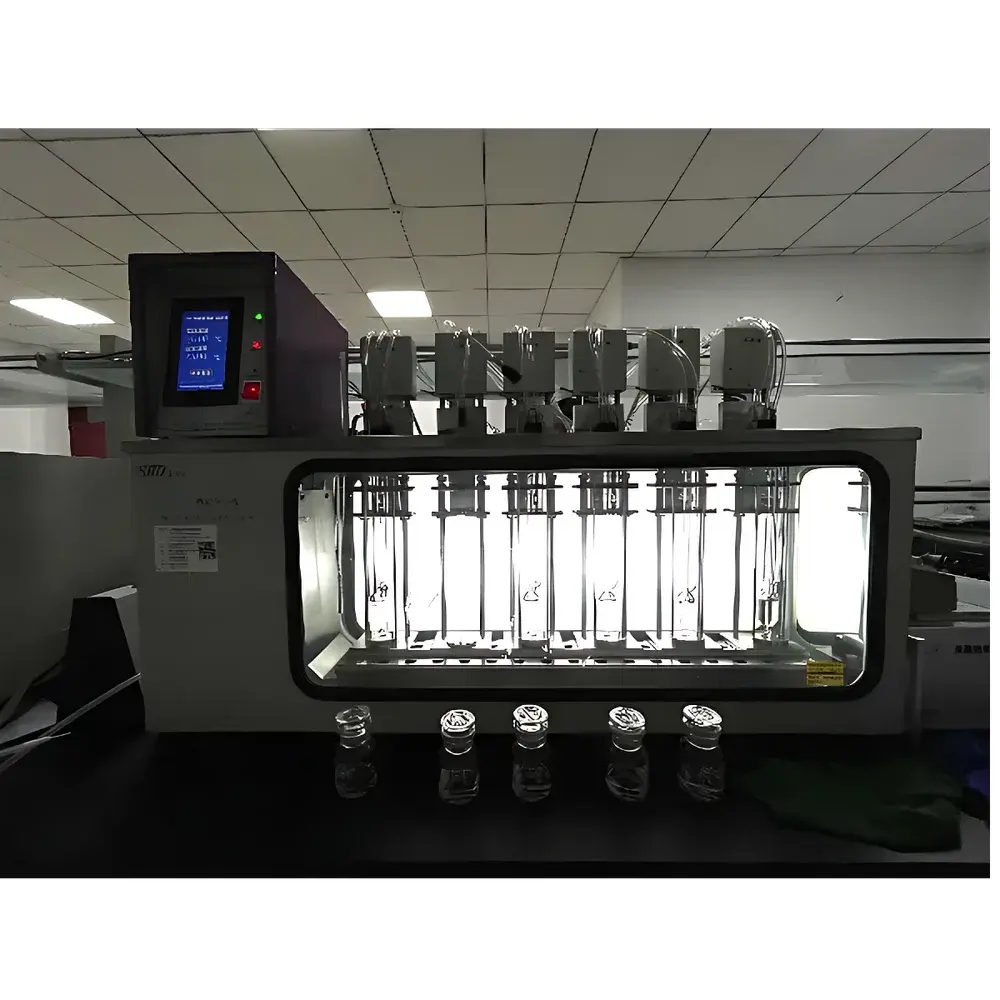
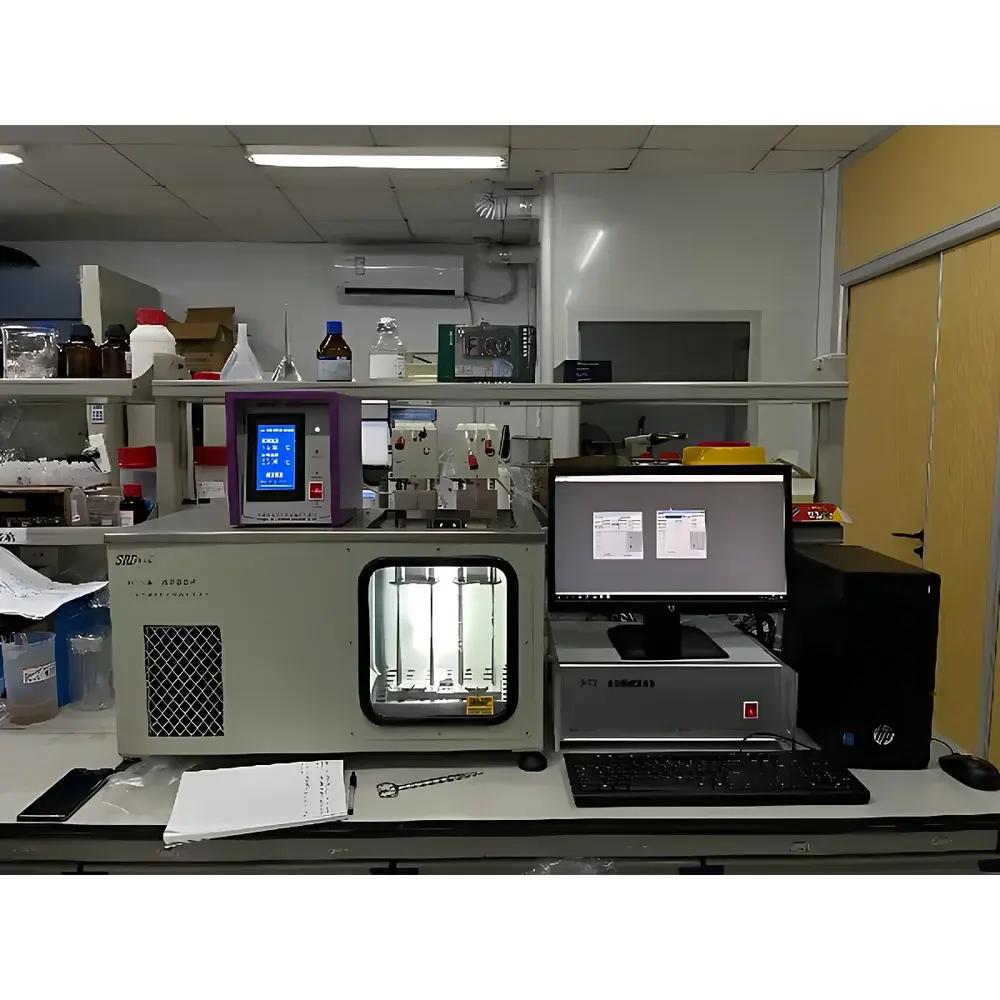
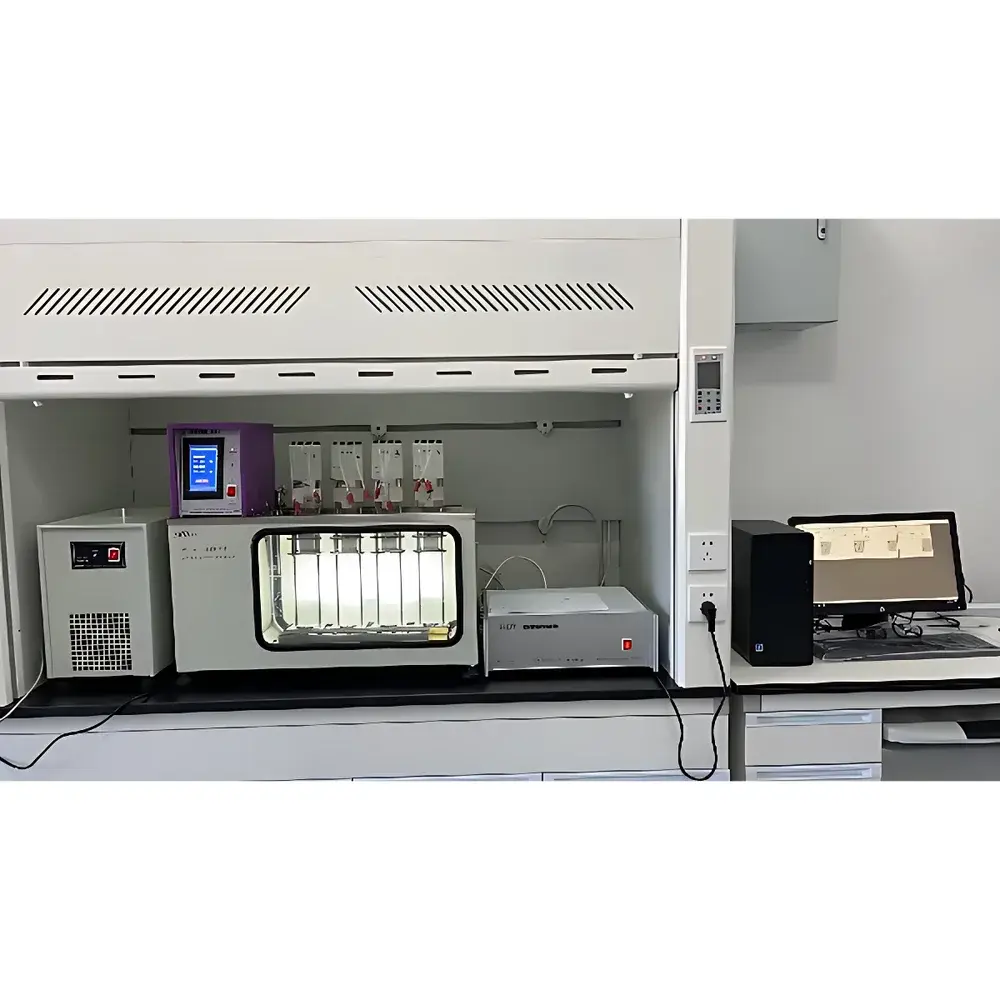
SRD NCY Series Automated Capillary Viscometer
| Brand | SRD |
|---|---|
| Model | NCY Series |
| Type | Fixed-Position Automated Capillary Viscometer |
| Origin | Shanghai, China |
| Viscosity Timing Range | 0.01–999.99 s |
| Temperature Range | 5–80 °C |
| Temperature Resolution | 0.01 °C |
| Temperature Accuracy | ±0.01 °C |
| Temperature Uniformity | ±0.01 °C |
| Timing Resolution | 0.01 s |
| Intrinsic Viscosity Range | 0.1–4.0 dL/g (typical: 0.5–1.5 dL/g) |
| Average Degree of Polymerization | 100–10,000 (typical: ~1,200) |
| Dynamic Viscosity | 5–800 mPa·s (typical: 100–300 mPa·s) |
| Kinematic Viscosity | 0.1–300 mm²/s |
| Heating Power | 1 kW |
| Cooling Capacity | 125/220 kcal/h |
| Power Supply | 220 V, 6–10 A |
| Configurable Test Units | 2–6 parallel capillary stations |
| Preloaded Calculation Formulas | 10 standard polymer-specific algorithms (e.g., Huggins, Kraemer, Schulz-Blaschke) |
| Compliance | Designed for ASTM D4603, ISO 1628-1/3, GB/T 17931, GB/T 14189, USP <911> |
Overview
The SRD NCY Series Automated Capillary Viscometer is an engineered solution for high-precision intrinsic viscosity, relative viscosity, limiting viscosity number (LVN), and average degree of polymerization (DP) determination in synthetic polymers and cellulose derivatives. It operates on the fundamental principle of capillary flow viscometry—measuring the efflux time of a dilute polymer solution through a calibrated glass capillary under gravity-driven laminar flow, per Poiseuille’s law. The system integrates a precision thermostatic bath, multi-channel automated fluid handling, optical flow detection, and dedicated software to eliminate manual timing, pipetting, and calculation errors inherent in traditional Ubbelohde or Cannon-Fenske methods. Designed specifically for quality control and R&D laboratories in polyester, nylon, acrylic, PVA, PVC, viscose rayon, and pulp industries, the NCY platform delivers traceable, repeatable, and auditable viscosity data compliant with international polymer characterization standards.
Key Features
- Modular architecture supporting 2–6 parallel capillary test units—enabling concurrent analysis of multiple samples without cross-contamination or thermal interference.
- Ultra-stable temperature control: ±0.01 °C uniformity and stability across the entire bath volume (5–80 °C range), verified using NIST-traceable 0.01 °C resolution platinum resistance thermometers.
- Optical flow sensing with sub-10 ms response time for precise start/stop timing of efflux events—eliminating human reaction delay and parallax error.
- Automated solvent aspiration, sample loading, rinsing, and drying cycles—reducing operator dependency and improving inter-laboratory reproducibility.
- Pre-programmed calculation engine with 10 standardized viscosity algorithms—including Huggins, Kraemer, Schulz-Blaschke, and single-point relative viscosity—configurable per sample batch.
- Real-time graphical monitoring of fluid meniscus movement in each capillary, with digital overlay of elapsed time and predicted viscosity trend.
- Auto-rejection logic: Outlier detection via statistical deviation (e.g., >2σ from mean efflux time) triggers automatic retest without user intervention.
- Full audit trail: Timestamped records of all parameter changes, calibration events, raw timing data, intermediate calculations, and final reports—supporting GLP/GMP documentation requirements.
Sample Compatibility & Compliance
The NCY Series is validated for use with common polymer solvents including phenol/1,1,2,2-tetrachloroethane (for PET), sulfuric acid (for cellulose), formic acid (for nylon), and dimethylformamide (for acrylics). Its measurement methodology aligns with ASTM D4603 (intrinsic viscosity of PET), ISO 1628-1 (general principles) and ISO 1628-3 (polyamides), GB/T 17931 (viscose staple fiber), and USP (viscosity of pharmaceutical polymers). All temperature and timing subsystems are calibrated against certified reference standards, and the system supports instrument qualification protocols (IQ/OQ/PQ) required for regulated environments. While not FDA 21 CFR Part 11–certified out-of-the-box, its logging architecture provides the foundational data integrity framework necessary for validation under Part 11-compliant SOPs.
Software & Data Management
Controlled via Windows-based application (compatible with Windows 98–10), the NCY software provides bilingual UI (English/Chinese) with role-based access control. Raw timing data, temperature logs, and calculated viscosity values are stored in encrypted local databases with configurable backup intervals. Export options include CSV, PDF, and XML formats compatible with LIMS integration. The software supports customizable report templates—including certificate-of-analysis layouts with embedded digital signatures—and optional barcode scanning for sample tracking. All data entries are immutable post-acquisition; modifications require administrator-level justification logged with timestamp and user ID—ensuring ALCOA+ (Attributable, Legible, Contemporaneous, Original, Accurate, Complete, Consistent, Enduring, Available) compliance.
Applications
- Batch release testing of polyethylene terephthalate (PET) chips and fibers per intrinsic viscosity specifications.
- Monitoring molecular weight distribution shifts during nylon 6/6 polymerization and degradation studies.
- Quality assurance of viscose rayon pulp and lyocell dissolving pulp via cuprammonium or sulfuric acid viscosity.
- Stability assessment of PVA solutions used in adhesives, coatings, and pharmaceutical film-forming agents.
- Process optimization of acrylic fiber spinning dopes through real-time DP tracking.
- Regulatory submission support for polymer excipients under ICH Q5C guidelines.
FAQ
What capillary types are supported?
Standard Ubbelohde-type capillaries (e.g., Cannon-Ubbelohde, Schott ViscoStar) with calibrated constants (0.01–0.10 mm²/s²) can be installed; custom calibrations are user-loadable.
Is external calibration required?
Yes—capillary constant verification using certified Newtonian standards (e.g., silicone oils per ISO 3104) and temperature probe calibration per ISO/IEC 17025 are recommended annually or after maintenance.
Can the system interface with LIMS?
Yes—via RS232 or optional USB-to-serial adapter; ASCII-based data streaming protocol allows bidirectional communication with most laboratory information management systems.
What maintenance is needed for long-term stability?
Quarterly cleaning of capillary bores with appropriate solvents, annual recalibration of temperature sensors and timing circuitry, and periodic verification of bath circulation uniformity using multi-point thermistor mapping.
Does it support non-aqueous solvents?
Yes—fully compatible with organic solvents (e.g., chlorinated hydrocarbons, formic acid, concentrated sulfuric acid); chemical-resistant wetted materials include borosilicate glass, PTFE, and 316 stainless steel.



