
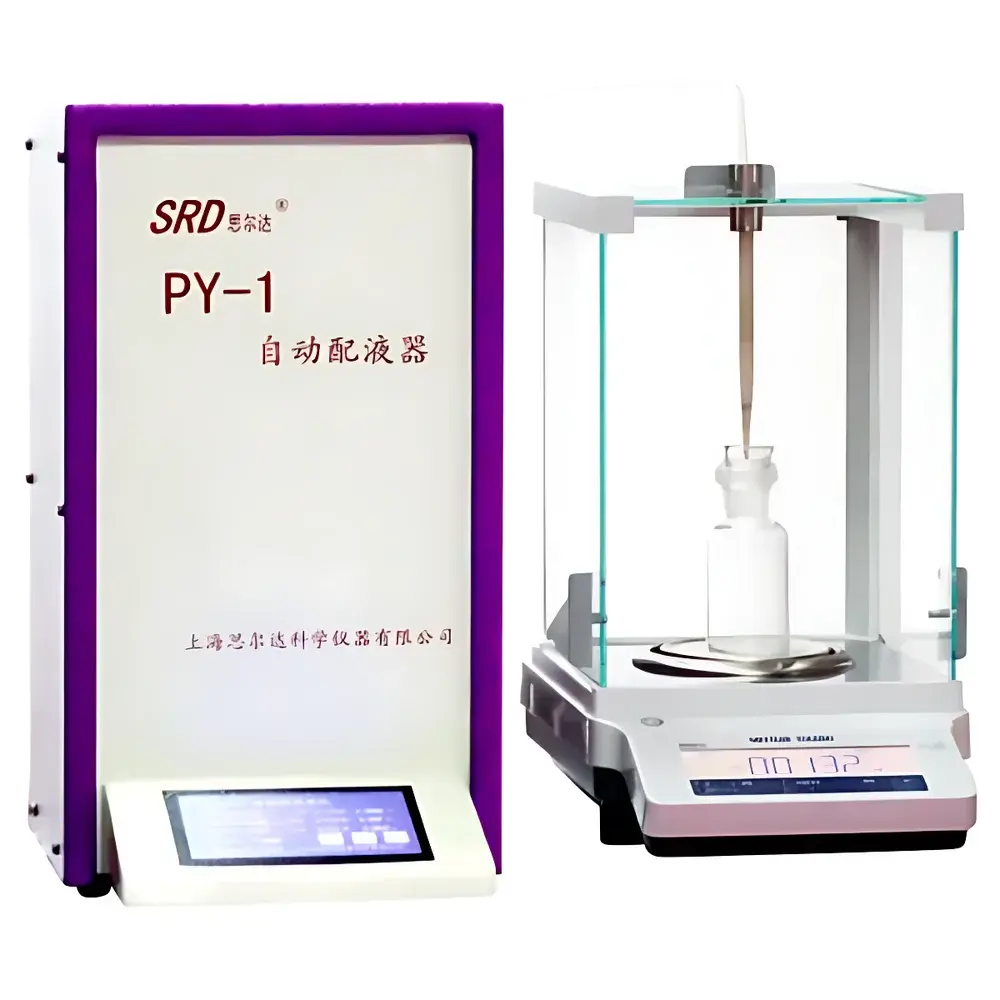
SRD PY-1 Automated Viscosity Solution Preparation System
| Brand | SRD |
|---|---|
| Origin | Shanghai, China |
| Model | PY-1 |
| Instrument Type | Fixed-Position Capillary Viscometry Preparation System |
| Viscosity Range | 0.1–4.0 dL/g |
| Temperature Control Point | 30 °C |
| Temperature Stability | ±0.1 °C (typical for thermostatted capillary viscometry workflows) |
| Compliance | Designed for ASTM D4603, ISO 1628-1, USP <911>, and GB/T 12005.1–1989 polymer intrinsic viscosity testing protocols |
| Software Interface | Touchscreen HMI with audit trail logging (GLP-compliant event timestamps) |
| Power Supply | 220 V AC, 50 Hz |
| Dimensions | 320 × 280 × 360 mm |
| Weight | 12.5 kg |
Overview
The SRD PY-1 Automated Viscosity Solution Preparation System is an integrated, benchtop platform engineered to eliminate manual variability in the preparation of polymer solutions for intrinsic viscosity (IV) determination via capillary viscometry. Unlike conventional manual methods—such as volumetric dilution in calibrated flasks or gravimetric dispensing with pipettes—the PY-1 implements a closed-loop, mass-based solvent delivery architecture synchronized with high-precision analytical balance input. It operates on the principle that intrinsic viscosity [η] is derived from concentration-dependent relative viscosity measurements (ηrel = t/t0) under controlled thermal conditions, where solution homogeneity, exact mass concentration (g/dL), and thermal equilibration are prerequisites for reproducible Huggins or Kraemer plot extrapolation. The PY-1 ensures traceable, operator-independent preparation of solutions at defined mass concentrations (e.g., 0.1–4.0 dL/g), directly supporting standardized test methods including ASTM D4603 (polyethylene terephthalate), ISO 1628-1 (general polymers), and USP (pharmaceutical-grade polymers).
Key Features
- Automated gravimetric solution preparation: Accepts user-entered sample mass and target concentration; calculates and dispenses precise solvent mass via motorized peristaltic pump with real-time feedback from integrated 0.1 mg resolution balance.
- Dedicated capillary viscometry workflow integration: Pre-configured protocols align with common IV test sequences—dilution series generation, solvent blanking, and temperature-stabilized equilibration prior to viscometer injection.
- Thermostatically stabilized environment: Built-in 30 °C temperature-controlled chamber (±0.1 °C stability) maintains solution thermal equilibrium during preparation and transfer—critical for minimizing density drift and capillary flow time variance.
- Touchscreen HMI with GLP-compliant audit trail: Logs operator ID, timestamp, sample ID, initial mass, dispensed solvent mass, final concentration, and system status—exportable as CSV for regulatory review.
- No open-flask handling: Sealed solvent reservoir and disposable tip path minimize solvent evaporation, moisture ingress, and cross-contamination—particularly essential for hygroscopic polymers (e.g., PET, PVC, PVA).
- Calibration-ready architecture: Supports routine verification using certified reference masses and NIST-traceable solvent density tables.
Sample Compatibility & Compliance
The PY-1 is validated for use with common organic solvents employed in polymer IV analysis—including phenol/1,1,2,2-tetrachloroethane (for PET), cyclohexanone (for PVC), and formic acid (for polyacrylonitrile). Its fluid path materials (PTFE tubing, borosilicate glass vial interface, and chemically resistant pump heads) resist degradation from aggressive solvents. The system conforms to the procedural requirements of ISO/IEC 17025 for testing laboratories, supports FDA 21 CFR Part 11 readiness through optional electronic signature modules, and facilitates GMP/GLP documentation by enabling full traceability from raw material weighing to final solution labeling. It is not intended for volatile, highly toxic, or pressurized solvent systems.
Software & Data Management
The embedded control software provides a role-based interface with three access levels: Operator (run protocols), Supervisor (edit parameters, manage users), and Administrator (calibration, audit log export, firmware update). All solution preparation events are time-stamped and stored locally with tamper-evident hashing. Data export includes metadata (balance serial number, ambient temperature/humidity logs if external sensors are connected), enabling full chain-of-custody reconstruction. Optional Ethernet/Wi-Fi connectivity allows integration into LIMS environments via HL7 or ASTM E1384-compliant messaging.
Applications
- Quality control laboratories performing routine IV testing on PET resin used in bottle-grade packaging and fiber production.
- R&D departments developing PVC formulations requiring precise molecular weight correlation via Mark–Houwink–Sakurada relationships.
- Contract testing labs serving pharmaceutical clients needing USP -compliant polymer characterization for excipient qualification.
- Academic polymer science facilities standardizing student-run capillary viscometry experiments with reduced inter-operator variance.
- Regulatory submission support: Generating auditable preparation records for ANDA, DMF, or CE technical documentation packages.
FAQ
Does the PY-1 replace the capillary viscometer itself?
No. The PY-1 prepares standardized polymer solutions for subsequent measurement in standalone Ubbelohde, Cannon–Fenske, or automated capillary viscometers.
Can it prepare solutions at temperatures other than 30 °C?
The current configuration maintains a fixed 30 °C chamber. Custom thermal modules for 25 °C or 40 °C operation are available upon request and require factory calibration.
Is solvent density compensation automatic?
Yes—the system applies pre-loaded density tables (e.g., phenol at 30 °C = 1.072 g/mL) to convert target concentration (dL/g) into required solvent mass, accounting for thermal expansion effects.
What maintenance is required?
Monthly cleaning of solvent lines with compatible rinse solvent; annual verification of balance linearity and pump delivery accuracy using certified weights and volumetric standards.
Does it support multi-step dilution series?
Yes—up to five sequential dilutions can be programmed, each with independent concentration targets and solvent selection, maintaining full audit trail per step.
Related Products



